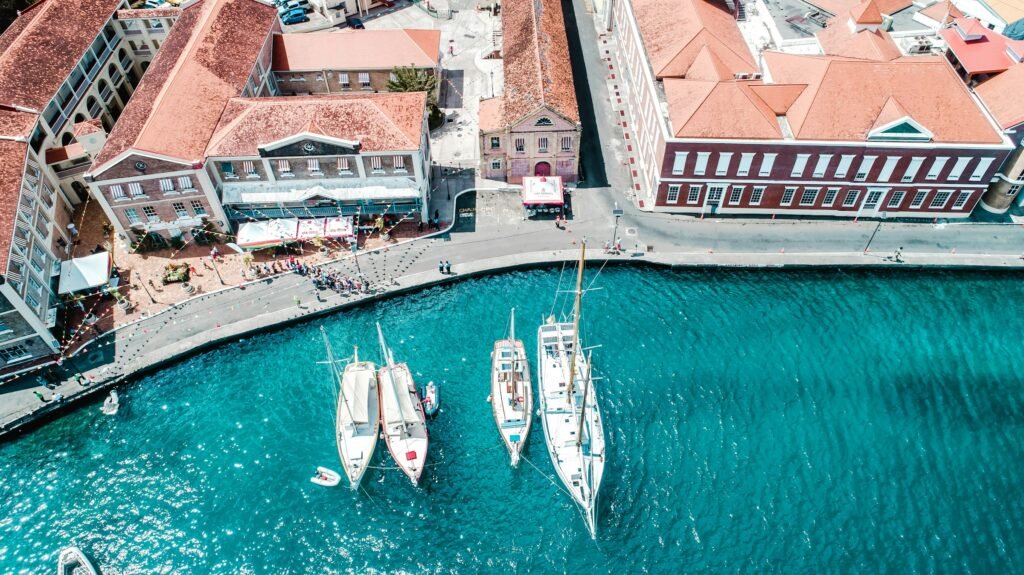
Grenada is a small island nation in the southeastern Caribbean best known as the “Spice Isle,” the world’s second-largest producer of nutmeg after Indonesia. Its capital, St. George’s, wraps around a horseshoe-shaped harbor called the Carenage, overlooked by the eighteenth-century Fort George, one of the most photographed views in the Eastern Caribbean. Beyond its spice trade, Grenada is remembered internationally for a 1979 revolution and the 1983 US-led invasion that followed it.
Where Is Grenada Located?
Grenada sits in the southeastern Caribbean Sea, roughly 100 miles north of the Venezuelan coast, making it the southernmost inhabited island in the Lesser Antilles chain. The country is made up of the main island of Grenada plus two smaller dependencies, Carriacou and Petite Martinique, and is divided administratively into six parishes: Saint George, Saint John, Saint Mark, Saint Patrick, Saint Andrew, and Saint David.
Geography of Grenada
Grenada covers about 120 square miles, or roughly 311 square kilometers, with Carriacou adding another 13 square miles and Petite Martinique about 486 acres. The island’s volcanic origins produced a terrain that ranges from mountainous rainforest in the interior to dry lowlands and coastal mangroves near the shore. The highest point, Mount Saint Catherine, reaches 2,757 feet (about 840 meters) and sits above a landscape of old volcanic craters, several of which now hold crater lakes.
A Brief History of Grenada
Colonial Rule and Independence
Grenada passed between French and British colonial control before becoming a British colony in the eighteenth century, its economy built on plantation agriculture. The country achieved full independence from the United Kingdom on February 7, 1974, under Prime Minister Eric Gairy, whose path to that milestone was marked by labor unrest and political controversy in the years before.
The 1979 Revolution and the 1983 US Invasion
On March 13, 1979, while Gairy was traveling abroad, the New Jewel Movement staged a bloodless coup and installed Maurice Bishop as prime minister of a new People’s Revolutionary Government. Bishop’s government pursued socialist policies and accepted aid from Cuba, drawing concern from Western governments during the Cold War. The experiment collapsed in October 1983, when a hardline faction within Bishop’s own government seized power in a coup that ended with his execution. Days later, on October 25, 1983, US forces led a multinational invasion, Operation Urgent Fury, that removed the coup leaders within a matter of days. Governor-General Paul Scoon oversaw a return to constitutional government, and a regional peacekeeping force remained on the island until 1985.
Government and Economy
Grenada is a parliamentary democracy and a Commonwealth realm, with a governor-general representing the head of state. It is a member of the Organisation of Eastern Caribbean States, and the World Bank classifies it as an upper-middle-income country. The economy leans heavily on tourism, agriculture, and construction, with nutmeg, mace, cocoa, and bananas among its leading agricultural exports. Growth has been resilient in recent years, with the economy expanding an estimated 4.5 percent in 2025 on the strength of construction activity, even as poverty remained elevated, with roughly 17.9 percent of the population living below $8.30 a day by that year’s estimate. Grenada’s exposure to hurricanes is a persistent economic risk: Hurricane Beryl struck in July 2024 and caused damage equivalent to about 16.5 percent of the country’s GDP.
Culture and People
Grenada’s population is estimated at around 117,000 people as of 2025. The island’s spice-growing culture, particularly its nutmeg and cocoa production, remains central to its identity and export economy. Grenada is also home to St. George’s University, founded in 1976, which has grown into one of the largest sources of new doctors entering first-year residency positions in the United States, drawing students and faculty from more than 150 countries.
What Is Grenada Known For, and Why It Matters
Grenada is known first for spice, as one of the few countries where nutmeg production shapes both the terrain under cultivation and the economy, and second for the view over St. George’s harbor from Fort George, widely considered one of the most recognizable scenes in the Eastern Caribbean. Internationally, Grenada is also remembered for the 1979 revolution and the 1983 US invasion, an episode that remains a reference point in discussions of Cold War intervention in the Caribbean. Alongside neighboring island nations such as Barbados, Antigua and Barbuda, and Dominica, Grenada is part of a cluster of small Windward and Leeward Islands states whose economies depend on tourism and agriculture and whose small size leaves them especially exposed to hurricanes and other climate shocks, a vulnerability shared with larger Caribbean neighbors such as the Bahamas and Cuba.
Key facts
- Grenada is the world's second-largest producer of nutmeg, after Indonesia.7
- Independence from the United Kingdom: February 7, 1974.4
- The 1983 US-led invasion, Operation Urgent Fury, followed the killing of Prime Minister Maurice Bishop during an internal coup.5
- Population: approximately 117,000 (2025).2
- St. George's University, founded in 1976, is now the largest source of new doctors entering first-year US residency positions.8
Quick checkWhat event triggered the US invasion of Grenada in 1983?Show answer
The killing of Prime Minister Maurice Bishop during an internal coup within his own New Jewel Movement government, which prompted the US-led Operation Urgent Fury on October 25, 1983.
Sources
- World Bank. Grenada Overview. Undated (accessed 2026-09-23)
- World Bank. World Bank Open Data: Grenada. 2025 (accessed 2026-09-23)
- Encyclopaedia Britannica. Grenada. Undated (accessed 2026-09-23)
- Encyclopaedia Britannica. Grenada - Independence. Undated (accessed 2026-09-23)
- Encyclopaedia Britannica. U.S. Invasion of Grenada. Undated (accessed 2026-09-23)
- Embassy of Grenada in the United States. Geography. Undated (accessed 2026-09-23)
- Embassy of Grenada in the United States. Grenada's Economy. Undated (accessed 2026-09-23)
- St. George's University. Our History. Undated (accessed 2026-09-23)
Editorially reviewed by Specialty Digest Editorial TeamLast reviewed September 23, 2026Researched and drafted with AI assistanceReport an issue