The Haida are an Indigenous people of the Northwest Coast whose traditional territory includes Haida Gwaii, off British Columbia, and the southern half of Prince of Wales Island in Southeast Alaska. In the early eighteenth century Haida from K’iis Gwaii migrated north and settled next to Tlingit territory, and these settlers became the Kaigani Haida. The Haida language is a linguistic isolate, and Haida art is a leading part of Northwest Coast art [1].
| Alaska homeland | Southern Prince of Wales Island |
|---|---|
| Alaska group | Kaigani Haida |
| Language | Haida (linguistic isolate) |
| Moieties | Raven and Eagle |
| Federally recognized (Alaska) | Hydaburg Cooperative Association; Central Council of the Tlingit & Haida |
| U.S. Haida population | 5,977 |
Homeland and Migration
The Haida’s traditional territory includes Haida Gwaii and the southern half of Prince of Wales Island. In the early 18th century, Haida from K’iis Gwaii migrated north and settled on southern Prince of Wales Island, next to Tlingit territory, and these settlers became the Kaigani Haida [1].
Language
Haida is a linguistic isolate. Revitalization efforts began in the 1970s, but only about three or four dozen speakers remain, nearly all aged 70 or older [1].
Clans and Society
The Haida were divided into two moieties, the Raven and the Eagle. Marriage within the same moiety was prohibited, and children took their mother’s moiety. Each moiety held rights to specific fishing, hunting and housing sites, and its own myths, songs and dances [1].
Art
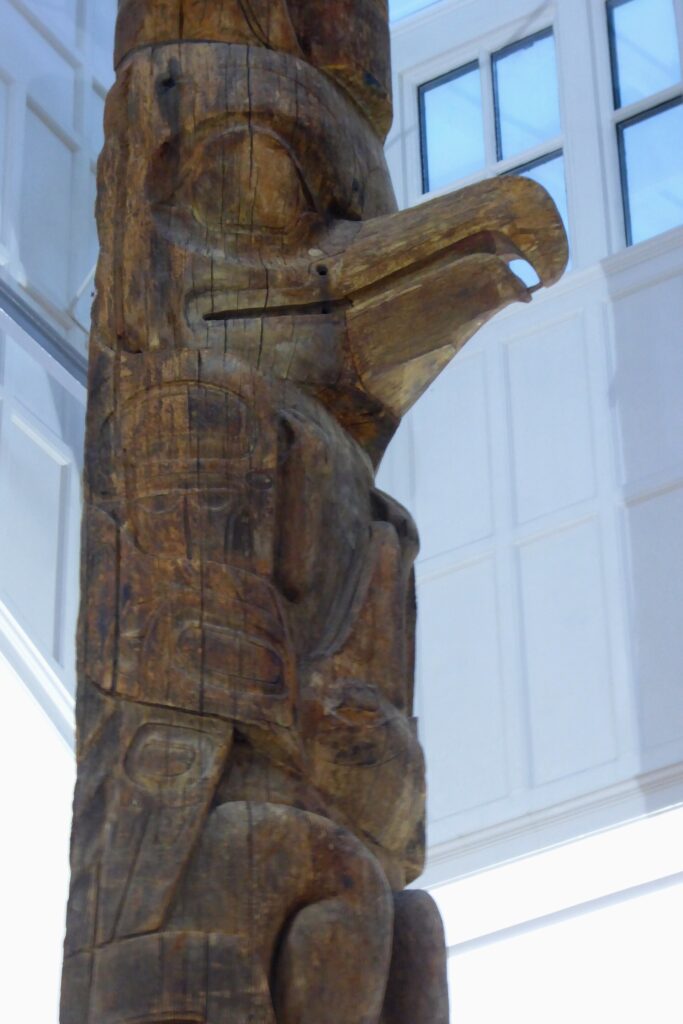
Haida art is a leading part of Northwest Coast art and includes totem poles, Chilkat weaving, bentwood boxes and jewelry. Transformation masks were used ceremonially, and men carved canoes and totem poles. Notable artists include Charles Edenshaw, Florence Davidson, Robert Davidson and Bill Reid [1]. See the entry on the culture of Alaska.
History
A smallpox epidemic in 1862 devastated Haida Gwaii, reducing its population from an estimated 6,607 to 829 by 1881. Missionaries and the 1884 potlatch ban weakened ceremonial life [1].
Governance
Federally recognized Haida tribes in the United States include the Central Council of the Tlingit & Haida Indian Tribes of Alaska and the Hydaburg Cooperative Association. All people of Haida ancestry are entitled to Haida citizenship, including the Kaigani [1].
FAQs
Where do the Haida live in Alaska? On the southern half of Prince of Wales Island in Southeast Alaska.
Who are the Kaigani Haida? Haida who migrated north from Haida Gwaii to southern Prince of Wales Island in the early 18th century.
What is the Haida language? A linguistic isolate with only a few dozen speakers left.
What are the Haida moieties? Raven and Eagle.
What is Haida art known for? Totem poles, Chilkat weaving, bentwood boxes, jewelry and canoes.
Sources
More in Anthropology
Key facts
Quick checkWhat are the two Haida moieties?Show answer
Raven and Eagle
Sources
- Wikipedia. Haida people. 2026 (accessed 2026-11-12)
Editorially reviewed by Specialty Digest Editorial TeamLast reviewed November 12, 2026Researched and drafted with AI assistanceReport an issue