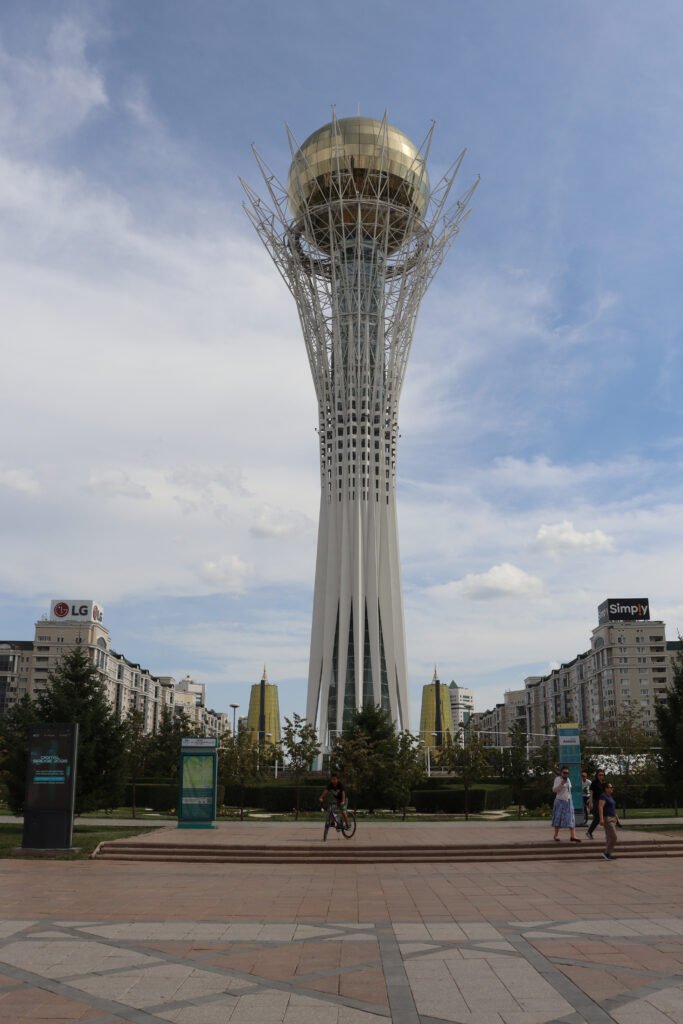
Kazakhstan is a country in Central Asia and the largest landlocked nation on Earth, stretching from the Caspian Sea to the borders of China. Its capital, Astana, is defined by a skyline of futuristic architecture built rapidly after independence, most famously the Baiterek Tower.
Where Is Kazakhstan Located?
Kazakhstan sits at the crossroads of Europe and Asia in Central Asia, bordered by Russia to the north, China to the east, and Kyrgyzstan, Uzbekistan and Turkmenistan to the south, with a coastline on the landlocked Caspian Sea to the west. According to the World Bank, it is the world’s largest landlocked country and the ninth largest by total territory, with vast steppe, desert and mountain terrain and one of the lowest population densities anywhere, at about 7.4 people per square kilometer.
A Brief History
The territory was historically home to nomadic Turkic and Mongol peoples along Silk Road trade routes before being absorbed into the Russian Empire in the eighteenth and nineteenth centuries and later becoming a Soviet republic. Kazakhstan declared independence in 1991 following the collapse of the Soviet Union. In 1997, the government moved the capital from Almaty, the country’s largest city, to a planned city then called Astana in the country’s north, which was renamed Nur-Sultan in 2019 and reverted to Astana in 2022.
Government and Economy Today
Kazakhstan is a presidential republic. According to the World Bank, market reforms in the 1990s combined with investment in the oil and gas sector propelled Kazakhstan to upper-middle-income status, though the transition to a fully market-based economy remains incomplete and the country continues to depend heavily on non-renewable resource exports. Kazakhstan is a central part of the Middle Corridor, a transport route linking Chinese and European markets through Central Asia and the South Caucasus.
Culture and People
Kazakhstan’s population was approximately 20.8 million in 2025, according to the World Bank. Kazakh and Russian are both widely used, reflecting the country’s Turkic heritage and its long period within the Russian Empire and Soviet Union. Traditional nomadic culture, including horsemanship and the eagle-hunting practiced by some Kazakh and Kyrgyz communities, remains an important part of national identity alongside a largely urbanized, resource-driven modern economy.
What Is Kazakhstan Known For?
Kazakhstan is best known internationally as the world’s largest landlocked country, for its oil and mineral wealth, and for the Baikonur Cosmodrome, the world’s first and largest space launch facility, leased to Russia. Its most recognizable landmark is the Baiterek Tower in Astana, a 105-meter observation tower completed in 1997 and built as a symbol of the new capital and Kazakhstan’s post-independence identity.
Key Takeaways
- Kazakhstan is the world’s largest landlocked country, bordered by Russia, China, Kyrgyzstan, Uzbekistan and Turkmenistan.
- It declared independence from the Soviet Union in 1991 and moved its capital to Astana in 1997.
- Its upper-middle-income economy is built substantially on oil, gas and mineral exports.
- The country hosts the Baikonur Cosmodrome, the world’s first space launch facility.
- The Baiterek Tower in Astana, completed in 1997, is Kazakhstan’s most iconic landmark.
Key facts
Quick checkWhat distinguishes Kazakhstan geographically among the world's countries?Show answer
It is the world's largest landlocked country and the ninth largest country by total territory.
Sources
- World Bank. Kazakhstan, Population total. 2025 (accessed Accessed 2026)
- World Bank. Kazakhstan Overview. Accessed 2026 (accessed 2026)
Editorially reviewed by Specialty Digest Editorial TeamLast reviewed September 27, 2026Researched and drafted with AI assistanceReport an issue