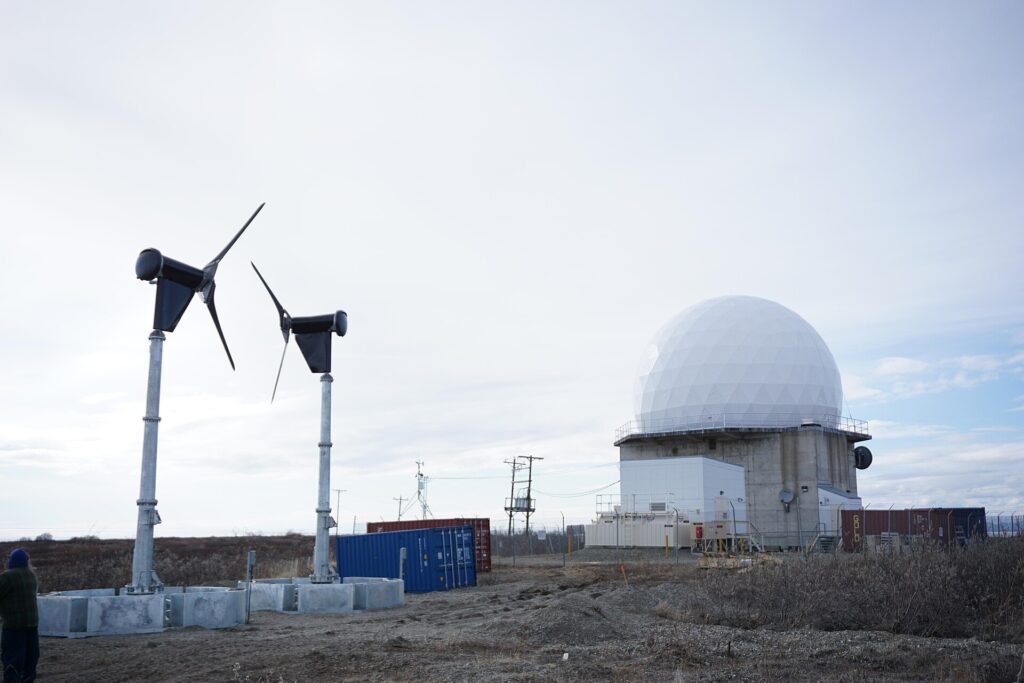
Kotzebue Electric Association (KEA) was a pioneer of wind power above the Arctic Circle. Its first three 66 kilowatt turbines became operational in 1997, and wind later supplied about a quarter of its total energy.[1]
| Utility | Kotzebue Electric Association |
|---|---|
| First turbines | Three 66 kW (1997) |
| Large turbines | Two 900 kW (2012) |
| Wind share of energy | About 25% by 2017 |
| Peak wind share of load | Up to 75% |
| Battery | 1.2 MW lithium-ion |
Early years
The utility’s board committed $250,000 for initial research, and a study found that 20 turbines could be installed without affecting the nearby Air Force DEW Line radar site. Three Atlantic Orient Corporation 66 kilowatt turbines became operational in 1997, and the first ten were fully installed by 1999. One early turbine ran for 21 years and was the oldest operating wind turbine above the Arctic Circle before it was decommissioned.[1]
Expansion
In 2012 two EWT 900 kilowatt turbines were installed, each equal to about 22 of the older machines and standing 250 feet tall with variable speed. Wind supplied about 25 percent of the utility’s total energy by 2017 and at times up to 75 percent of its load.[1]
Storage and influence
After long-duration flow batteries failed, the utility adopted a 1.2 megawatt lithium-ion battery to address stability issues. It bought the first commercial Northwind 100 turbine, which helped open the market for that model, and the Alaska Village Electric Cooperative later bought many Northwind turbines. The utility also added solar photovoltaic systems.[1]
FAQs
When did Kotzebue start using wind power? 1997.
What share of energy came from wind? About 25 percent by 2017.
What storage did it adopt? A 1.2 MW lithium-ion battery.
Sources
Key facts
- Wind about 25% of energy by 2017
- Two 900 kW turbines in 2012
Quick checkWhen did Kotzebue first operate wind turbines?Show answer
1997
Sources
- Alaska Center for Energy and Power. Kotzebue’s legacy as a wind energy pioneer. 2026 (accessed 2026-11-14)
Editorially reviewed by Specialty Digest Editorial TeamLast reviewed November 14, 2026Researched and drafted with AI assistanceReport an issue