The Southeast Alaska timber industry developed around the Tongass National Forest, which covers about 93 percent of the region’s timberlands. Its pulp mills at Ketchikan and Sitka operated from the 1950s to the 1990s.[1]
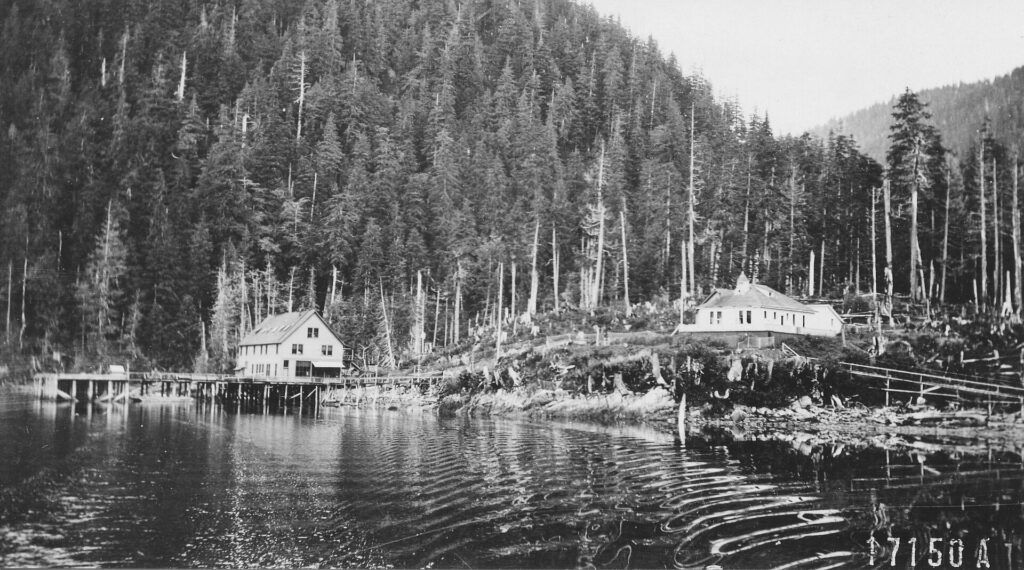
| Tongass established | 1907 |
|---|---|
| Ketchikan pulp mill | 1954 to March 1997 |
| Sitka pulp mill | About 1959 to 1994 |
| Tongass Timber Act | 1947 |
| ANILCA sawlog mandate | 450 million board feet (1980) |
| Tongass Timber Reform Act | 1990 |
Early period
After the 1867 purchase, timber was harvested at small volumes mainly for mining and fishing. The Forest Service was created in 1905 and the Tongass National Forest was established in 1907. The Alaska Spruce Log Program of 1942 to 1944 sent about 38.5 million board feet of spruce to Anacortes, Washington, and about 46 million board feet of lower-grade timber to local mills.[1]
Pulp mill era
The Tongass Timber Act of 1947 extended timber sale terms from 25 to 50 years. A Ketchikan long-term contract was signed in 1951, the Ketchikan Pulp Company mill began operating in 1954, and a Sitka contract was signed in 1957 with that mill operating by 1959. The Alaska Native Claims Settlement Act of 1971 transferred timberlands to Native corporations, with harvest on that land beginning in earnest in the early 1980s.[1]
Legislation and closures
The 1980 Alaska National Interest Lands Conservation Act added wilderness and monument areas and mandated 450 million board feet of sawlog timber annually. The 1990 Tongass Timber Reform Act added wilderness and roadless areas and removed that mandate. The Sitka mill closed in 1994 and the Ketchikan mill closed permanently in March 1997.[1]
Later years
A 1997 land management plan set aside over one million acres of old-growth reserves. The source, an industry-published history written around 2008, reports timber under contract falling from over 2,000 million board feet in 1990 to about 100 million in 2007 and current industry employment at about 15 percent of its level when the pulp mills operated. It is an industry perspective, and other sources may weigh the history differently.[1]
FAQs
When was the Tongass established? 1907.
When did the pulp mills close? Sitka in 1994 and Ketchikan in March 1997.
What share of regional timberland is Tongass? About 93 percent.
Sources
Key facts
- Tongass est. 1907
- Sitka mill closed 1994
Quick checkWhen did the Ketchikan pulp mill close?Show answer
March 1997
Sources
- Alaska Forest Association. Alaska Timber Industry History: Southeast Alaska. 2023 (accessed 2026-11-14)
Editorially reviewed by Specialty Digest Editorial TeamLast reviewed November 14, 2026Researched and drafted with AI assistanceReport an issue