Moldova is a landlocked country in Eastern Europe, bordered by Romania to the west and Ukraine to the north, east, and south. With a population of roughly 2.4 million people, according to the World Bank, it is one of Europe’s smaller nations and, by conventional measures, one of its poorest, a legacy of economic shocks that have repeatedly disrupted its post-Soviet development.
Where Is Moldova Located?
Moldova sits between Romania and Ukraine in the region historically known as Bessarabia, covering about 33,850 square kilometers, according to World Bank data. Its landscape is dominated by rolling steppe and fertile plains drained by the Dniester and Prut rivers, terrain well suited to the vineyards and orchards that have long defined the country’s agricultural economy. The capital, Chisinau, lies in the center of the country.
A Brief History of Moldova
The territory has changed hands repeatedly over the centuries, passing between the Principality of Moldavia, the Ottoman Empire, and the Russian Empire, which annexed the region known as Bessarabia in 1812. It briefly united with Romania after the First World War before the Soviet Union established the Moldavian Soviet Socialist Republic following the Second World War. Moldova declared independence from the Soviet Union in 1991. Since then, the breakaway region of Transnistria, on the country’s eastern border with Ukraine, has operated outside the control of the central government, a frozen conflict that remains unresolved.
Government and Economy
Moldova is a parliamentary republic bordering Romania and Ukraine. According to the World Bank, it is an upper middle income economy whose growth has been repeatedly affected by external shocks, including the COVID-19 pandemic and spillovers from Russia’s invasion of Ukraine, alongside structural constraints such as low domestic competition and a heavy reliance on remittances from Moldovans working abroad. Moldova has pursued closer integration with the European Union in recent years as a central plank of its economic and political strategy.
Culture and People
Romanian is Moldova’s official language and is spoken by the majority of the population, with Russian, Ukrainian, and Gagauz also spoken by minority communities. The country’s culture is closely tied to its winemaking tradition, one of the oldest in Europe, with archaeological evidence of viticulture in the region dating back thousands of years. Orthodox Christianity is the predominant religion, and rural folk traditions in music, dance, and craft remain strong outside the capital.
What Is Moldova Known For?
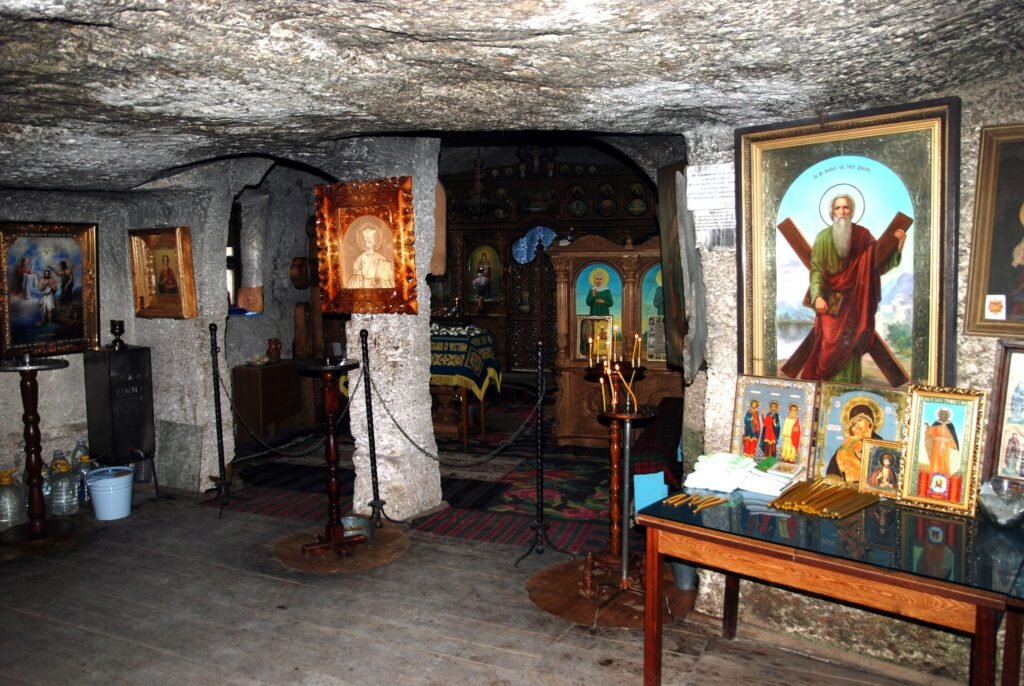
Moldova’s single most recognizable landmark is Orheiul Vechi, or Old Orhei, a dramatic limestone cliff landscape above a bend in the Raut River that holds the ruins of settlements dating back more than two thousand years alongside a still active cave monastery carved directly into the rock face. The monastic caves, first hollowed out by Orthodox monks, together with the surrounding archaeological remains of Geto-Dacian, medieval Moldavian, and Golden Horde era settlement, make Orheiul Vechi the country’s most visited and most photographed historical site, and it sits on the national list of protected natural and cultural monuments.
Why Moldova Matters
Moldova occupies a strategically sensitive position between the European Union and a region shaped by Russia’s war in Ukraine, and its pursuit of EU membership has made it a closely watched test case for post-Soviet integration into European institutions. Its winemaking heritage, among the oldest continuous traditions in Europe, also gives it an outsized cultural profile relative to its small size and population.
Key Takeaways
- Moldova is a landlocked parliamentary republic in Eastern Europe with a population of about 2.4 million people.
- It declared independence from the Soviet Union in 1991, and the breakaway region of Transnistria remains outside central government control.
- The World Bank classifies Moldova as an upper middle income economy shaped by remittances and vulnerability to external shocks.
- Moldova has one of Europe’s oldest winemaking traditions and has pursued closer integration with the European Union.
- Orheiul Vechi, a cliffside archaeological landscape with an active cave monastery, is Moldova’s single most iconic landmark.
Sources
Key facts
Quick checkWhat breakaway region has operated outside Moldova's central government control since shortly after independence?Show answer
Transnistria, on Moldova's eastern border with Ukraine.
Sources
- The World Bank. Moldova Overview. Undated (accessed 2026-09-28)
- The World Bank. World Development Indicators, Moldova. 2025 (accessed 2026-09-28)
Editorially reviewed by Specialty Digest Editorial TeamLast reviewed September 28, 2026Researched and drafted with AI assistanceReport an issue