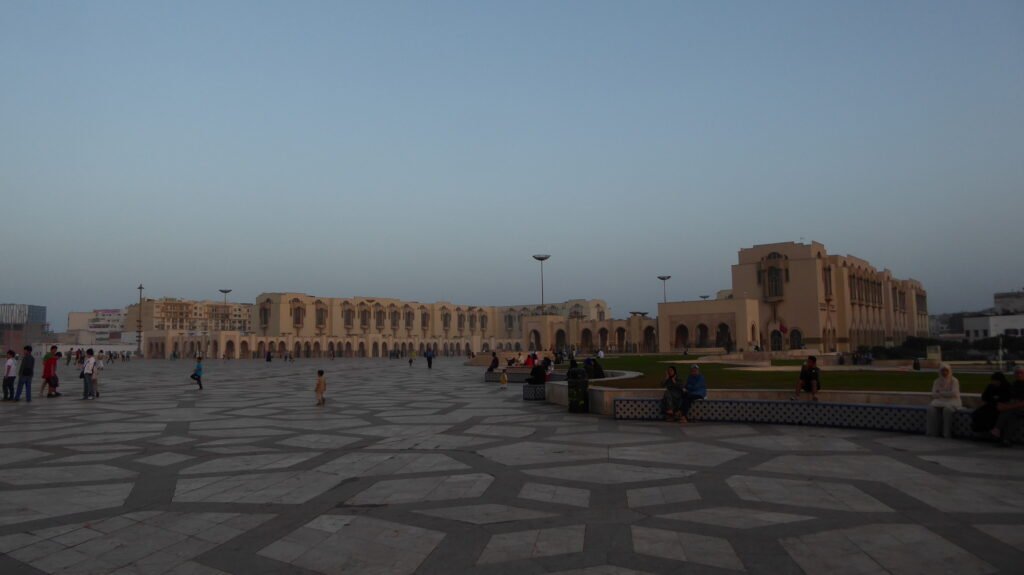
Morocco is a country in the far northwest of Africa, bordered by the Atlantic Ocean to the west, the Mediterranean Sea to the north, Algeria to the east, and the disputed territory of Western Sahara to the south. With a population of roughly 38.4 million people, according to the World Bank, it is one of the largest and most economically developed countries in North Africa, strategically positioned at the narrow strait separating Africa from Europe.
Where Is Morocco Located?
Morocco sits at the crossroads of Europe, Africa, and the Middle East, according to the World Bank, separated from Spain by the roughly 14 kilometer wide Strait of Gibraltar at its narrowest point. Covering about 446,550 square kilometers, its geography ranges from Mediterranean and Atlantic coastline to the Rif and Atlas mountain ranges, which rise to over 4,000 meters, and further south to the fringes of the Sahara Desert. The capital, Rabat, lies on the Atlantic coast, while Casablanca, further south along the same coast, is the country’s largest city and commercial center.
A Brief History of Morocco
Morocco’s history stretches from Amazigh, commonly known as Berber, kingdoms and Phoenician and Roman coastal settlements through successive Islamic dynasties beginning with the Idrisid dynasty in the late eighth century, followed by the Almoravid, Almohad, Marinid, Saadi, and, since the seventeenth century, the Alaouite dynasty, which still rules the country today, making it one of the world’s longest reigning royal houses. Morocco became a French protectorate in 1912, with a smaller northern zone administered by Spain, before regaining independence in 1956 under King Mohammed V.
Government and Economy
Morocco is a constitutional monarchy in which the king holds significant executive authority alongside an elected parliament and prime minister. According to the World Bank, Morocco has long leveraged its geography, political stability, and open economy to position itself as a regional hub, and its economy has recently been growing at its fastest pace in over a decade, powered substantially by public investment, with further gains expected to depend on private sector adoption of advanced digital technologies. Agriculture, phosphate mining and export, tourism, and a growing automotive and aerospace manufacturing sector are central to the modern Moroccan economy.
Culture and People
Arabic and Amazigh are Morocco’s two official languages, with French and Spanish widely used in business, education, and administration as a legacy of the colonial period. The overwhelming majority of Moroccans are Muslim, and the country’s culture blends Arab, Amazigh, Andalusian, and Sub-Saharan African influences, visible in its architecture, cuisine, and music. Morocco’s historic medina cities, including Fez, Marrakesh, and Meknes, preserve some of the best surviving examples of medieval Islamic urban planning anywhere in the world.
What Is Morocco Known For?
Morocco’s single most recognizable modern landmark is the Hassan II Mosque in Casablanca, completed in 1993 on a promontory extending into the Atlantic Ocean. It is among the largest mosques in the world outside Mecca and Medina, and its minaret, at roughly 210 meters, is one of the tallest religious structures ever built. Combining traditional Moroccan craftsmanship, including hand carved stucco, zellige tilework, and cedar wood ceilings, with modern engineering, the mosque was designed to hold tens of thousands of worshippers and has become the defining image of contemporary Morocco, distinct from the medieval medinas for which the country is also widely known.
Why Morocco Matters
Morocco’s position linking Europe, Africa, and the Arab world has made it a significant diplomatic and trade hub, reinforced by free trade agreements with the European Union and the United States and by major infrastructure investment, including Africa’s first high speed rail line. Its deep historical layering, from Amazigh and Islamic dynastic heritage to French colonial influence, also makes it one of the most culturally studied countries in North Africa.
Key Takeaways
- Morocco is a constitutional monarchy in northwest Africa with a population of about 38.4 million people.
- The Alaouite dynasty, ruling since the seventeenth century, is one of the world’s longest reigning royal houses.
- Morocco was a French and Spanish protectorate from 1912 until independence in 1956.
- According to the World Bank, Morocco’s economy is growing at its fastest pace in over a decade, driven by public investment.
- The Hassan II Mosque in Casablanca, completed in 1993 with one of the tallest minarets in the world, is Morocco’s single most iconic modern landmark.
Sources
Key facts
Quick checkWhich dynasty has ruled Morocco since the seventeenth century?Show answer
The Alaouite dynasty.
Sources
- The World Bank. Morocco Overview. Undated (accessed 2026-09-28)
- The World Bank. World Development Indicators, Morocco. 2025 (accessed 2026-09-28)
Editorially reviewed by Specialty Digest Editorial TeamLast reviewed September 28, 2026Researched and drafted with AI assistanceReport an issue