Mongolia is a landlocked country in East Asia, sandwiched between Russia to the north and China to the south, east, and west. With a land area of more than 1.5 million square kilometers and a population of only about 3.6 million people, according to the World Bank, it is the world’s most sparsely populated sovereign nation, a legacy of its vast steppe, desert, and mountain terrain and its historically nomadic way of life.
Where Is Mongolia Located?
Mongolia occupies a high plateau in the interior of East Asia, bordered entirely by Russia and China, with no access to the sea. Its landscape ranges from the Altai and Khangai mountain ranges in the west and north to the Gobi Desert in the south, and much of the country is covered by open grassland steppe. The capital, Ulaanbaatar, lies in the north central part of the country and is, by most measures, the coldest capital city in the world.
A Brief History of Mongolia
Mongolia’s most consequential historical period began in the early thirteenth century, when Genghis Khan unified the Mongol tribes and founded the Mongol Empire in 1206, which under his successors grew into the largest contiguous land empire in history, stretching from Korea to Eastern Europe. After centuries under Qing dynasty Chinese rule, Mongolia declared independence in 1911 and, following a further period of contested status, became a Soviet aligned socialist state in 1924 as the Mongolian People’s Republic, one of the earliest countries in the world to adopt a communist system after the Soviet Union itself. Mongolia transitioned peacefully to multiparty democracy in 1990, following the collapse of Soviet influence across the region.
Government and Economy
Mongolia is a semi-presidential parliamentary republic. According to the World Bank, the country transformed itself over the past three decades into a vibrant democracy, significantly reduced poverty, and tripled its GDP per capita, becoming an upper middle income country in 2024, with mining, particularly of coal, copper, and other minerals, forming a central pillar of its export economy alongside its traditional livestock and cashmere sectors.
Culture and People
Khalkha Mongolian is the country’s official language, and Tibetan Buddhism is the predominant religion, though traditions rooted in shamanism and nomadic herding culture remain deeply woven into national identity. A significant share of the population still practices some form of herding, and the traditional round felt tent known as the ger remains in wide use across the countryside. Mongolia’s most important cultural festival, Naadam, celebrates the three traditional sports of wrestling, horse racing, and archery each summer.
What Is Mongolia Known For?
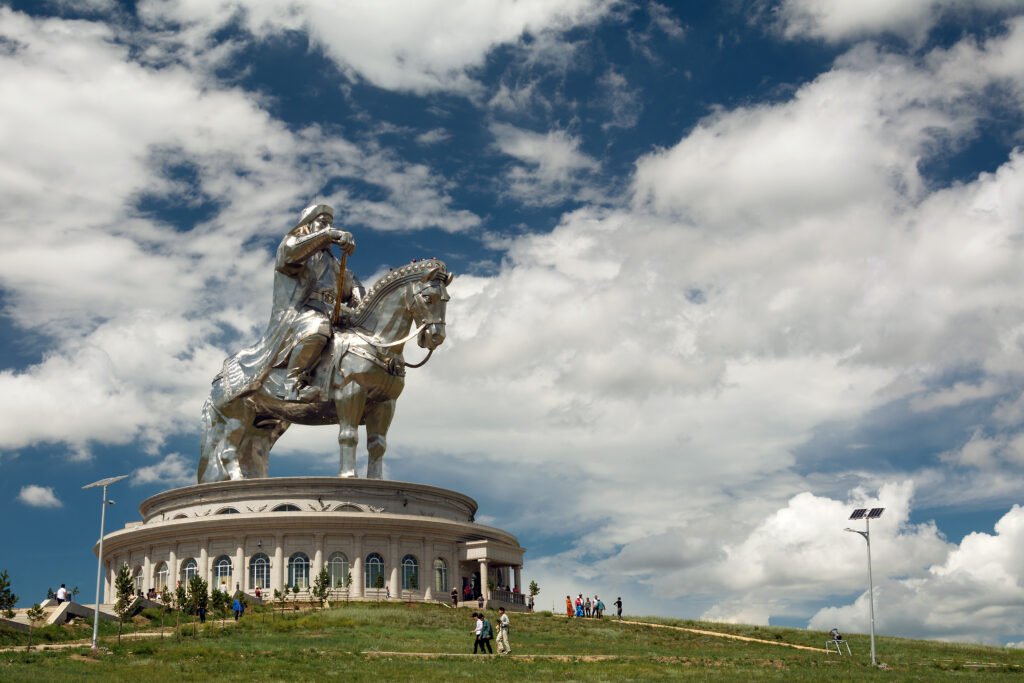
Mongolia’s single most recognizable landmark is the Genghis Khan Equestrian Statue, a monumental stainless steel statue of the empire’s founder on horseback, standing on the open steppe near Tsonjin Boldog, roughly fifty kilometers east of Ulaanbaatar. Completed in 2008, it ranks among the tallest equestrian statues in the world and has become the country’s defining modern monument, visually linking present day Mongolia to the empire that first made it a dominant power on the world stage.
Why Mongolia Matters
Mongolia occupies a distinctive place in world history as the origin of the largest land empire ever assembled, and its modern identity continues to draw on that nomadic, equestrian heritage even as the country urbanizes rapidly around Ulaanbaatar. Positioned between two major powers, Russia and China, Mongolia has also become a notable example of a small democracy sustaining itself in a geopolitically challenging neighborhood.
Key Takeaways
- Mongolia is a landlocked country between Russia and China with a population of about 3.6 million people, the lowest population density of any sovereign nation.
- Genghis Khan founded the Mongol Empire in 1206, which became the largest contiguous land empire in history.
- Mongolia became a Soviet aligned socialist state in 1924 and transitioned peacefully to multiparty democracy in 1990.
- The World Bank classifies Mongolia as an upper middle income country as of 2024, driven substantially by mining exports.
- The Genghis Khan Equestrian Statue, completed in 2008 near Ulaanbaatar, is Mongolia’s single most iconic modern landmark.
Sources
Key facts
Quick checkIn what year did Genghis Khan found the Mongol Empire?Show answer
1206.
Sources
- The World Bank. Mongolia Overview. Undated (accessed 2026-09-28)
- The World Bank. World Development Indicators, Mongolia. 2025 (accessed 2026-09-28)
Editorially reviewed by Specialty Digest Editorial TeamLast reviewed September 28, 2026Researched and drafted with AI assistanceReport an issue