The northern pike (Esox lucius) is a toothy freshwater predator found from Interior Alaska to the Arctic coast. Once scorned and used mainly as dog food, it is now one of the most important game fish in Interior Alaska.[1]
| Scientific name | Esox lucius |
|---|---|
| Common size | Up to 20 lb in some waters |
| Largest reported | About 30 lb and 4 ft |
| Eggs | Up to 500,000 for a 25–30 lb female |
| Incubation | About 30 days |
| Minto Flats | About 800 sq mi of waters |
Description
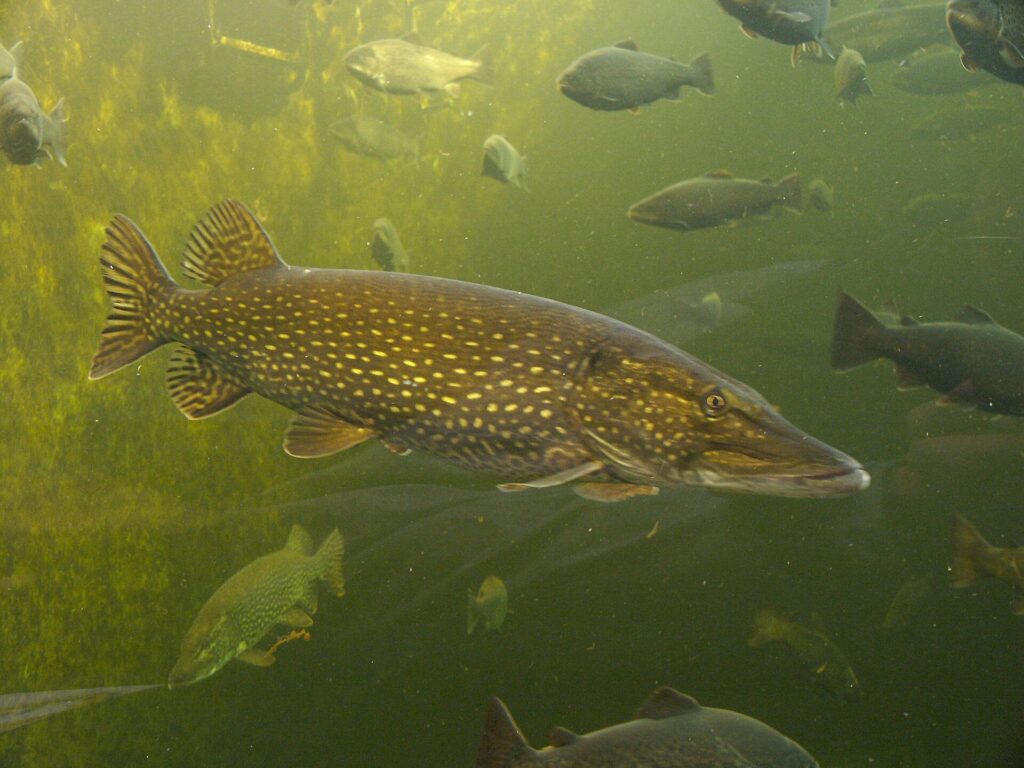
The pike has an elongated body with a broad, flat, duck-bill-like snout and numerous sharp teeth that are constantly replaced. Its single soft-rayed dorsal fin is set far back on the body. Colour varies with the water, light green in clear water and darker in sloughs and rivers, with whitish or yellowish underparts and yellow or gold spots in irregular rows on the sides. Fish up to 20 pounds are common in some waters, fish of 30 pounds and 4 feet have been caught, and females live longer and grow larger than males.[1]
Range and habitat
Pike live in Interior Alaska to the Arctic coast, from the Canadian border to the Seward Peninsula and southwest to the Bristol Bay drainages, with a small isolated population near Yakutat. They live in lakes, rivers and sloughs, and most overwinter in deep, slow waters of larger rivers because shallow lakes lose oxygen.[1]
Diet and growth
Young pike eat small crustaceans and insects and move to small fish by about two inches long. Larger pike eat mostly fish, plus shorebirds, small ducks, muskrats, mice, shrews and insects. In Interior Alaska a 12-inch pike is about two to three years old, a 25-inch, 5-pound pike about six to eight years, and pike of 15 pounds or more about 10 to 17 years old.[1]
Spawning
Spawning occurs in spring soon after ice breakup, in grassy lake margins, slow streams and sloughs, where the sticky eggs cling to vegetation or debris. A 25 to 30 pound female may carry up to 500,000 eggs, and incubation takes about 30 days.[1]
Sport fishery and spread
Major pike waters, such as Minto Flats west of Fairbanks, are reached mainly by plane or riverboat, and anglers need a wire leader. The source, a 1994 reprint, reports that pike had recently become established in streams of the Susitna River drainage south of the Alaska Range and on the Kenai Peninsula, so current status may differ.[1]
FAQs
How big do Alaska pike get? Up to about 30 pounds and 4 feet.
Where do they spawn? In grassy lake margins, slow streams and sloughs after ice breakup.
Where do they live? Interior Alaska to the Arctic coast.
Sources
Key facts
- Up to 500,000 eggs
- Up to 30 lb
Quick checkWhen do Alaska pike spawn?Show answer
In spring soon after ice breakup
Sources
- Alaska Department of Fish and Game. Northern Pike, Wildlife Notebook Series. 2026 (accessed 2026-11-14)
Editorially reviewed by Specialty Digest Editorial TeamLast reviewed November 14, 2026Researched and drafted with AI assistanceReport an issue