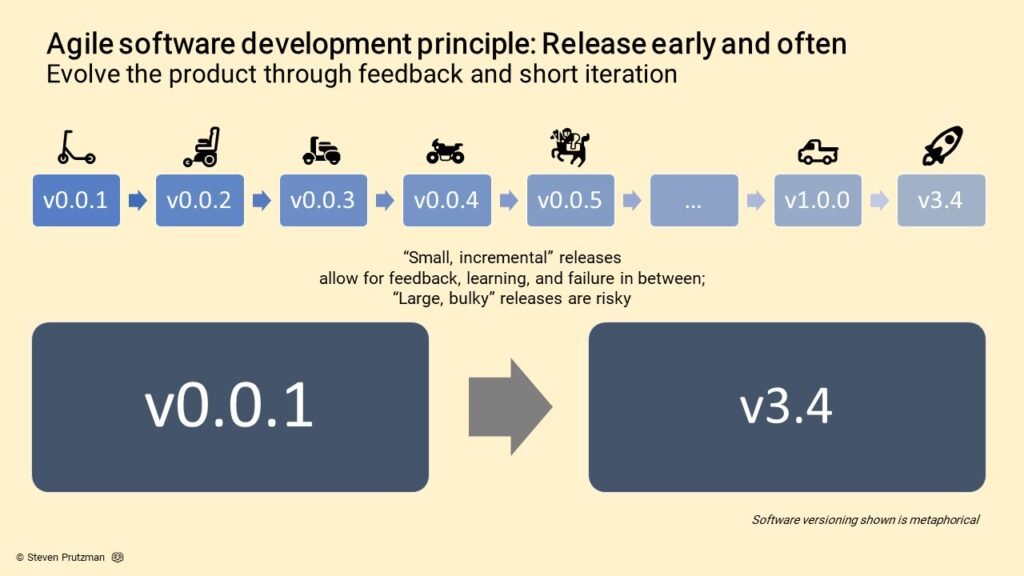
Agile software development is an approach to building software that emphasizes delivering working software in small, frequent increments, adapting plans continuously based on feedback, and maintaining close, ongoing collaboration between developers and the people who actually need the software, rather than attempting to plan every detail of a large project upfront and only delivering a
Agile Software Development Read More »
An approach to building software that delivers working increments frequently and adapts plans continuously based on feedback.
An application programming interface, or API, is a defined set of rules and tools that lets one piece of software communicate with another, specifying exactly what requests one program can make of another, what information must be included in that request, and what kind of response it can reasonably expect to receive back in return.
Application Programming Interface Read More »
A defined set of rules that lets one piece of software communicate with another, specifying requests and expected responses.
Cloud computing is the delivery of computing resources, including servers, storage, databases, and software, over the internet, letting individuals and organizations use and pay for these resources on demand rather than purchasing, installing, and maintaining their own physical computer hardware. Instead of a company buying servers and housing them in its own facility, cloud computing
Cloud Computing Read More »
The delivery of computing resources like servers, storage, and software over the internet, used and paid for on demand.
Google is an American technology company, now the largest business of its parent Alphabet Inc., best known for its internet search engine and for products such as YouTube, Android, Gmail, Chrome and Google Cloud. Alphabet, which reports Google’s results, had revenues of $402.8 billion in 2025, according to its annual report filed with the U.S.
Google Read More »
An American technology company, the largest business of Alphabet, known for Search, YouTube, Android and Google Cloud.
HTML, short for HyperText Markup Language, is the standard language used to structure content on the web, defining the headings, paragraphs, links, images, and other elements that make up a webpage. A web browser reads an HTML document and renders it into the visual page a person actually sees, interpreting a series of markup tags
HTML Read More »
The standard markup language used to structure content on the web, defining headings, paragraphs, links, and other elements.
An HTTP cookie, often simply called a cookie, is a small piece of data that a website sends to a visitor’s browser, which stores it and sends it back to that same website on later visits, letting the website remember information about that visitor across what would otherwise be a series of completely separate, disconnected
HTTP Cookie Read More »
A small piece of data a website stores in a visitor's browser and retrieves on later visits to remember information across page loads.
Meta Platforms, Inc. is an American technology company based in Menlo Park, California, that owns the social media and messaging services Facebook, Instagram and WhatsApp and develops virtual and augmented reality products. It reported revenue of $201.0 billion for 2025 in its annual report filed with the U.S. Securities and Exchange Commission (SEC), almost all
Meta Platforms Read More »
An American technology company in Menlo Park that owns Facebook, Instagram and WhatsApp and builds virtual reality products.
Microsoft is an American technology company headquartered in Redmond, Washington, that develops software, cloud services, devices and online services. In its fiscal year ended June 30, 2026, it reported total revenue of $331.8 billion, according to its annual report filed with the U.S. Securities and Exchange Commission (SEC). Its stated mission is to empower every
Microsoft Read More »
An American technology company in Redmond that makes Windows, Office, Azure cloud services, LinkedIn and Xbox.
In simple terms Open-source software is software whose source code, the human-readable instructions behind the program, is published under a license that lets anyone view, modify, and redistribute it. [1] That stands in contrast to proprietary software, where the vendor keeps the source code private and only distributes the compiled program. How it works The
Open-source software Read More »
Open-source software is software whose source code is published under a license that lets anyone view, modify, and redistribute it.
Version control is a system for tracking and managing changes to files over time, recording a complete history of exactly what changed, when it changed, and who made each change, while making it possible to retrieve, compare, or restore any earlier version whenever needed. Though version control can apply to any kind of file, it
Version Control Read More »
A system for tracking and managing changes to files over time, recording what changed, when, and by whom.