Upward Sun River (Xaasaa Na’) is a Late Pleistocene archaeological site in the Tanana River Valley of Interior Alaska that dates to about 11,500 years ago and contains the oldest human remains found on the American side of Beringia. DNA from two infants buried there identified a previously unknown population, the Ancient Beringians, described in a 2018 study in Nature [1][2].
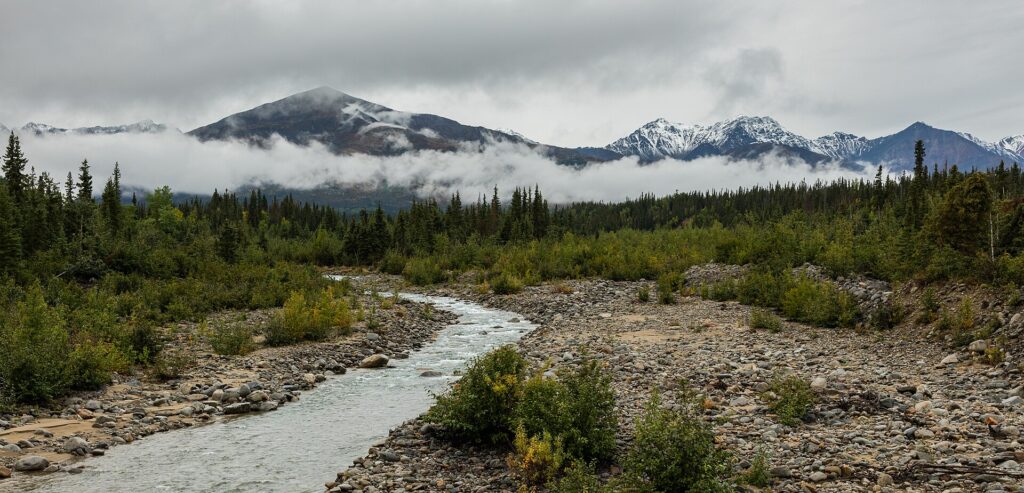
| Location | Tanana River Valley, Interior Alaska |
|---|---|
| Age | About 11,500 years |
| First excavation | 2010 |
| Key burials | Two infants (USR1, USR2) and a cremated child (USR3) |
| Group named | Ancient Beringians |
| Study published | Nature, January 3, 2018 |
The Site
Upward Sun River (Xaasaa Na’) is a Late Pleistocene site in the Tanana River Valley associated with the Paleo-Arctic tradition, dating to about 11,500 years before present. It was first discovered in 2006, and the first excavation took place in 2010 [1].
Excavations
The 2010 excavation found the cremated remains of a three-year-old child, known as USR3, in a hearth. In 2013 a double infant burial was found in a pit covered in red ochre with grave goods including four decorated antler rods, two stone dart points and bifaces, likely parts of a weapon system. One infant (USR1) was six to twelve weeks old, and the other (USR2) was a possibly stillborn fetus of about 30 weeks, the youngest Late Pleistocene individual recovered in the Americas. All three died in summer [1].
Evidence of Diet and Trade
About 300 salmonid bone fragments, identified as chum salmon, represent the earliest surviving evidence of salmon eating in North America. An obsidian flake among the grave goods traces to the Hoodoo Mountain source in Yukon, about 600 kilometers away [1].
The 2018 Genetic Study
In a study published in Nature on January 3, 2018, DNA from a six-week-old infant and a younger female infant from the same site, likely first cousins who lived about 11,500 years ago, matched no other known ancient population. Ben Potter of the University of Alaska Fairbanks led the archaeology, and J. Victor Moreno-Mayar and Eske Willerslev of the University of Copenhagen led the genetics. The team named the group Ancient Beringians [2].
What the DNA Shows
Genetic and demographic modeling indicated that a founding Native American group split from East Asians about 35,000 years ago and that about 20,000 years ago it split into the Ancient Beringians and the ancestors of all other Native Americans [2]. Wikipedia gives somewhat different estimates, with the Ancient Beringian lineage splitting from East Asians about 36,000 years ago and diverging from other Native American ancestors about 22,000 to 18,100 years ago [1]. Earlier work recovered mitochondrial genomes in 2015, with USR1 in haplogroup C1b [1].
Significance
The Ancient Beringians appear to have stayed in the Far North for thousands of years while other Native American ancestors moved south, and the study provided the first direct evidence of the initial founding Native American population. It made the story of early North American settlement more complex than previously thought [2]. See the entry on early Alaskan archaeology.
FAQs
Where is Upward Sun River? In the Tanana River Valley of Interior Alaska.
How old is the site? About 11,500 years old.
Who are the Ancient Beringians? A previously unknown ancient population identified from DNA of infants buried at the site.
Who led the research? Ben Potter of UAF led the archaeology, with genetics led by researchers at the University of Copenhagen.
What is notable about the infants? USR2 is the youngest Late Pleistocene individual recovered in the Americas.
Sources
- Wikipedia: Upward Sun River site
- ScienceDaily: Research reveals evidence of new population of ancient Native Americans
More in Archaeology
Key facts
Quick checkHow old is the Upward Sun River site?Show answer
About 11,500 years
Sources
- Wikipedia. Upward Sun River site. 2026 (accessed 2026-11-12)
- ScienceDaily. Research reveals evidence of new population of ancient Native Americans. 2018 (accessed 2026-11-12)
Editorially reviewed by Specialty Digest Editorial TeamLast reviewed November 12, 2026Researched and drafted with AI assistanceReport an issue