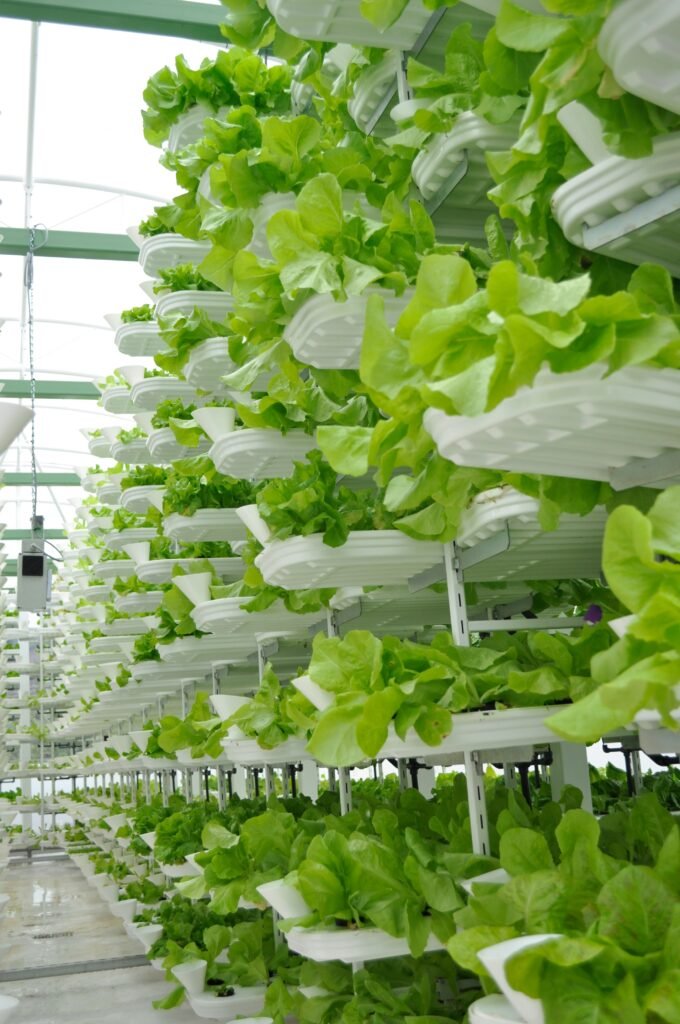
Vertical farming grows crops in vertically stacked layers rather than across horizontal farmland, typically inside warehouses, shipping containers, or purpose-built towers. Because the growing environment is enclosed, growers can control light, temperature, humidity, and nutrient delivery precisely, rather than depending on weather and soil conditions.
How Vertical Farming Works
Most vertical farms use one of two soil-free growing methods: hydroponics, where plant roots sit in a nutrient-rich water solution, or aeroponics, where roots are misted with a nutrient solution in the air. Crops are typically arranged on trays or towers stacked several meters high, lit by energy-efficient LED panels tuned to wavelengths plants use most efficiently for photosynthesis. Climate-control systems hold temperature and humidity within a narrow optimal range year-round, and sensors continuously monitor nutrient concentration, pH, and carbon dioxide levels so growing conditions can be adjusted in real time.
Why Growers Use It
Because a vertical farm multiplies growing area by stacking layers, it can produce far more food per acre of land than a traditional farm, and because it is enclosed, it is largely insulated from droughts, frosts, and pests. Operating indoors also means crops can be grown close to the cities that consume them, cutting transport time and the spoilage that comes with it, which is one reason leafy greens and herbs are among the most common vertical-farm crops. Water use is also dramatically lower than field agriculture, since hydroponic and aeroponic systems recirculate most of the water and nutrients a plant does not take up, rather than losing it to evaporation or runoff.
Limitations and Open Questions
The same artificial lighting and climate control that make vertical farming reliable also make it energy-intensive, and several high-profile vertical-farming companies have struggled to turn a profit once electricity costs are weighed against the price of the crops they grow. Vertical farms are also best suited to fast-growing, high-value crops like lettuce, herbs, and strawberries; staple crops such as wheat, rice, and corn require far more space and sunlight per calorie produced than a stacked indoor system can practically supply at current technology and cost levels.
FAQs
Is vertical farming the same as a greenhouse? No. A greenhouse still relies mainly on natural sunlight and grows crops on one level, while a vertical farm stacks multiple growing layers and typically uses artificial lighting instead of, or in addition to, the sun.
Can vertical farming feed the whole world? Not with current technology. It works well for leafy greens and herbs but is not yet cost-effective for the grains and staple crops that supply most of humanity’s calories.
Real-World Examples
Singapore, which imports more than 90 percent of its food and has very little arable land, has become one of the world’s most active vertical-farming hubs, with companies like Sustenir Agriculture and AeroFarms-style operations supplying supermarkets with locally grown lettuce, kale, and herbs year-round regardless of the tropical climate outside. In the United States, large indoor farms such as Plenty and Bowery Farming built warehouse-scale operations near major cities specifically to cut the distance between harvest and the grocery shelf from days to hours, extending shelf life and reducing the refrigerated trucking that conventional produce supply chains depend on.
Despite this interest, the industry has also seen high-profile setbacks: several well-funded vertical-farming startups scaled back operations or closed facilities in the early 2020s after discovering that electricity and labor costs made it difficult to compete on price with field-grown produce, even accounting for the land and water savings. This has pushed the industry toward a narrower focus on crops where freshness commands a price premium, such as specialty greens, microgreens, and culinary herbs, rather than attempting to replace broad-acre field agriculture.
Environmental Considerations
Vertical farming’s environmental case is mixed rather than uniformly positive. Water savings are real and substantial, since closed hydroponic and aeroponic loops can use up to 95 percent less water than open-field irrigation for the same crop. Land savings are also significant, since stacking growing layers can produce many times more food per acre of building footprint than a single-layer field. But those gains come at an energy cost: unless the electricity powering the LED lighting and climate control comes from low-carbon sources, the carbon footprint of growing a given crop indoors can exceed that of growing it outdoors in a favorable climate, since sunlight itself is free while artificial lighting is not.
Food-safety regulators have also had to adapt existing produce-safety rules, written mainly with open-field and greenhouse growing in mind, to indoor hydroponic systems where the usual risks of soil-borne contamination are largely absent but new risks, such as waterborne pathogens recirculating through a shared nutrient solution, take their place.
Investment in the sector has not disappeared despite the setbacks of the early 2020s; instead it has shifted toward hybrid models that pair vertical growing systems with greenhouses to capture free daylight when available and supplement it with LEDs only when needed, which cuts the electricity bill that sank several pure indoor-only operators. Robotics and automated monitoring are also being layered into newer facilities to reduce the labor costs that, alongside electricity, are the other major expense weighing on the economics of growing food indoors at scale, with automated seeding, transplanting, and harvesting systems increasingly replacing manual labor on the highest-volume crops like lettuce and leafy greens.
Researchers are also experimenting with crops beyond leafy greens, including dwarf varieties of tomatoes, peppers, and strawberries bred specifically for compact indoor growing, in an attempt to widen the range of produce vertical farms can profitably supply.
Editorially reviewed by Specialty Digest Editorial TeamLast reviewed November 4, 2026Researched and drafted with AI assistanceReport an issue