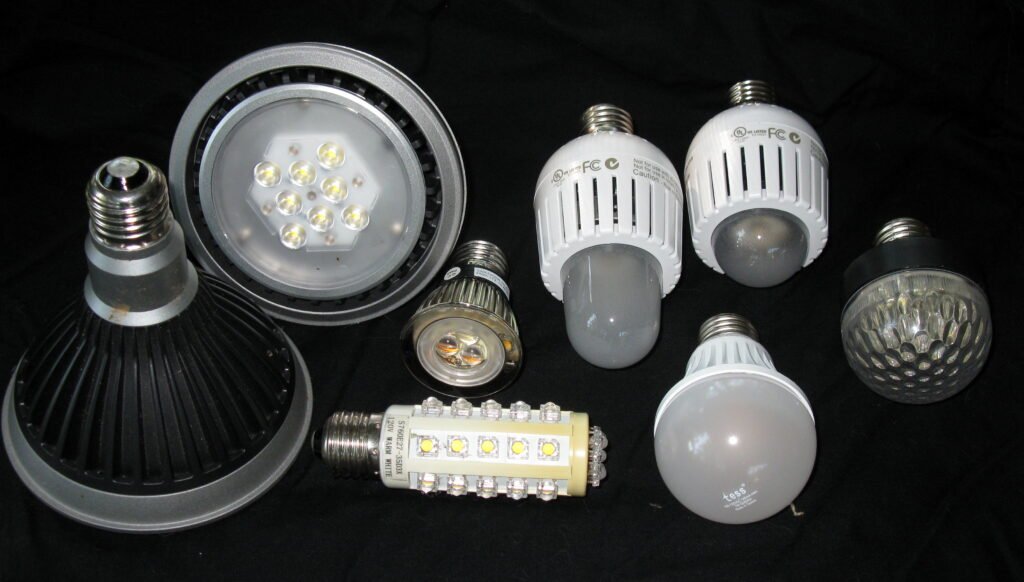
LED lighting is electric lighting that uses light-emitting diodes (LEDs), semiconductor devices that give off light when current passes through them. A diode is a component that lets current flow mainly in one direction. LED lamps convert more of their electricity into visible light than incandescent bulbs or fluorescent tubes do, and they last much longer, which is why they have become the default choice for homes, streets and offices.
History of LED lighting
Red and green LEDs had existed for a long time, but a bright blue one was missing, and without blue light a white lamp could not be built. The Royal Swedish Academy of Sciences notes that the blue LED remained a challenge for three decades, despite considerable effort in universities and industry.
In the early 1990s, Isamu Akasaki and Hiroshi Amano at Nagoya University in Japan, and Shuji Nakamura at the small company Nichia Chemicals in Tokushima, produced efficient blue beams from semiconductors. The three shared the 2014 Nobel Prize in Physics “for the invention of efficient blue light-emitting diodes which has enabled bright and energy-saving white light sources.” The committee called the invention a fundamental transformation of lighting technology.
Since then, white LEDs have kept improving. The U.S. Department of Energy (DOE) says LED lighting now delivers the highest luminous efficacy of any light-source technology, and falling prices have driven wide adoption.
How LED lighting works
An LED produces nearly monochromatic light, meaning light of a single narrow color. That is already efficient for colored signals such as traffic lights and exit signs, but general lighting needs white light. The DOE describes three ways to make it. Phosphor conversion places a phosphor on or near the LED to convert the colored light to white. Color mixing combines red, green and blue LEDs. A hybrid method uses both phosphor-converted and single-color LEDs.
Efficiency is measured as luminous efficacy, the amount of visible light in lumens produced per watt of electricity. According to the Nobel Committee, a typical incandescent bulb gives about 16 lumens per watt and a fluorescent lamp close to 70, while the best laboratory LED reached just over 300 in 2014. The DOE reports efficacies of up to 150 lumens per watt or more in some specialized commercial products.
LEDs also give designers more control over where the light goes. Because the source is small and bright, optics can aim it precisely. Fluorescent and bulb-shaped incandescent lamps emit in every direction, and in many fixtures, including recessed downlights, troffers and under-cabinet lights, only 50 to 60 percent of the light actually leaves the fixture.
The DOE says the ability of LEDs to produce high-quality white light with unprecedented energy efficiency is the main motivation for the research and development it supports.
Types of LED lighting
LED lighting is usually grouped by how it produces white light, using the phosphor-converted, color-mixed or hybrid designs above. Phosphor-converted LEDs are common in general-purpose lamps. Color-mixed systems can change their color on demand, which is useful for stage lighting and architecture. Products also vary by form, from replacement bulbs to complete fixtures built around LED modules.
A related technology, the organic light-emitting diode, or OLED, makes a thin, diffuse sheet of light rather than a point source. The DOE says OLEDs are still some years from widespread use in general lighting, largely because of cost.
Applications of LED lighting
Beyond homes and offices, LEDs are used in traffic signals and exit signs, where their single-color output is an advantage. Because they can be dimmed instantly and respond to sensors, they work well with building controls such as occupancy sensing, which switches lights off in empty rooms, and daylight harvesting, which reduces electric light when the sun supplies enough.
Lighting accounts for about one fourth of world electricity consumption, according to the Nobel Committee, so efficiency gains here matter. The committee also pointed out that LED lamps need so little power that they can run on small local solar panels, which could improve life for the more than 1.5 billion people without access to an electric grid.
Advantages and disadvantages of LED lighting
The advantages are well documented. The DOE lists compact size, long life, resistance to breakage and vibration, good performance in cold temperatures, no infrared or ultraviolet emissions, instant-on operation, and easy dimming and color control. The Nobel Committee gives lifetimes of up to 100,000 hours for LEDs, compared with about 1,000 hours for incandescent bulbs and 10,000 hours for fluorescent lamps. The DOE estimates that LEDs could cut general lighting energy use nearly in half by 2030.
The disadvantages are mainly about variability and room to improve. The DOE cautions that energy efficiency and color quality differ widely among white LED products. Buyers can compare them using labels and lists such as ENERGY STAR and the DesignLights Consortium Qualified Products List. The DOE also says the technology can still improve in efficiency, color attributes, light distribution, form factor and building integration, and that manufacturing can still be made cheaper and more flexible, with custom and on-demand production as goals. The agency also points to future gains from better controls and from lighting designed to support health and productivity.
LED vs. incandescent and fluorescent lighting
Incandescent bulbs make light by heating a filament until it glows, so most of their energy is lost as heat. Fluorescent lamps are more efficient but contain a gas discharge and a phosphor coating, and they last roughly a tenth as long as the best LEDs. LEDs convert electricity to light directly in a semiconductor, which accounts for their higher efficacy and longer service life. The figures above compare typical lamps with a laboratory record, so real products fall in between, and the DOE says the best purchasing decisions rely on tested product ratings rather than on technology type alone.
More in Electrical Engineering
Key facts
- Efficient blue LEDs were invented in the early 1990s by Akasaki, Amano and Nakamura, who won the 2014 Nobel Prize in Physics.2
- White light from LEDs is made by phosphor conversion, by mixing colors, or by a hybrid of both.1
- Typical incandescent bulbs give about 16 lumens per watt and fluorescent lamps close to 70, against a laboratory LED record of just over 300 in 2014.2
- LEDs can last up to 100,000 hours, compared with about 1,000 for incandescent and 10,000 for fluorescent lamps.2
- The DOE says LED efficacy reaches 150 lumens per watt or more in some specialized products.1
Related concepts
Quick checkWhy did the blue LED matter for lighting?Show answer
Red and green LEDs already existed, but white light needs blue as well. Efficient blue LEDs, developed in the early 1990s, made energy-saving white LED lamps possible and won the 2014 Nobel Prize in Physics.
Sources
- 1. U.S. Department of Energy, LED Basics, https://www.energy.gov/eere/ssl/led-basics
- 2. The Royal Swedish Academy of Sciences, The Nobel Prize in Physics 2014, Press release, October 7, 2014, https://www.nobelprize.org/prizes/physics/2014/press-release/
- 3. U.S. Department of Energy, OLED Basics, https://www.energy.gov/eere/ssl/oled-basics
Editorially reviewed by Specialty Digest Editorial TeamLast reviewed November 4, 2026Researched and drafted with AI assistanceReport an issue