Blood is one of the few medical resources that cannot be made in a factory. Every unit used in an operating room, a delivery ward or a trauma bay began as a gift from another person. World Blood Donor Day, observed every year on June 14, exists to thank those people and to ask more of us to join them. It is also a day about fairness, because whether a patient receives safe blood still depends heavily on the country where they happen to live.
A scientist’s birthday and a health assembly’s decision
The date honors Karl Landsteiner, born in Vienna on June 14, 1868. In 1901 he explained that people have different types of red blood cells, which is to say different blood groups. That insight made safe transfusion possible, because matching blood groups is what keeps a transfusion from harming the patient. In 1930 he received the Nobel Prize in Physiology or Medicine for his discovery of human blood groups.
The World Health Organization and its partners, the International Federation of Red Cross and Red Crescent Societies, the International Federation of Blood Donor Organizations and the International Society of Blood Transfusion, first organized the day in 2004. In May 2005, health ministers at the Fifty-Eighth World Health Assembly adopted resolution WHA58.13, which designated World Blood Donor Day as an annual event on June 14.
What the numbers say
The most recent WHO global status report on blood safety and availability, released in June 2026, draws mainly on 2023 data and covers 168 countries, home to 97 percent of the world’s people. It records about 120 million blood donations in 2023, and global collections rose by nearly 19 percent between 2013 and 2023. Voluntary donors, who give without payment, now account for more than 85 percent of donations. Seventy countries collect all or nearly all (more than 99 percent) of their supply from voluntary unpaid donors.
- 120 millionblood donations collected worldwide, 2023
- 85%+of donations come from voluntary unpaid donors, 2023
- 70countries collect all or nearly all blood from voluntary donors
- 29%of donations worldwide are given by women, 2023
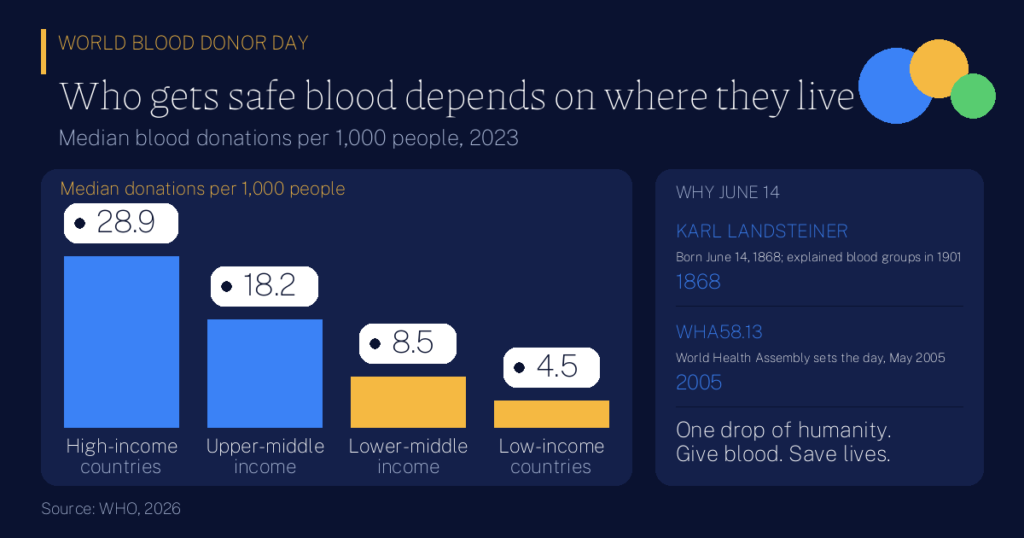
Those totals hide a steep divide. High-income countries, home to 15 percent of the world’s population, collected 36 percent of all donations. The median donation rate in 2023 was 28.9 per 1,000 people in high-income countries and 4.5 per 1,000 in low-income countries. Across all countries the rate ranged from 0.4 to 53 donations per 1,000 people.
Example 1: two towns. Imagine two towns of 100,000 people. At the high-income median of 28.9 per 1,000, the first town collects about 2,890 donations a year. At the low-income median of 4.5 per 1,000, the second collects about 450. These round numbers are illustrative, but the gap is the point: the second town’s hospitals must care for emergencies with a fraction of the supply.
Why voluntary giving matters
WHO promotes blood from voluntary, unpaid donors who give regularly, because it is the foundation of a reliable and safe supply. The gap again shows up by income. In 2023, voluntary donors supplied 98.4 percent of donations in high-income countries but 63.4 percent in low-income countries. Fifty-nine countries still rely on family or replacement donors, or on paid donors, for more than half of their blood.
Safety is part of the same story. WHO says screening for HIV, hepatitis B, hepatitis C and syphilis should be mandatory. Ten countries cannot yet screen every donation for one or more of these infections. Nearly one-third of countries lack specific blood safety legislation, and 133 of the 168 reporting countries have a national blood policy.
Who needs the blood
The patients differ by region. In low- and middle-income countries, WHO says transfusion is used more often to manage pregnancy-related complications and severe childhood anemia. In high-income countries it is used most often for cardiovascular surgery, transplant surgery, massive trauma and cancer therapy. WHO’s 2026 report lists women with life-threatening bleeding during childbirth among those who still lack access to safe blood. That link to maternal care ties this day closely to the International Day to End Obstetric Fistula, since both days concern the risks of giving birth where services are thin.
One donation, many uses
A single donation can do more than one job. Whole blood can be separated into components, such as red cells, plasma and platelets, so that different patients receive what they specifically need. Yet the share of blood separated into components varies widely: 52 percent in low-income countries, 81 percent in lower-middle-income countries, 94 percent in upper-middle-income countries and 98 percent in high-income countries.
Example 2: a hospital’s supply. Suppose a hospital receives 1,000 units of whole blood. If 98 percent are separated into components, about 980 units serve more than one kind of patient. At 52 percent, about 520 do. The numbers are round and illustrative, but they show how processing capacity stretches a limited gift.
Plasma shows a similar divide. Only 49 of the 168 reporting countries produce plasma-derived medicinal products, and 119 say these products are all imported or were not used at all.
How the day is marked
Each year WHO and its partners choose a global theme, and a host country holds the main event. Donor centers hold drives, health ministries recognize long-serving donors, and campaigns invite first-time donors to join. The 2026 theme, “One Drop of Humanity. Give Blood. Save Lives.”, includes among its objectives driving sustained growth in regular, voluntary unpaid donation worldwide. Recent themes show the range of the message.
- 2014Safe blood for saving mothers
- 2019Safe blood for all
- 2021Give blood and keep the world beating
- 2024Celebrating 20 years of giving: thank you, blood donors!
- 2025Give blood, give hope: together we save lives
- 2026One Drop of Humanity. Give Blood. Save Lives.
Example 3: a donor’s lifetime. Picture a donor who gives twice a year for 20 years. That is 40 donations. Eligibility rules and intervals vary by country and by individual, so this is purely an illustration, but it shows why regular donors are the backbone of a steady supply. Women make up 29 percent of donations worldwide, and the share ranges from 0.6 percent to 81 percent depending on the country, so many systems also have room to widen their donor base.
Systems matter as much as donors. WHO’s report found that 88 countries, 52 percent, have a system to track adverse reactions to transfusion, and that more than 1 in 7 countries have no dedicated budget or cost-recovery mechanism for blood services. Blood is a public health service, and it needs steady funding and oversight like any other.
Key Takeaways
- The date honors a discovery. June 14 is Karl Landsteiner’s birthday, and his work on blood groups made safe transfusion possible.
- Progress is real. Global collections rose nearly 19 percent from 2013 to 2023, reaching about 120 million donations.
- Voluntary giving is the goal. Voluntary unpaid donors supply more than 85 percent of donations, and 70 countries are at or near 100 percent.
- Access is unequal. The median donation rate is 28.9 per 1,000 people in high-income countries and 4.5 in low-income countries.
- Safety needs systems. Mandatory screening, legislation, oversight and funding protect both patients and donors.
- Mothers and children are at stake. In lower-income countries transfusion often treats pregnancy complications and severe childhood anemia.
- You can help. Ask your local blood service whether you are eligible, and consider giving regularly.
How solid is this? Figures come from WHO’s 2026 release of the global status report, based mainly on 2023 data reported by countries, and some data rest on older submissions. The fact sheet gives two slightly different counts of the rise in voluntary donations, so this article uses only the percentage growth in total collections. The three worked examples use round, made-up numbers to show an idea. See also the International Days hub and the International Days Calendar.
More in Health
- WHO, Safe blood supply improves as voluntary donations exceed 85%, but many people still lack access (June 12, 2026)
- WHO, Blood safety and availability fact sheet (June 2026)
- WHO, World Blood Donor Day 2026: One Drop of Humanity. Give Blood. Save Lives.
- WHO, World Blood Donor Day campaign page and past themes
- WHO, World Blood Donor Day 2019: About (resolution WHA58.13)
- WHO South-East Asia, World Blood Donor Day (June 14, 2025)
- Nobel Prize, Karl Landsteiner facts