Albinism is not an illness, and it is not a curse. It is a rare, inherited difference present at birth that reduces the pigment called melanin in the hair, skin and eyes. Yet in many places the people who live with it face two kinds of danger: the sun, which can harm unprotected skin and eyes, and fear and myth, which can harm far more. International Albinism Awareness Day, observed every June 13, asks the world to replace superstition with science and exclusion with rights.
How the day came to be
The day grew out of years of work by civil society groups and UN human rights bodies that were alarmed by reports of attacks on people with albinism, many of them children. On December 18, 2014, the General Assembly adopted resolution 69/170, which proclaimed June 13 as International Albinism Awareness Day, with effect from 2015. In March 2015 the Human Rights Council created the mandate of an Independent Expert on the enjoyment of human rights by persons with albinism, and the first expert, Ikponwosa Ero of Nigeria, was appointed that June. The first observance took place on June 13, 2015.
What albinism is, and what it is not
The United Nations describes albinism as a rare, non-contagious, genetically inherited difference present at birth. It results in a lack of pigmentation in the hair, skin and eyes. In most cases both parents carry the gene, often without knowing it, which is why a child with albinism can be born into a family where no one has the condition. There is no cure for the absence of melanin, and nothing a person does or fails to do causes it.
Albinism occurs in every region of the world and in every ethnic group. Because melanin also helps the eye develop and function, almost all people with albinism have some visual impairment. These are medical facts. They do not explain the myths, and they never justify mistreatment.
Example 1: a family surprise. Suppose two parents each carry one copy of the gene and have never had any sign of it. With each pregnancy there is a chance their child will inherit both copies and be born with albinism. Nobody in the family did anything wrong, and the child is a full member of the family and the community. This story is illustrative, but it matches the inheritance pattern described by the United Nations.
How common is it?
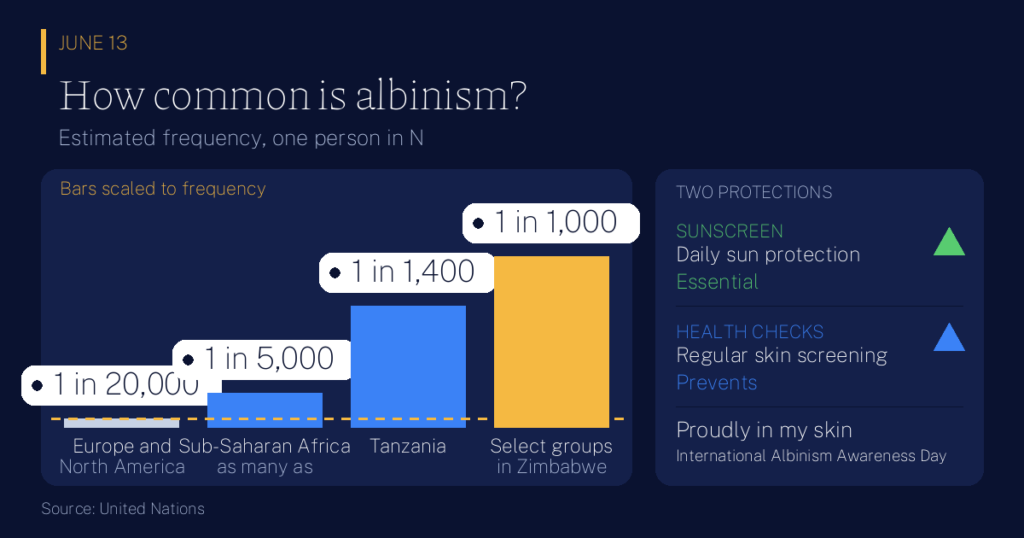
The UN observances page gives different pictures for different places. In North America and Europe, about 1 in every 17,000 to 20,000 people has some form of albinism. In sub-Saharan Africa the rate is much higher: the same page reports 1 in 1,400 people in Tanzania, and as high as 1 in 1,000 in select populations in Zimbabwe and elsewhere in Southern Africa. A separate figure on the page says as many as 1 in 5,000 across sub-Saharan Africa. These are estimates, and they differ because the studies behind them differ.
Example 2: what the rate means. Take a district of 10,000 people where the rate is 1 in 1,000. You would expect about 10 residents with albinism. In a district of the same size where the rate is 1 in 20,000, you would expect none or one. The numbers are round and made up for illustration, but they show why services such as sunscreen and eye care matter most in the places where albinism is most common.
The sun, the skin and the eyes
Melanin is the skin’s natural shield against ultraviolet light. Without it, a person burns easily, and the damage can accumulate over a lifetime. The UN reports that in some countries a majority of persons with albinism die from skin cancer between the ages of 30 and 40. It also stresses that this is highly preventable, through regular health checks, sunscreen, sunglasses and sun-protective clothing.
That is why the 2025 statement by the UN Independent Expert called for something as simple as a bottle of life-saving sunscreen, and urged that sunscreen be included on national essential medicines lists. The expert noted that current research points to more deaths of people with albinism from skin cancer than from ritual attacks and killings.
Example 3: a small clinic plan. Imagine a clinic that serves 40 patients with albinism and screens each one every year. If it catches even a few early skin changes, those patients can be treated before they become dangerous. The clinic, the patients and the numbers are illustrative, but regular checks are exactly the measure the UN lists.
Protection from fear and stigma
The harder side of this day concerns safety. In 2015 the UN High Commissioner for Human Rights said that hundreds of people with albinism, a majority of them children, had been killed, mutilated or otherwise attacked in at least 25 African countries, and that more cases remain undocumented. These attacks have often been driven by false beliefs about the body. The UN Independent Expert has called for such attacks to be treated as serious crimes, including as forms of torture and trafficking, and for prosecution of those responsible.
Stigma is wider than violence. Misunderstanding can lead to exclusion from school, work and health care, and the UN notes that prejudice can block access to adequate health care. The 2026 theme, Proudly in my skin, speaks to how color-based discrimination can affect dignity, safety and mental wellbeing. If you or someone you know faces threats or discrimination, local police, health services and human rights institutions are the first places to turn, and the UN human rights site albinism.ohchr.org shares resources and stories.
How the day is marked
Governments, schools, health workers and community groups mark June 13 with events that share facts, hear directly from people with albinism, and press for services such as sunscreen, vision care and legal protection. The UN invites people to use the hashtags #iaad2026 and #ProudlyInMySkin. Recent themes show the focus moving from survival toward rights and pride.
- 2025Demanding our rights: Protect our skin, Preserve our lives
- 2026Proudly in my skin: celebrating all skin tones
Key Takeaways
- Albinism is a natural, inherited difference. It is not contagious, and it has no connection to curses or misfortune.
- It is more common in some regions. Estimates run from about 1 in 17,000 to 20,000 in Europe and North America to as high as 1 in 1,000 in select African populations.
- The sun is a daily risk. Skin cancer is highly preventable with checks, sunscreen, sunglasses and covering clothing.
- Vision matters too. Almost all people with albinism have some visual impairment, so eye care and school support are essential.
- Myths have cost lives. The UN reported attacks in at least 25 African countries in 2015, and urges prosecution and protection.
- The day is recent and rights-based. Resolution 69/170 created it in 2014, and the first observance was in 2015.
- You can help. Share accurate facts, challenge myths and support access to sunscreen and health care.
How solid is this? Prevalence figures are estimates, and the UN page gives more than one figure for sub-Saharan Africa. The attack figure is the High Commissioner’s 2015 statement and may have changed. The three worked examples use round, made-up numbers to show an idea. See also the International Days hub and the International Days Calendar.
More in Society
- United Nations, International Albinism Awareness Day
- OHCHR, Human Rights Dimension of Albinism
- UN News, On first-ever International Day, June 13, 2015
- OHCHR, Statement on International Albinism Awareness Day, June 11, 2025
- OHCHR, UN expert calls on States to do more, March 2025
- OHCHR, Independent Expert on the rights of persons with albinism