Most people have never seen a blood test for it, yet it is one of the most common inherited conditions on Earth. Sickle-cell disease reshapes red blood cells, causes severe pain and anemia, and shortens lives wherever care is out of reach. World Sickle Cell Day, observed every June 19, exists because a condition this common, this treatable and this often missed deserves far more attention than it gets. The day asks the public, health workers and governments to learn the facts, test early and treat well.
How the United Nations came to mark the day
Attention began with health bodies. The 59th World Health Assembly gave sickle-cell disease a dedicated focus in May 2006, and in 2010 the 63rd Assembly adopted a resolution on preventing and managing congenital disorders that included it, according to WHO’s Africa office. In between, the UN General Assembly acted directly. In 2008 it adopted a consensus resolution titled “Recognition of sickle-cell anaemia as a public health problem.” It urged member states and the UN system to raise awareness of the disease on June 19 each year.
The first observance followed in 2009, when the Secretary-General issued a message on sickle-cell anemia and the UN held a press conference on awareness on June 19. The date has been kept ever since. Recognition mattered because it moved the disease from a private family burden toward a public health priority that governments are expected to plan for.
What sickle-cell disease actually is
Healthy red blood cells are round and flexible, and they carry oxygen through the smallest vessels. In sickle-cell disease, a change in the HBB gene produces an abnormal form of hemoglobin, called hemoglobin S. Cells containing it can stiffen and bend into a crescent shape. They block small vessels and break down early, which causes pain crises, anemia, frequent infections, delayed growth and organ damage. WHO notes that swelling of the hands and feet, called dactylitis, is often the first symptom in babies.
The condition is inherited. A person gets the disease only after receiving two copies of the hemoglobin S gene, one from each parent. Someone with a single copy has sickle-cell trait and usually has no symptoms, but can pass the gene on. That is why the disease can appear in a family where nobody has ever been diagnosed.
Example 1: a family surprise. Imagine a couple who each carry the trait and have never been tested. They have four children. On average one in four children would have the disease, but chance does not follow a calendar, so one family might have two affected children and another none. The numbers are round and illustrative. The lesson is real: knowing your carrier status before pregnancy gives families a choice that guessing never does.
The numbers behind the day
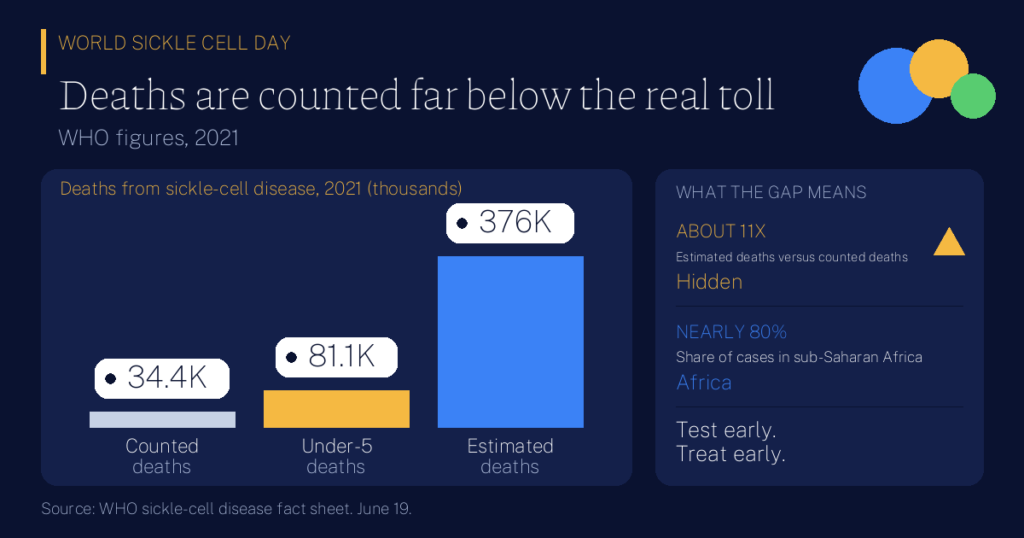
WHO estimates that 7.74 million people were living with sickle-cell disease worldwide in 2021, and that about 515,000 babies were born with it that year. The burden is not spread evenly. Sub-Saharan Africa accounts for nearly 80 percent of global cases. Among children under five, WHO counts 81,100 deaths from the disease in 2021, which made it the 12th leading cause of death in that age group.
- 7.74 millionpeople living with the disease worldwide, 2021
- 515,000babies born with it, 2021
- Nearly 80%of cases are in sub-Saharan Africa
- 81,100deaths in children under five, 2021
A hidden toll
The most striking fact may be what the records miss. Many people with the disease die without ever being diagnosed, and their deaths are filed under other causes such as infection or anemia. WHO reports that cause-specific statistics counted 34,400 deaths in 2021, while modeled estimates of actual deaths reach 376,000, about 11 times higher. When a problem is undercounted, it is underfunded, and that cycle is part of why the day exists.
Example 2: the missing zeros. Suppose a region’s health office records 10 deaths a year from the disease. If the true toll is about 11 times higher, as the global pattern suggests, nearer to 110 people are dying, and the clinics, medicines and screening that region plans for will be set for one tenth of the need. The figures are round and illustrative, but they show how a gap in data becomes a gap in care.
Why Africa carries so much of the weight
A WHO regional fact sheet from May 2024 calls the condition the most widespread genetic disorder in the African region. It reports that around 1,000 babies are born every day in Africa at high risk of the disease, and that it accounts for 6.4 percent of deaths in children under five there. It also states that 50 to 80 percent of African infants born with the disease die before age five, usually because nobody knew they were affected. The same document notes that many countries have no or limited newborn screening, and that standardized screening has started in 12 sub-Saharan countries, among them Ghana, Kenya, Nigeria and Uganda.
Those numbers describe a gap in access, not a lack of knowledge. The disease is manageable, and in places with early diagnosis and steady care, children now reach adulthood. For a related story about how a missing diagnosis becomes a lost life, see World Blood Donor Day, because many people with the disease rely on safe transfusions.
What good care looks like
WHO describes a ladder of care. It starts with finding the disease early, ideally at birth. Preventive care follows, with vaccinations and folic acid. Hydroxyurea, a medicine that raises fetal hemoglobin, reduces pain crises and the need for transfusions. Transfusions treat severe anemia and help prevent stroke. A bone marrow transplant can be a cure for some patients, particularly children, and gene therapy is described by WHO as emerging, though access remains very limited.
Example 3: why screening at birth pays off. Picture a clinic that tests 1,000 newborns and finds 20 with the disease. Without testing, those 20 families might first learn of it during a crisis. With testing, all 20 can be enrolled in preventive care in the first months of life. The numbers are round and illustrative, but this is the logic WHO gives for early diagnosis: the sooner a child is identified, the more can be done.
How the day is marked, and what comes next
Activities on June 19 include free carrier testing, school talks, blood drives, patient stories and clinic open days, often led by patient groups and national health ministries. The UN resolution asks governments and the UN system to raise awareness, and WHO’s Africa office has published a package of guidance modules for countries building sickle-cell programs. If you or a family member may be affected, a clinician can arrange a simple blood test, and patient organizations can offer practical support.
Key Takeaways
- It is inherited, not contagious. A child needs two copies of the hemoglobin S gene to have the disease.
- The burden is large. About 7.74 million people lived with it in 2021, and about 515,000 babies were born with it.
- Africa carries most of it. Sub-Saharan Africa accounts for nearly 80 percent of global cases.
- Deaths are undercounted. WHO reports 34,400 counted deaths against 376,000 estimated in 2021.
- Early diagnosis changes outcomes. Many infants die before five when no one knows they are affected.
- Treatment exists. Vaccines, folic acid, hydroxyurea and transfusions help, and transplant can cure some patients.
- Know your status. A simple test tells you whether you carry the gene before it matters.
How solid is this? Global figures are modeled 2021 estimates from WHO and are revised with each update, and the African figures come from a May 2024 WHO regional fact sheet that uses different years and definitions, so the two sets should not be combined. The three worked examples use round, made-up numbers. The exact resolution number and adoption date could not be verified here, so only the year is given. See the International Days hub and the International Days Calendar.
More in Health
- WHO, Sickle-cell disease fact sheet (2025)
- WHO Africa, Sickle cell disease: the silent killer in Africa (May 2024)
- United Nations, General Assembly urges awareness of sickle-cell anaemia on 19 June each year (2008)
- United Nations, Secretary-General message on sickle-cell anaemia (2009)
- United Nations, Press conference on raising awareness of sickle-cell anaemia (2009)
- WHO Africa, Guidance to boost the fight against sickle cell disease (2024)