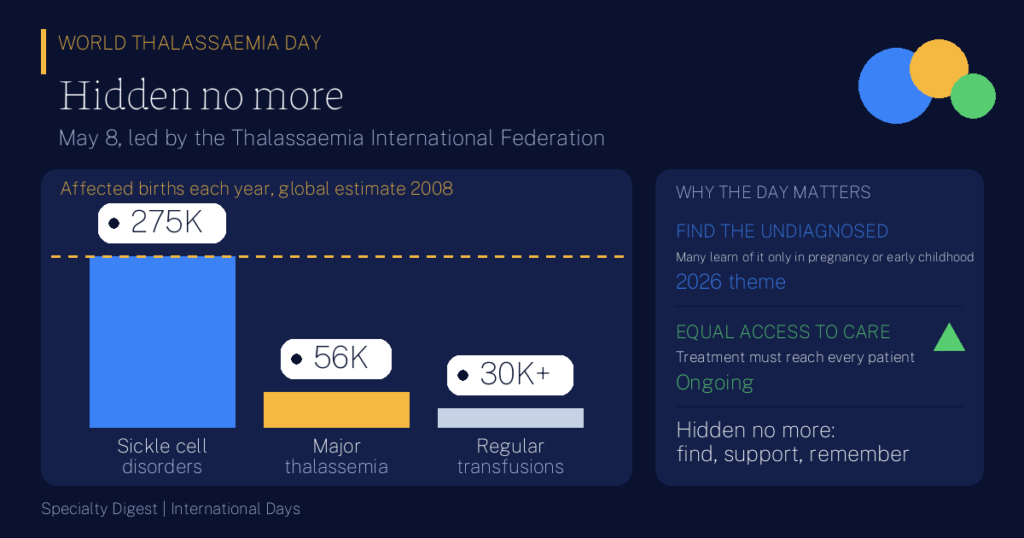
Some conditions announce themselves, and some hide in plain sight. Thalassemia is often the second kind. It is an inherited blood disorder, passed from parents to children through genes, and many people carry those genes without ever knowing it. International Thalassaemia Day, observed every May 8, asks the world to find people who are still undiagnosed, to support those who live with the condition, and to remember the patients who are no longer here. Unlike many days in this series, it did not begin with a United Nations resolution. It was started by a patient organization, which gives it a personal character. Its central demand, fair access to health care, is the same one behind World Health Day.
A day born from a family’s loss
The Thalassaemia International Federation, known as TIF, established May 8 in 1994 as International Thalassaemia Day. It did so in loving memory of George Englezos and of all thalassemia patients who are no longer with us. George was the son of Panos Englezos, TIF’s founder and president. TIF’s own account describes George as a patient who became a scientist, and it credits the early awareness work to parents, patient associations and a small group of doctors and nurses. TIF’s pages do not say why May 8 was chosen.
Every year since, TIF has organized the day around a campaign and a theme. Its stated purposes are to raise awareness, to promote the struggle of patients, to commemorate those who have died, and to renew a promise to keep working until a final cure is found.
What thalassemia is
Hemoglobin is the protein inside red blood cells that carries oxygen around the body. Thalassemias are a family of inherited disorders of hemoglobin, usually grouped as alpha or beta thalassemia depending on which part of the molecule is affected. A person can carry a changed gene and pass it on, and many people discover the condition only during pregnancy or in early childhood, as TIF’s 2026 campaign notes.
At the severe end, known as a major form, patients depend on lifelong medical care. Researchers Bernadette Modell and Matthew Darlison estimated in 2008 that about 56,000 babies are born each year with a major thalassemia, and that at least 30,000 of them need regular blood transfusions to survive. They also estimated that about 5,500 die around birth because of alpha thalassemia major. These are modeled estimates, and they describe a condition that is serious but that people can live with when care reaches them.
Example 1: counting carriers in a town. The 2008 analysis found that at least 5.2 percent of the world’s population carries a significant hemoglobin variant. In an illustrative town of 10,000 people, that would mean roughly 520 carriers. Most would have no idea. The numbers are round and made up, but they show why a hidden trait can matter at the scale of a whole community.
The numbers behind the day
TIF’s 2024 campaign cited an estimated 100 million people worldwide who carry genes responsible for thalassemia, and more than 300,000 babies born each year with severe forms of the disease. Published WHO figures use a broader definition: its 2006 report said about 300,000 infants are born each year with major hemoglobin disorders of all kinds, including more than 200,000 cases of sickle cell anemia in Africa. The same report said that globally there are more carriers of thalassemia than of sickle cell anemia. Estimates differ by source and definition, so the safest reading is the order of magnitude: hundreds of thousands of affected births a year, and many millions of carriers.
- 5.2%of the world’s people carry a significant hemoglobin variant, 2008 estimate
- 56,000babies a year born with a major thalassemia, 2008 estimate
- 30,000+of them need regular transfusions to survive
- 71%of 229 countries face a significant hemoglobin disorder problem
Who carries it, and where
The same study estimated that haemoglobin disorders are a significant health problem in 71 percent of 229 countries, covering 89 percent of all births worldwide. It put the share of pregnant women who carry a significant variant at over 7 percent, and the share of couples at risk of having an affected child at around 1.1 percent. It also estimated that haemoglobin disorders account for about 3.4 percent of deaths in children under 5, a figure that covers sickle cell disorders as well as thalassemias.
Example 2: couples at risk. At the world average of about 1.1 percent, an illustrative city with 100,000 couples would have roughly 1,100 couples at risk of having an affected child. Real rates vary widely from place to place, so this is a teaching example, not a forecast for any city.
Prevention, treatment and the fight for access
Because thalassemia is inherited, prevention is possible in a way that is rare for chronic diseases. WHO’s 2006 report named carrier screening programs in Montreal, the Maldives, Cyprus, Iran, Greece and Italy as examples of what countries have done. Treatment, for those born with a major form, centers on regular transfusions and the long-term care that goes with them, and it depends on a dependable supply of safe blood and on clinics that patients can reach.
That is why access dominates the day’s themes. TIF has called for access to safe and effective drugs in 2016, universal access to quality health care services in 2019, affordable novel therapies in 2020, and an end to health inequalities in 2021. In 2024 the theme was equitable and accessible treatment for all. The pattern is hard to miss: the challenge is not only medical science, it is whether care reaches every patient wherever they live.
Example 3: a year of transfusions. Imagine a patient who needs a transfusion every four weeks. That is 13 visits a year, each one needing a clinic bed, safe blood and a day away from school or work. If the nearest clinic is a long journey away, or blood is short, the gap in care is easy to picture. The schedule is made up for illustration, but it shows why access is a daily matter, not an abstract one.
Hidden no more: the 2026 theme
The 2026 campaign, “Hidden No More: Finding the Undiagnosed. Supporting the Unseen,” turns attention to two groups. The first is people who have never been diagnosed. TIF notes that many discover thalassemia only during pregnancy or early childhood. The second is people who have been diagnosed but continue to live without the visibility, recognition and support they need. The community calls for stronger awareness, earlier detection and greater support.
- 2012Patients’ Rights Revisited
- 2016Access to safe and effective drugs in thalassaemia
- 2019Universal access to quality thalassaemia healthcare services
- 2021Addressing Health Inequalities Across the Global Thalassaemia Community
- 2024Empowering Lives, Embracing Progress: Equitable and Accessible Thalassaemia Treatment for All
- 2026Hidden No More: Finding the Undiagnosed. Supporting the Unseen.
How the day is marked
TIF leads a yearly campaign, and national patient associations, clinics and supporters join in. TIF reported more than 50 building illuminations for the 2023 observance. Individuals can take part by learning whether thalassemia or related blood disorders are common in their family or region, and by speaking with a doctor or genetic counselor about carrier testing if so. Anyone worried about symptoms such as unexplained, lasting fatigue or paleness should see a health professional, who can arrange a simple blood test. Giving blood, where eligible, supports patients who depend on transfusions.
Key Takeaways
- A family started the day. TIF established May 8 in 1994 in memory of George Englezos and all patients who have died.
- Thalassemia is inherited. Carriers can pass it on without knowing, which is why awareness matters.
- The numbers are large. At least 5.2 percent of people carry a significant hemoglobin variant, by a 2008 estimate.
- Severe forms need lifelong care. About 56,000 babies a year are born with a major thalassemia, and at least 30,000 need regular transfusions.
- Prevention works. WHO cited carrier screening programs in six places as examples.
- Access is the through line. Themes from 2016 to 2024 all ask that care reach every patient.
- Hidden no more. The 2026 theme asks us to find the undiagnosed and support the unseen.
How solid is this? The birth and carrier figures are modeled estimates from a 2008 study and a 2006 WHO report, and TIF’s own campaign figures use a different definition, so totals vary by source. Day-specific facts come from TIF, which leads the observance. The three worked examples use round, made-up numbers to show an idea. This article is general information, not medical advice. See also the International Days hub and the International Days Calendar.
More in Health
- Thalassaemia International Federation: International Thalassaemia Day
- Thalassaemia International Federation: When and how the day was established
- Thalassaemia International Federation: 2026 theme
- Thalassaemia International Federation: 2024 theme
- World Health Organization, Fifty-ninth World Health Assembly, document A59/9 (2006)
- Modell B, Darlison M. Global epidemiology of haemoglobin disorders and derived service indicators. Bulletin of the World Health Organization, 2008