Most holidays remember an event. World Health Day remembers a promise. On April 7, 1948, the Constitution of the World Health Organization came into force, and nations agreed to work together on something no border can stop: disease. Every year since, the day has asked a simple question. Are we keeping that promise? It is a good day to look at how far health has come, who is still waiting, and why a doctor’s visit should never depend on a family’s bank account. It also sits naturally beside World Toilet Day, since safe sanitation is one of the oldest public health tools we have.
From a founding date to a global day
WHO’s own history page records that its Constitution did not come into force until April 7, 1948, when the 26th of the 61 governments that had signed it ratified its signature. The first Health Assembly then opened in Geneva on June 24, 1948, with delegations from 53 of the 55 Member States. That Assembly called for a World Health Day to mark the founding of WHO. Since 1950, the day has been celebrated every year on April 7, each time with a different theme chosen to focus attention on one pressing issue.
What “health for all” really asks
The idea behind the day is universal health coverage, often shortened to UHC. It means that everyone can get the health services they need, when and where they need them, without being pushed into hardship by the bill. Two questions measure it. Can people reach essential services, from vaccines to maternity care to treatment for chronic illness? And can they pay for them without sacrificing food, school or housing? Both matter. A clinic that people cannot afford is as closed as one that was never built.
The numbers: real progress, large gaps
The long view is encouraging. In its 2026 campaign, WHO notes that the global maternal mortality rate has fallen by more than 40 percent since 2000 and that deaths among children under five have been reduced by over 50 percent. WHO also says that over the past 50 years, global immunization efforts have saved over 154 million children from infectious diseases.
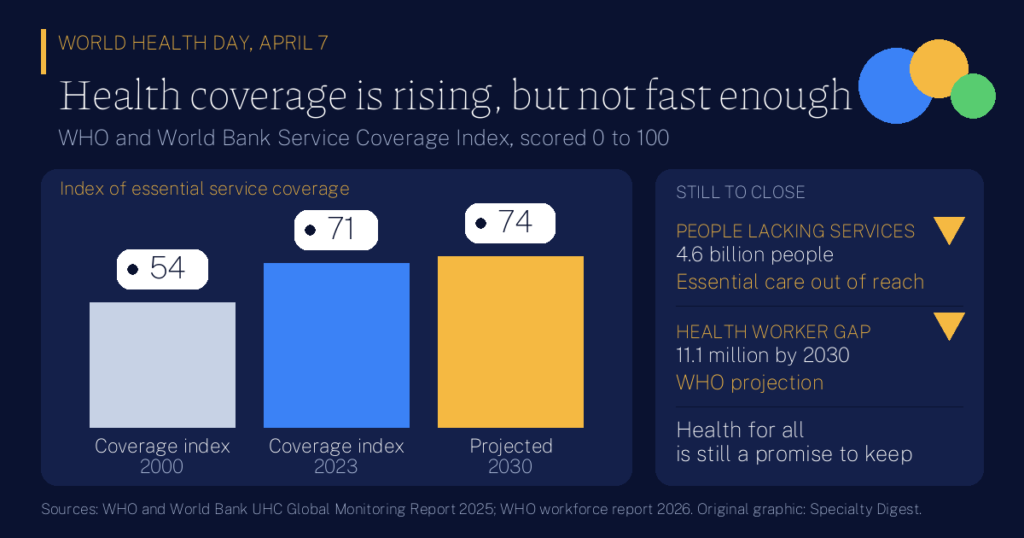
The WHO and World Bank monitoring report released in December 2025 tracks the same story from the coverage side. The Service Coverage Index, a score from 0 to 100 that combines essential services, rose from 54 to 71 between 2000 and 2023. The share of people facing financial hardship from out-of-pocket health payments fell from 34 percent to 26 percent between 2000 and 2022.
Yet the same report shows how much is left. An estimated 4.6 billion people still lack access to essential health services. About 2.1 billion face financial hardship, including 1.6 billion who are in poverty or pushed into it by health costs. In 2022, three in four of the poorest people faced hardship from health costs, compared with fewer than one in 25 of the richest. The index is projected to reach only 74 out of 100 by 2030, and only one-third of countries improved both coverage and financial protection since 2015.
Example 1: the cost of one illness. Imagine a household earning $200 a month. A child needs treatment that costs $150 out of pocket. The family borrows or sells a few assets, and three-quarters of a month’s income is gone in a day. The numbers are round and made up for illustration, but the pattern is what WHO means by financial hardship: care that is available but not affordable.
A changing burden of disease
WHO’s new Global Health Estimates, published in October 2026, show a world that has recovered from the pandemic years but faces a different set of threats. Life expectancy reached 73.3 years in 2023, just short of the 73.4 years recorded in 2019. Healthy life expectancy reached 62.8 years, still 0.4 years below its 2019 level. Noncommunicable diseases, such as heart disease, cancer, diabetes and chronic lung disease, caused 74 percent of deaths in 2023, up from 58 percent in 2000. Dementia rose from the 19th leading cause of death in 2000 to the fifth in 2023.
- 73.3 yearsglobal life expectancy, 2023
- 74%of deaths from noncommunicable diseases, 2023
- 43 millionNCD deaths in 2021
- 82%of the 18 million premature NCD deaths in low- and middle-income countries, 2021
The WHO fact sheet on noncommunicable diseases adds that in 2021 these conditions killed at least 43 million people, and 18 million died from them before age 70. Four groups of disease, cardiovascular diseases, cancers, chronic respiratory diseases and diabetes, account for 80 percent of those premature deaths. Many of these deaths can be prevented by early detection, affordable medicines and lower exposure to risks such as tobacco, harmful alcohol use and air pollution.
Example 2: catching it early. Suppose a district screens 1,000 adults for high blood pressure and finds 200 with the condition. If a clinic can start treatment for even half of them, 100 people gain protection against heart attack and stroke at a small monthly cost. The figures are illustrative, but they show why WHO treats primary care as the backbone of any health system.
The people who deliver health
No system works without workers. WHO’s 2026 report on national health workforce accounts finds that the global density of health workers rose 52 percent, from 44.8 per 10,000 people in 2006 to 67.9 in 2025. There are now more than 70 million health and care workers worldwide. Gaps remain wide: doctor density is 13 times higher in the European Region than in the African Region. WHO projects a shortage of 11.1 million health workers by 2030, and 67 countries will not have enough to meet their populations’ needs. Across 122 countries, nearly one in four doctors is older than 55 and will retire in the next decade.
Example 3: one nurse, many villages. Picture a region with one nurse for every 2,000 people. Training and keeping enough nurses to halve that ratio would double the time each patient receives. The numbers are round and illustrative, yet the logic is the one behind WHO’s call to invest in the health workforce.
2026: stand with science
This year’s theme, Together for health. Stand with science., celebrates the power of scientific collaboration to protect the health of people, animals, plants and the planet. WHO calls on governments, scientists, health workers, partners and the public to stand with science to protect lives, rebuild trust and secure a healthier future. Governments are asked to strengthen investment in science and build evidence into health, climate, food and environmental decisions. Everyone else is invited to ask a health question that matters to them, share how science helps answer it, and join in with #StandWithScience and #WorldHealthDay. The campaign is linked to a Global Forum of WHO Collaborating Centres held April 7 to 9, 2026, a network WHO describes as more than 800 institutions in over 80 countries.
- 2022Our planet, our health
- 2023Health For All
- 2024My health, my right
- 2025Healthy beginnings, hopeful futures
- 2026Together for health. Stand with science.
Key Takeaways
- The day marks a founding promise. WHO’s Constitution came into force on April 7, 1948, and the day has been observed since 1950.
- Health for all has two tests. People must reach services and be able to pay for them without hardship.
- Progress is real. The Service Coverage Index rose from 54 to 71 between 2000 and 2023.
- The gaps are large. About 4.6 billion people still lack access to essential health services, and 2.1 billion face financial hardship.
- The disease burden has shifted. Noncommunicable diseases caused 74 percent of deaths in 2023, and many of those deaths are preventable.
- Workers are the foundation. WHO projects a shortage of 11.1 million health workers by 2030.
- Science needs public trust. The 2026 theme asks everyone to choose evidence, trust facts and support science-led health.
How solid is this? Coverage, mortality and workforce figures are WHO and World Bank estimates, which are modeled, differ by year of data, and are revised with each release. Where a statistic has no year in the source, none is given here. The three worked examples use round, made-up numbers to show an idea. See also World Toilet Day, the International Days hub and the International Days Calendar.
More in Health
- World Health Organization. History of WHO.
- World Health Organization. World Health Day.
- World Health Organization. World Health Day 2026: Together for health. Stand with science.
- WHO and World Bank. Most countries make progress towards universal health coverage, but major challenges remain (6 December 2025).
- World Health Organization. New WHO estimates show changing global health landscape (2 October 2026).
- World Health Organization. Noncommunicable diseases fact sheet.
- World Health Organization. One in four doctors nearing retirement age as WHO warns of global health workforce gap (2026).