Discrimination rarely announces itself. It can be a clinic receptionist who treats a patient differently, a landlord who suddenly has no vacancy, or a neighbor who stops visiting. Each act looks small. Together they decide who gets care, work, schooling and respect. Zero Discrimination Day, observed every year on March 1, asks everyone to notice those moments and to end them. It is led by UNAIDS, the Joint United Nations Programme on HIV/AIDS, and its symbol is the butterfly, a sign of transformation.
A day built on a simple promise
The day grew out of the fight against HIV. In December 2013, on World AIDS Day, UNAIDS launched its #zerodiscrimination campaign, with Aung San Suu Kyi as UNAIDS Global Advocate. On February 27, 2014, UNAIDS Executive Director Michel Sidibé launched Zero Discrimination Day at an event in Beijing, China, and the first observance followed on March 1, 2014. UNAIDS described it as a call to promote everyone’s right to live a full life with dignity, no matter what they look like, where they come from or whom they love.
The idea behind it is older than the day. In 1948 the General Assembly proclaimed the Universal Declaration of Human Rights, whose first article says all human beings are born free and equal in dignity and rights. Article 2 adds that everyone is entitled to those rights without distinction of any kind, such as race, color, sex, language, religion, political or other opinion, national or social origin, property, birth or other status. Zero Discrimination Day turns that sentence into a yearly habit of attention. For more on the declaration, see Human Rights Day.
What discrimination means
Discrimination is unfair treatment of a person because of a group they belong to or are thought to belong to, rather than anything they have done. Stigma is the attitude behind it: shame, blame or fear attached to a trait or condition. The two feed each other. Stigma makes people hide, and hiding makes it harder to seek care, work or justice. The International Labour Organization addressed one major arena in 1958, when it adopted Convention 111 on discrimination in employment and occupation. It covers grounds such as race, color, sex, religion, political opinion, national extraction and social origin, and the ILO reports ratification by 172 countries.
Example 1: the same résumé. Imagine two job applicants with identical skills and experience, and an employer who calls back 10 of every 100 applicants from one group but only 5 of every 100 from another. The gap says nothing about ability. The numbers are round and illustrative, but they show how discrimination works: it is measured by who is treated differently for the same merit.
The numbers behind the day
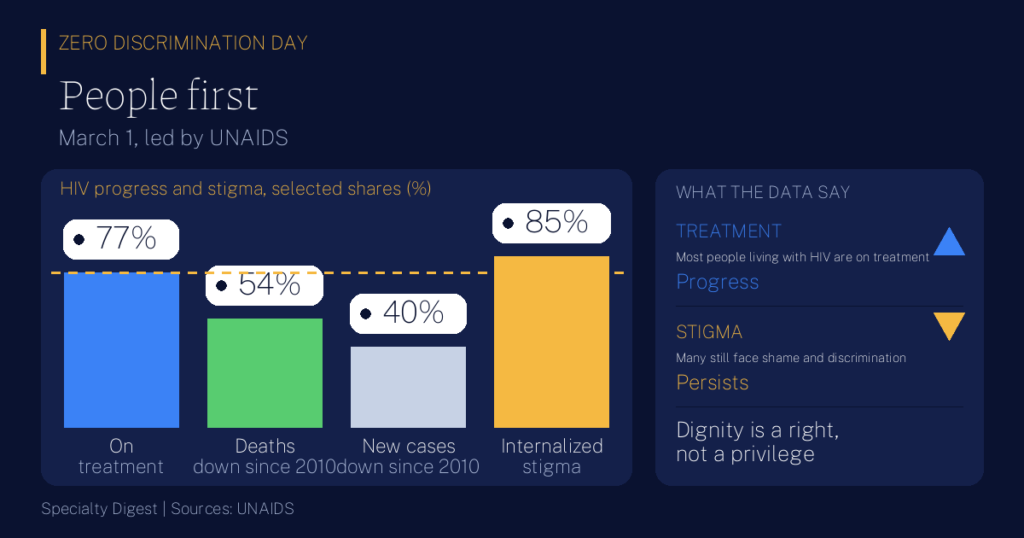
The day has stayed closely tied to HIV because few conditions show so clearly how fear can undermine health. UNAIDS estimates that in 2024 there were 40.8 million people living with HIV worldwide, 1.3 million new infections and 630,000 AIDS-related deaths. New infections were 40 percent lower than in 2010, and deaths were 54 percent lower. An estimated 77 percent of people living with HIV were receiving antiretroviral therapy, and 73 percent had a suppressed viral load. These are modeled estimates, and UNAIDS publishes ranges around each one.
- 40.8 millionpeople living with HIV, 2024
- 1.3 millionnew HIV infections, 2024
- 630,000AIDS-related deaths, 2024
- 30,000+people surveyed in 25 countries by the Stigma Index
Stigma in everyday life
Numbers about treatment do not capture what living with a stigmatized condition feels like. For that, UNAIDS points to the People Living with HIV Stigma Index 2.0, which gathered data from more than 30,000 people living with HIV in 25 countries. It found that about 1 in 4 had faced discrimination when seeking health care for something other than HIV, that 24 percent had experienced discrimination in their community in the past year, and that 38 percent felt ashamed of being HIV-positive. Some 85 percent reported some form of internalized stigma, meaning they had absorbed negative views about themselves.
Example 2: the clinic visit. Suppose a community has 400 residents living with HIV, and 1 in 4 of them avoids a clinic for an unrelated illness because of how staff have treated them before. That is 100 people whose broken arm, infection or pregnancy goes unattended for longer than it should. The figures are round and illustrative, but they show why UNAIDS treats discrimination as a health problem as well as a moral one.
Laws, women and who is left behind
Attitudes are reinforced or challenged by law. UNAIDS reported in 2025 that discriminatory and punitive laws, along with gender inequality and violence, continue to hold back the HIV response, and that the number of countries criminalizing the populations most at risk had risen for the first time since UNAIDS began reporting. The Stigma Index also found that women living with HIV reported coercion in the past 12 months in every country covered, based on data from 26,502 women in 23 countries.
Discrimination is not limited to HIV. The same dynamics affect people because of disability, race, ethnicity, religion, gender, sexual orientation, age or migration status. The day’s broad message is that no one should be refused care, work or dignity because of who they are.
Example 3: a school gate. Picture a school of 500 students where a rumor about one family spreads and 20 parents withdraw their children from a shared activity. One family loses its place in the community, and 480 other children learn that exclusion is acceptable. The numbers are made up for illustration. The lesson is that discrimination harms those who practice it, too, by narrowing the world they live in. Aung San Suu Kyi put it this way in 2014: people who discriminate narrow the world of others as well as their own.
How the day is marked, and what 2026 asks
The 2026 theme, “People first,” puts people ahead of labels and prejudice and focuses on discrimination against people living with and at risk of HIV. UNAIDS calls for sustaining the gains, standing with communities and sharing the facts, along with removing discriminatory laws, protecting the right to health care, addressing stigma and supporting community-led responses. Earlier themes included “Save lives: Decriminalise” in 2023, “To protect everyone’s health, protect everyone’s rights” in 2024 and “We stand together” in 2025.
Ordinary people can take part too. Learn the facts, challenge jokes and rumors, ask whether your workplace or school treats people fairly, and support local groups. Anyone who fears discrimination or needs HIV testing, treatment or support can contact a local health service or community organization, and UNAIDS lists resources on its website.
Key Takeaways
- It is a UNAIDS day with a broad message. Launched on February 27, 2014 and first observed on March 1, 2014, it promotes dignity for everyone.
- The principle is old. The 1948 Universal Declaration of Human Rights already declared everyone equal in dignity and rights.
- Progress is real. In 2024, new HIV infections were 40 percent lower and deaths 54 percent lower than in 2010, according to UNAIDS.
- Stigma still harms health. In the Stigma Index, about 1 in 4 people living with HIV had faced discrimination seeking other health care.
- Laws matter. UNAIDS warns that punitive laws continue to hold back the response.
- 2026 says “People first.” The theme asks for facts, solidarity and community-led action.
How solid is this? HIV figures are modeled UNAIDS estimates for 2024, and Stigma Index results come from surveys in selected countries, not the whole world. Themes and dates were checked against UNAIDS pages. Browse the International Days hub or the calendar.
More in Society
- UNAIDS, Zero Discrimination Day
- UNAIDS, Zero Discrimination Day 2026: People first
- UNAIDS, Zero Discrimination Day launch press release, February 27, 2014
- UNAIDS, Global AIDS Update 2025, executive summary
- United Nations, Universal Declaration of Human Rights
- ILO, Convention 111 and the International Day for the Elimination of Racial Discrimination