Disarmament is a word people meet mostly in headlines and treaty texts, rarely in a classroom. That gap is exactly what March 5 is meant to close. The International Day for Disarmament and Non-Proliferation Awareness asks the public, and young people above all, to understand how the world limits its most dangerous weapons, why that work is slow, and why it still matters to ordinary lives. It is not a day of protest or of any one government. It is a day of learning, and learning begins with plain definitions and honest numbers.
A day created to build understanding
In resolution A/RES/77/51, adopted in December 2022, the United Nations General Assembly invited all Member States to observe March 5 as the International Day for Disarmament and Non-Proliferation Awareness. It also invited UN system organizations, civil society, academia, the media and individuals to take part. According to the UN, the day seeks to promote better awareness and understanding of disarmament issues among the public, especially young people.
Why a day of awareness rather than another treaty? Because treaties are negotiated by diplomats, but they are sustained by public understanding. Governments answer to citizens, and citizens who know what a warhead count or a review conference means can follow the debate, ask better questions, and recognize when progress is real.
The day sits on a longer history. The Treaty on the Non-Proliferation of Nuclear Weapons, known as the NPT, was opened for signature in 1968 and entered into force in 1970. On May 11, 1995, its parties extended it indefinitely. Its parties meet to review it every five years, as Article VIII, paragraph 3 provides.
Three words worth knowing
Disarmament means reducing or eliminating weapons that already exist. Non-proliferation means stopping weapons, and the means to make them, from spreading to new hands. Arms control is the wider practice of setting agreed limits and rules so that competition stays less dangerous. The three work together. A world that keeps its stockpiles but stops new states from joining the club is safer than one that does neither, and a world that shrinks stockpiles gains most of all.
Example 1: how reduction works. Suppose a country holds 1,000 weapons and agrees to retire 100 each year. It would take ten years to reach zero, and each year inspectors would need to confirm the count. The numbers are round and illustrative, but they show why disarmament is a long process of counting, checking and trust rather than a single announcement.
The numbers behind the day
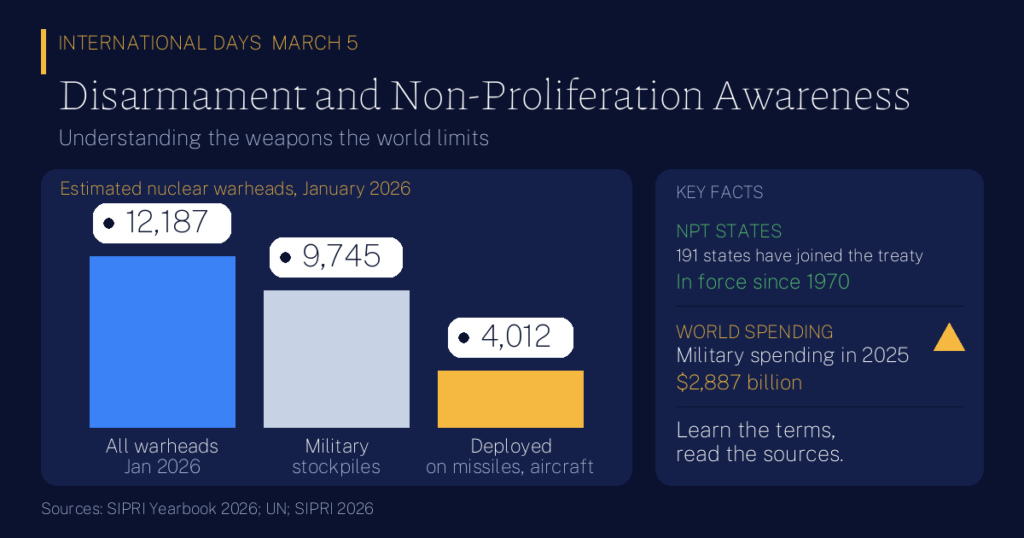
According to the SIPRI Yearbook 2026, the world held an estimated 12,187 nuclear warheads in January 2026. About 9,745 were in military stockpiles for potential use, and an estimated 4,012 were deployed with missiles and aircraft. Between 2,100 and 2,200 of the deployed warheads were kept on high operational alert on ballistic missiles. Russia and the United States together hold about 83 percent of stockpiled warheads. SIPRI estimates China at around 620 warheads.
SIPRI notes that the global inventory has normally fallen year on year since the Cold War, and says this trend is likely to be reversed in the coming years. That history shows that sustained agreement can change the numbers, and the warning shows why the awareness day exists.
- 12,187estimated nuclear warheads worldwide, January 2026
- 191states have joined the NPT, including the five nuclear-weapon states
- $2,887 billionworld military spending in 2025
- 11th yearof consecutive rises in military spending, 2025
Example 2: reading the stockpile. Imagine 1,000 warheads, of which 800 sit in military stockpiles and 330 of those are deployed. The rest are stored. Counting each category separately matters, because a headline total hides how many weapons are ready for use. The figures are round and made up for illustration, but SIPRI reports its real numbers in this same layered way.
What the world spends on arms
Disarmament is also a question of money. SIPRI reports that world military expenditure reached $2,887 billion in 2025, a rise of 2.9 percent in real terms over 2024, in constant 2024 prices. It was the 11th year of consecutive increases. The global military burden stood at 2.5 percent of world GDP, its highest level since 2009.
SIPRI reports that the United States, China and Russia together spent $1,480 billion, 51 percent of the world total. Europe spent $864 billion, up 14 percent on 2024, and China spent $336 billion, up 7.4 percent. These are measurements, not judgments. The point for an awareness day is simply that the choices behind such sums are public policy, and citizens can understand them.
Example 3: the opportunity view. Suppose a country shifted 1 percent of a $100 billion defense budget, which is $1 billion, to schools. At an illustrative $5 million per new school, that would build about 200 schools. The numbers are round and invented, and real budgets involve security needs and trade-offs, but the exercise shows why people ask what spending choices mean in everyday terms.
Why the process feels stuck, and why it still matters
The NPT’s 2026 Review Conference ran in New York from April 27 to May 22, 2026. According to SIPRI, it was the third review conference in a row to close without a final outcome document. That does not cancel the treaty, which continues to bind its 191 parties. It does show how hard consensus has become among states with very different security views.
Disarmament reaches beyond nuclear weapons. Chemical weapons are covered by a separate treaty, and the world also remembers their victims every November 30, as our article on the Day of Remembrance for all Victims of Chemical Warfare explains. States also manage the neutrality and security questions described in our piece on the International Day of Neutrality. Understanding where each tool fits is part of the literacy the March 5 observance hopes to build.
How the day is marked
Because the resolution invites schools, media, civil society and individuals to take part, observances tend to be educational. Typical activities include classroom lessons, public talks, exhibitions and reading about treaties. Teachers can pair the day with history, civics and mathematics, since the arithmetic of inventories and budgets is a natural classroom subject. Anyone can take part by learning the three definitions above, checking one figure from a primary source, and discussing what a safer world would require.
Key Takeaways
- It is a day for understanding. The UN created March 5 to promote awareness of disarmament issues, especially among young people.
- Definitions matter. Disarmament reduces weapons, non-proliferation stops their spread, and arms control sets shared limits.
- The numbers are large. SIPRI estimates 12,187 nuclear warheads in January 2026, with 4,012 deployed.
- The NPT is near universal. 191 states have joined the treaty that entered into force in 1970.
- Spending keeps rising. World military expenditure reached $2,887 billion in 2025, the 11th consecutive annual rise.
- Consensus is hard. The 2026 NPT Review Conference ended without a final outcome document, as two before it did.
- Anyone can take part. Learning the terms and reading primary sources is a real contribution.
How solid is this? Warhead counts are SIPRI estimates for January 2026 and are revised each year, and military spending figures are in constant 2024 prices. The treaty and resolution facts come from the UN and its disarmament office. The three worked examples use round, made-up numbers to show an idea. See also the International Days hub and the International Days Calendar.
More in Society
- United Nations. International Day for Disarmament and Non-Proliferation Awareness.
- UN General Assembly. Resolution A/RES/77/51 (December 2022).
- UN Office for Disarmament Affairs. Treaty on the Non-Proliferation of Nuclear Weapons (NPT).
- United Nations. 2026 NPT Review Conference.
- SIPRI. SIPRI Yearbook 2026 press release (June 2026).
- SIPRI. Global military spending rise continues (April 2026).