Evolutionary and Social Origins
Domestic cats descend from the African wildcat, a species that hunts and lives largely alone, a trait that distinguishes feline social structure from the more cooperative pack behavior of domesticated dogs. This ancestry shapes much of modern cat behavior, including a preference for controlling access to resources rather than sharing them, a tendency toward independent problem-solving, and territorial responses that can seem puzzling to owners expecting dog-like sociability. Despite this solitary heritage, domestic cats show considerable social flexibility and can form strong bonds with humans and other animals when properly socialized.
Communication Signals
Cats communicate through an integrated system of vocalization, body posture, and scent. Vocal signals range from the well-known meow, largely directed at humans rather than other cats, to purring, which can indicate contentment but also occurs during stress or pain. Body language, including tail position, ear orientation, and pupil dilation, conveys emotional state with considerable nuance; a slow blink toward a familiar person is often interpreted as a trust signal. Scent communication, delivered through facial and paw glands, allows cats to mark territory and identify familiar individuals and spaces without direct confrontation.
Territorial and Resource Behavior
Territoriality strongly influences feline behavior, particularly in multi-cat households where resources such as food, water, litter boxes, and resting spots must be distributed to avoid conflict. Behaviorists generally recommend providing resources in multiples and in separate locations to reduce competition-driven stress. Vertical space, including shelves and cat trees, allows cats to establish separate territories within a shared floor plan, reducing confrontation by giving individuals the ability to avoid direct contact while still occupying the same room.
Predatory and Play Behavior
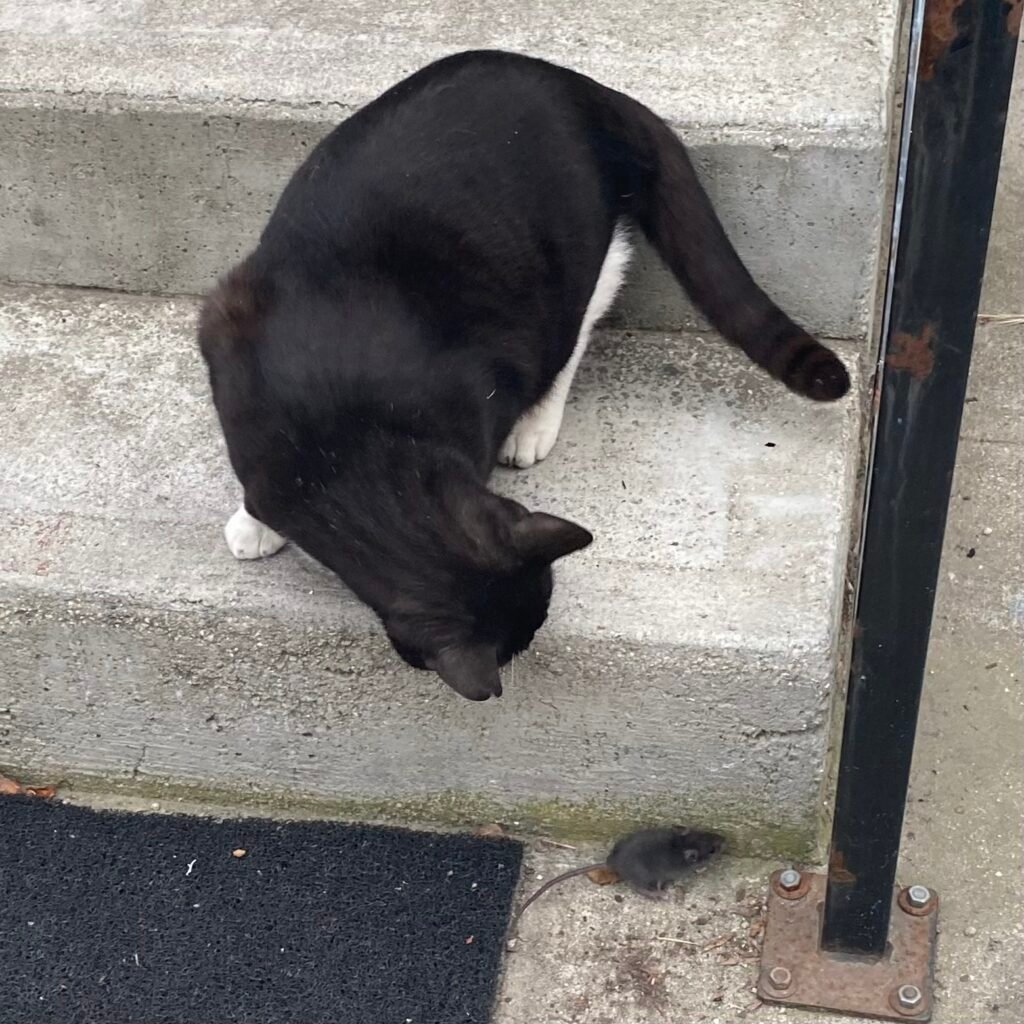
Even well-fed indoor cats retain strong predatory instincts, which manifest as play behavior involving stalking, pouncing, and batting at moving objects. Providing regular opportunities for this instinctive hunting sequence through interactive toys helps prevent frustration-related problem behaviors, including unwanted pouncing on human feet or ankles. Predatory play differs physiologically from aggressive behavior, though the two can appear similar to an untrained observer, making context and body language essential for accurate interpretation.
Common Behavior Problems
Litter box avoidance ranks among the most frequently reported feline behavior issues and often has medical, not purely behavioral, origins, including urinary tract disease or arthritis that makes the box physically uncomfortable to access. Inter-cat aggression, inappropriate scratching, and excessive vocalization are other common concerns. Because many apparent behavior problems have underlying medical causes, veterinary evaluation is typically recommended as a first step before pursuing behavioral or environmental interventions.
Scent Marking and Chemical Communication
Beyond scratching, cats mark territory through several additional scent-based behaviors, including facial rubbing against objects and people, which deposits pheromones from glands located around the cheeks and chin, and urine marking, which in unneutered or stressed cats can occur outside the litter box as a territorial or anxiety-driven signal rather than a simple hygiene failure. Flehmen response, a distinctive lip-curling behavior, allows cats to direct scent particles toward a specialized organ in the roof of the mouth for more detailed chemical analysis, most often observed when investigating another cat’s scent marks.
Stress and Environmental Enrichment
Cats are highly sensitive to environmental change, and seemingly minor disruptions, such as rearranged furniture, a new household member, or altered feeding schedules, can trigger stress responses including hiding, overgrooming, or litter box avoidance. Environmental enrichment strategies, including predictable routines, hiding spots, scratching surfaces, and opportunities for predatory play, help buffer cats against environmental stressors. Multi-cat households benefit particularly from enrichment since resource competition and territorial tension are more likely in shared spaces without adequate environmental complexity to allow individual cats to maintain some separation.
Kitten Socialization
Early socialization during a kitten’s first weeks of life significantly shapes adult temperament, with positive, gentle handling and exposure to varied people, sounds, and experiences during this window associated with more confident, adaptable adult behavior. Kittens that miss this socialization window, including many raised in under-socialized feral conditions, can still improve with patient exposure later, though typically require more time and may retain some baseline wariness compared to kittens socialized during the optimal developmental period.
Indoor Versus Outdoor Lifestyle Considerations
Whether a cat lives strictly indoors, has supervised outdoor access, or roams freely significantly shapes its behavioral expression and risk profile. Indoor-only cats require more deliberate enrichment to satisfy predatory and exploratory instincts that outdoor access would otherwise provide naturally. Outdoor access, while behaviorally enriching, carries substantially elevated risks from traffic, predators, disease exposure, and territorial conflict with other cats, leading most veterinary and welfare organizations to recommend enriched indoor or supervised outdoor arrangements such as secure enclosures over unrestricted roaming.
Introducing a new cat to an existing household, whether another cat, a dog, or a baby, benefits from a gradual, scent-first approach rather than immediate direct interaction. Swapping bedding to exchange scent, followed by supervised visual contact through a barrier, and only later direct supervised interaction, reduces the likelihood of a negative first impression that can create lasting tension between household members sharing the same territory.
Veterinary behaviorists increasingly collaborate with general practitioners to address persistent feline behavior problems, combining environmental, medical, and sometimes pharmacological approaches when simple environmental changes alone prove insufficient to resolve a long-standing or severe behavioral concern affecting the cat’s welfare or the household’s wellbeing.
Ultimately, understanding feline behavior through the lens of the species’ independent evolutionary history, rather than judging it against canine social expectations, helps owners build more realistic, satisfying relationships with their cats.
This perspective also improves welfare outcomes substantially.
Key facts
- Array
Quick checkWhy do cats scratch furniture and other surfaces even when they have a scratching post available?Show answer
Scratching serves multiple functions beyond claw maintenance, including scent marking through glands in the paws and visual territorial marking, so cats may scratch multiple surfaces regardless of post availability unless the post closely matches their texture and location preferences.
Sources
- Array
Editorially reviewed by Specialty Digest Editorial TeamLast reviewed November 4, 2026Researched and drafted with AI assistanceReport an issue