Domestication and Social Evolution
Dogs share ancestry with wolves but diverged through a domestication process spanning thousands of years, during which selection favored individuals tolerant of human proximity and cooperative in shared environments. This history produced an animal uniquely attuned to human social cues, including the ability to follow pointing gestures and read human facial expressions, skills not seen to the same degree even in close primate relatives. The resulting human-dog relationship is best understood as a distinct social bond rather than a simple extension of wolf pack dynamics.
Communication and Body Language
Dogs communicate primarily through body posture, facial expression, and vocalization. Tail position and movement, ear carriage, weight distribution, and mouth tension together convey emotional state, though no single signal should be read in isolation. A loosely wagging tail at a relaxed height generally signals friendliness, while a stiff, high tail paired with forward weight shift often signals arousal or potential aggression. Vocalizations, including barks, growls, and whines, vary in pitch and context depending on the underlying motivation, from alarm to play solicitation.
Social Structure Reconsidered
Early behavioral models borrowed dominance-hierarchy concepts from captive wolf studies to explain dog behavior, framing many problem behaviors as struggles for rank. Subsequent research on both free-ranging dogs and domestic pet dogs has substantially revised this view, showing that relationships are typically more fluid and context-dependent than a fixed hierarchy suggests. Most contemporary behaviorists instead emphasize that behaviors once attributed to dominance, such as jumping or pulling on leash, usually reflect excitement, poor impulse control, or learned habit rather than a bid for social rank.
Fear, Anxiety, and Aggression
Aggression in dogs frequently stems from fear or anxiety rather than confidence or dominance-seeking. A dog that growls when approached while eating may be attempting to create distance from a perceived threat to a valued resource, a behavior termed resource guarding. Recognizing the emotional state underlying aggressive displays is essential for effective intervention, since punishing a fear-based growl can suppress the warning signal while leaving the underlying fear unaddressed, potentially increasing the risk of an escalated bite without warning.
Socialization and Developmental Windows
Puppies pass through a sensitive socialization period, generally spanning several weeks during early development, when exposure to novel people, animals, environments, and stimuli has an outsized influence on adult temperament. Positive, varied experiences during this window help build resilience and reduce the likelihood of fear-based behavior problems later in life. Missed or negative experiences during this period can be partially addressed through careful, gradual exposure later, though the process is typically slower and less reliable than socialization completed during the original developmental window.
Play Behavior and Bite Inhibition
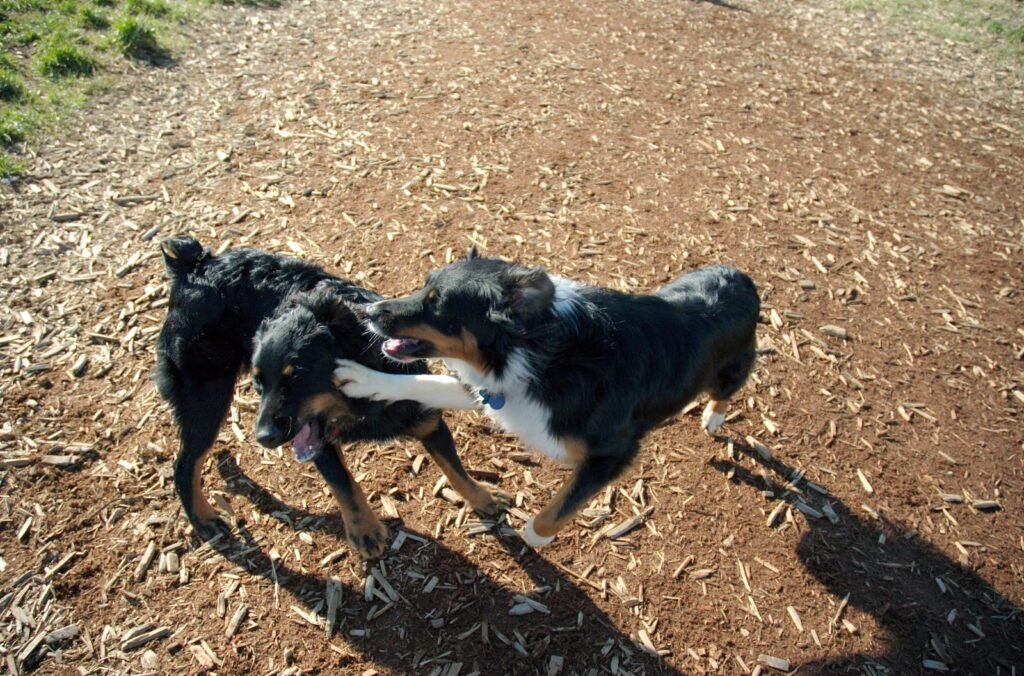
Play between dogs, and between dogs and humans, serves important developmental functions beyond simple entertainment. Puppies learn bite inhibition, the ability to control the force of their mouth, largely through play with littermates, where an overly hard bite typically ends the play session abruptly, providing immediate feedback. Owners can reinforce this learning by similarly withdrawing attention when a puppy bites too hard during play, helping shape a soft mouth that persists into adulthood. Play also helps dogs practice reading and responding to social signals, including recognizing when a play partner wants to disengage.
Breed-Typical Behavioral Tendencies
Decades of selective breeding for specific working functions have left many breeds with behavioral predispositions relevant to pet ownership. Herding breeds may show tendencies toward chasing and nipping at moving objects, including children, reflecting instincts originally selected for livestock work. Scent hounds often display strong independent sniffing behavior that can override recall cues when a compelling scent trail is present. Guardian breeds may show heightened territorial alertness. Understanding these tendencies helps owners anticipate training challenges and provide appropriate outlets rather than expecting uniform behavior across all breeds.
Separation-Related Behavior
Many dogs experience distress when separated from their owners, ranging from mild restlessness to severe separation anxiety involving destructive behavior, house-soiling, or vocalization. True separation anxiety is considered a clinical condition that often benefits from a structured desensitization protocol, environmental management, and in more severe cases, veterinary behavioral medication alongside behavioral intervention. Distinguishing genuine separation anxiety from boredom-driven destructive behavior is an important diagnostic step, since the two conditions require different intervention strategies.
Enrichment and Mental Stimulation
Beyond formal training, dogs benefit substantially from mental enrichment activities such as puzzle feeders, scent work games, and novel exploration opportunities, which help satisfy cognitive needs that pure physical exercise does not fully address. Working and herding breeds in particular often show reduced problem behaviors when given structured outlets for their mental energy, since boredom and understimulation frequently underlie destructive or attention-seeking behaviors that owners might otherwise interpret as purely disobedience.
Recall training, teaching a dog to return reliably when called, is widely considered among the most safety-critical behaviors to establish, since a strong recall can prevent dangerous situations involving traffic, wildlife encounters, or aggressive interactions with unfamiliar animals. Building recall reliability typically requires extensive practice across a wide range of distraction levels, paired consistently with highly valued rewards, before an owner can trust the behavior in a genuinely high-distraction real-world setting.
Owners who invest early in structured socialization and basic obedience generally report fewer behavioral challenges later in a dog’s life, reinforcing why many veterinary behaviorists emphasize prevention-focused early intervention over reactive problem-solving once an unwanted behavior pattern has already become well established and harder to change.
Understanding the evolutionary and social roots of canine behavior equips owners to interpret everyday actions with greater empathy and accuracy.
Such empathy improves outcomes for both dog and owner alike.
Key facts
- Array
Quick checkHas scientific understanding of dog social structure moved away from the traditional dominance hierarchy model?Show answer
Yes, most contemporary canine behaviorists consider rigid dominance-hierarchy explanations of pet dog behavior outdated, instead emphasizing individual learning history, fear, and context as primary drivers of behavior such as aggression or resource guarding.
Sources
- Array
Editorially reviewed by Specialty Digest Editorial TeamLast reviewed November 4, 2026Researched and drafted with AI assistanceReport an issue