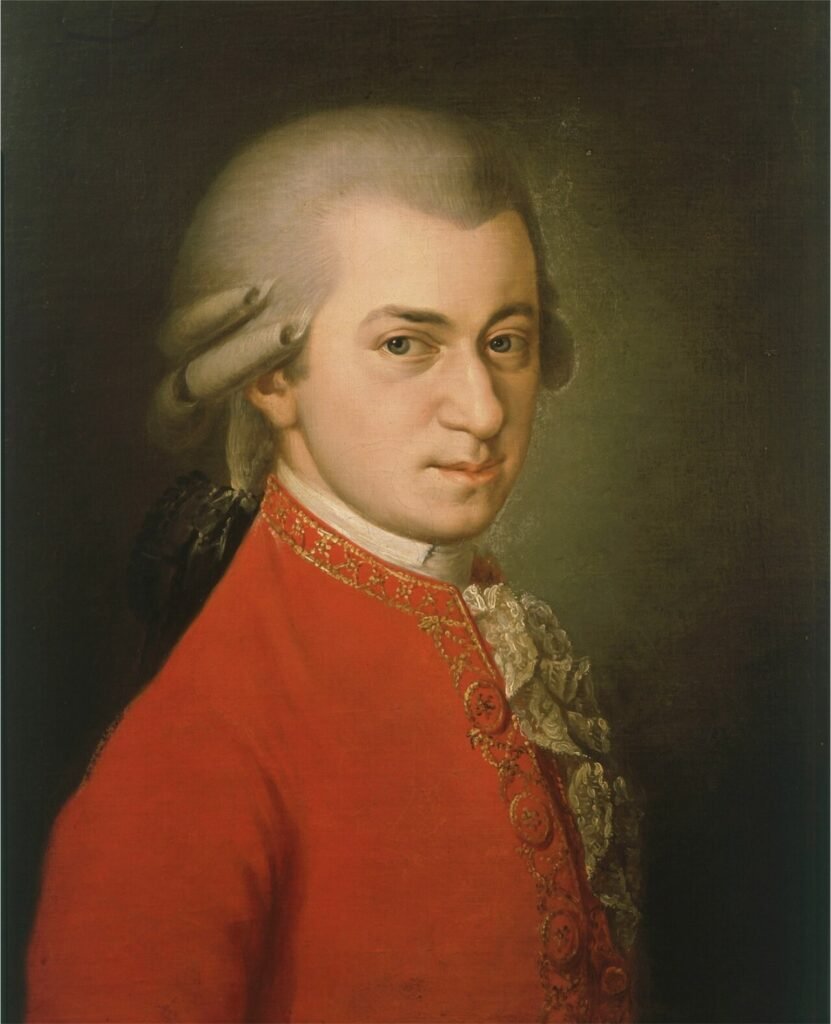
Wolfgang Amadeus Mozart (1756 to 1791) was an Austrian composer of the Classical era who wrote hundreds of works in nearly every major genre of his time, including opera, symphony, concerto, chamber music and sacred music. He was born in Salzburg, became a celebrated child performer, and spent the last decade of his short life in Vienna. He died there on 5 December 1791 at the age of 35.
Early life of Mozart
Mozart was born on 27 January 1756 in Salzburg, the seventh and last child of the court musician Leopold Mozart and his wife Anna Maria, born Pertl. Five of the seven children died in infancy, and only Wolfgang and his sister Maria Anna, known as Nannerl, who was five years older, reached adulthood. He was baptized Johannes Chrysostomus Wolfgang Theophilus. The Mozarteum Foundation writes his name as Wolfgang Amadé Mozart, and Amadeus is the Latinized form used in most English-language writing.
Leopold Mozart was himself a composer and a violinist, and he became vice-kapellmeister at the Salzburg court in 1763. He taught both of his children music from an early age. His 1756 treatise on violin playing brought him fame across Europe.
By the age of five or six, Wolfgang was showing his talent at the courts of Salzburg, Munich and Vienna. Encouraged by these successes, Leopold arranged a long concert tour on which both children performed. Between June 1763 and December 1766 the family traveled to Paris, London, The Hague, southern and western Germany and Switzerland, and Wolfgang increasingly presented works of his own.
Career and major works
Mozart’s early career was divided between Salzburg and travel, and in 1781 he settled in Vienna after a break with his employer, the Archbishop of Salzburg. He built a living there as a composer, performer and teacher rather than as a court employee. In August 1782 he married Constanze Weber, and the couple had two sons who survived to adulthood.
His Vienna years produced a run of masterpieces. The Abduction from the Seraglio, a German-language comic opera, was staged in 1782. The Marriage of Figaro followed in 1786, with a libretto by Lorenzo Da Ponte, and Don Giovanni had its first performance in Prague in 1787. Cosi fan tutte appeared in 1790, and The Magic Flute, a Singspiel, which is an opera with spoken German dialogue, was first staged in Vienna in September 1791.
He also wrote a large body of instrumental music. His piano concertos were written largely for his own performances in Vienna. His late symphonies include No. 39, No. 40 and No. 41, the last known as the Jupiter. He dedicated a set of six string quartets to Joseph Haydn, whom he admired and who became a friend. Mozart’s own piano quartet in G minor was first published in Vienna in 1785, and Harvard Library holds a copy of that first edition.
The Mozarthaus Vienna, in a building where Mozart lived, describes itself as the only surviving Viennese apartment of the composer. Many of his letters and documents are preserved by the Mozarteum Foundation, which also runs a digital edition of his correspondence.
Ideas and contributions
Mozart’s importance lies in how he combined existing forms with unusual melodic and dramatic skill. In instrumental music he worked within sonata form, the standard plan for the opening movement of a symphony or sonata, and he used it with great flexibility. In opera he joined Italian comic traditions with serious human drama, so that characters in works like Figaro and Don Giovanni feel both funny and real.
He wrote for the instruments and singers of his day. The concertos let him display his own skill at the keyboard, while the operas gave singers music that matched the personality of each role. He also wrote sacred works, including a mass and a Requiem, and he joined the Freemasons in Vienna, a membership that colored a few of his late works, notably The Magic Flute.
Most of his music is cataloged using Köchel numbers, a system created in the nineteenth century by Ludwig von Köchel. The numbers appear after the letter K in titles such as the Requiem, K. 626, and they let performers and scholars refer to each piece without confusion.
Death of Mozart
Mozart fell ill in late 1791 while working on the Requiem and died in Vienna on 5 December, according to the Mozarteum Foundation. The Requiem was left unfinished, and other musicians completed it afterward, most notably his pupil Franz Xaver Süssmayr.
The cause of his death has never been settled. Contemporary records point to a fever, and modern researchers have proposed several illnesses, but none of these explanations has been proven.
Legacy of Mozart
Mozart’s operas and concertos remain among the most performed works in the repertory, and his name is closely tied to Salzburg, where the Mozarteum Foundation maintains his birthplace and a museum of his family life. Libraries preserve his manuscripts and early printed editions, and Harvard Library reports that its collection includes nearly one hundred first editions of his instrumental music and operas, most of them printed before 1800.
He influenced later composers, including Ludwig van Beethoven, who traveled to Vienna as a young man hoping to study with him. Beethoven’s trip in late 1786 and early 1787 was cut short by news that his mother was dying, and the Beethoven-Haus in Bonn notes that a meeting between the two men may have been arranged but is not documented.
Myths and controversies
Several popular stories about Mozart’s death have not held up. A rumor that the composer Antonio Salieri poisoned him circulated in the nineteenth century and has been dramatized in plays and films, but historians have found no evidence for it. Biographers also caution against treating the stories of his poverty and lonely burial as simple fact, since his income in Vienna was at times substantial even though he struggled to manage it.
More in Music
Key facts
- Mozart was born on 27 January 1756 in Salzburg, the seventh and last child of Leopold and Anna Maria Mozart.1
- Between June 1763 and December 1766 he toured Paris, London, The Hague, Germany and Switzerland as a child performer.1
- He died in Vienna on 5 December 1791 at the age of 35.1
- He married Constanze Weber in 1782 and they had two sons.1
- Mozarthaus Vienna describes its building as the only surviving Viennese apartment of Mozart.2
Related concepts
Quick checkWhen and where did Mozart die?Show answer
Mozart died in Vienna on 5 December 1791, aged 35. The cause is not settled, and the Requiem he was writing was completed by other musicians.
Sources
- Internationale Stiftung Mozarteum Salzburg, Wolfgang Amadé Mozart: life and work, https://mozarteum.at/en/wolfgang-amade-mozart
- Mozarthaus Vienna, Mozart museum in his only surviving Viennese apartment, https://www.mozarthausvienna.at/en
- Harvard Library, Mozart at Harvard (first and early editions and manuscripts), https://library.harvard.edu/collections/mozart-harvard
- Beethoven-Haus Bonn, Chronology Beethoven in Bonn (1786 to 1787 Vienna trip), https://www.beethoven.de/en/g/zeittafel-beethoven-in-bonn
Editorially reviewed by Specialty Digest Editorial TeamLast reviewed November 4, 2026Researched and drafted with AI assistanceReport an issue