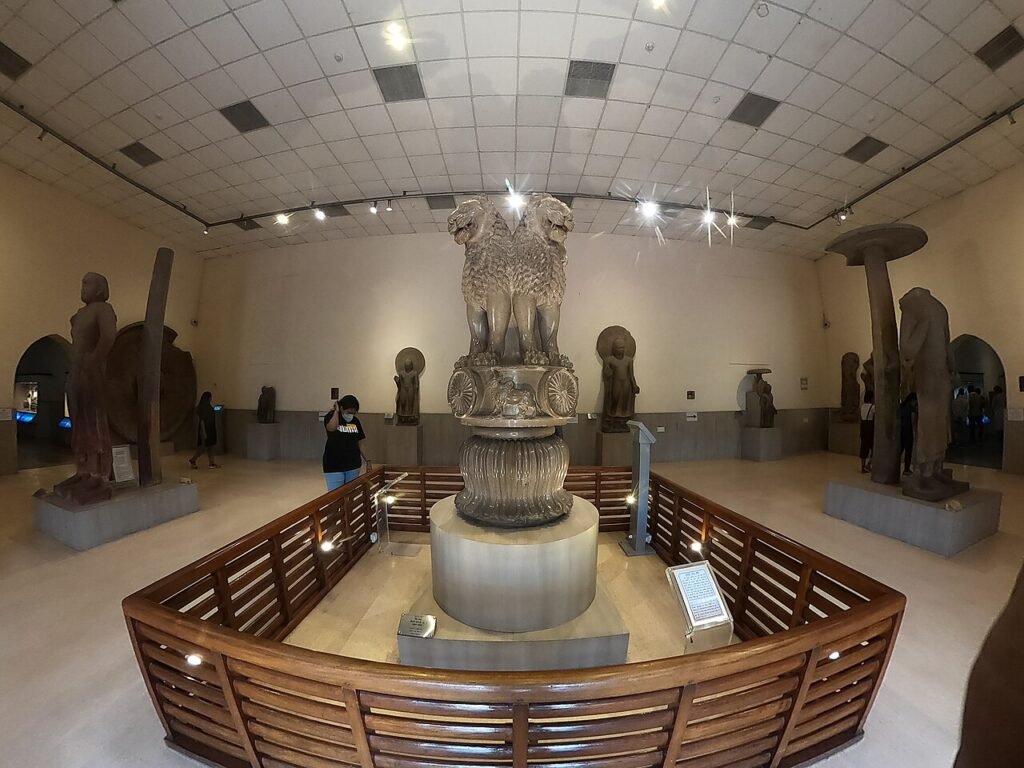
Ashoka (reigned about 268 to 232 BCE), also spelled Asoka, was the third emperor of the Maurya dynasty and ruled most of the Indian subcontinent from his capital at Pataliputra. He is remembered for expressing regret over a brutal war, for promoting a code of ethical conduct called dhamma, and for supporting the spread of Buddhism.
Early life of Ashoka
The name Ashoka most likely means without sorrow. In his own inscriptions he is called Devanampiya Piyadassi, usually translated as Beloved of the Gods and Gracious of Mien. His grandfather Chandragupta founded the Maurya Empire around 322 BCE, and his father Bindusara ruled after him. Ashoka’s birth date is unknown, and a common estimate is around 304 BCE.
Much of what is told about his youth comes from Buddhist texts written long after his death. These say he was one of many sons, though most scholars doubt the story of a hundred princes. They add that he was sent to put down a revolt at Taxila and then governed the commercial city of Ujjain. Accounts differ on how he came to the throne. Some say his ministers favored him over his elder brother Susima, and that he had Susima killed. The details are legendary, and scholars treat them with caution.
Reign and the Kalinga War
Ashoka took the throne around 268 BCE, after a period of succession struggle. At its height his empire stretched from the region of modern Afghanistan and Iran across nearly all of the subcontinent. It was governed through the administrative methods of the Arthashastra, a political treatise tied to his grandfather’s minister Chanakya.
In about 260 BCE, in the eighth year of his reign, he invaded the coastal kingdom of Kalinga. His own Thirteenth Rock Edict describes the cost: about 100,000 people killed, 150,000 deported, and many more who died of disease and famine. In the same edict he states that he felt remorse, that the slaughter and deportation of a conquered people weighed heavily on him. This is the clearest firsthand evidence about his attitude, and it is unusual for a ruler of the ancient world.
His turn toward Buddhism was probably gradual and not a single moment. Buddhist legends link it to a visit to the battlefield, but his edicts show him drawn to the faith over several years after the war. He traveled on pilgrimages to sites linked to the Buddha. Tradition holds that his son Mahinda led a mission to Sri Lanka, and Buddhist sources credit Ashoka with sponsoring monasteries and many stupas, the dome-shaped monuments that hold relics.
Dhamma and the edicts
Ashoka’s central idea was dhamma, a Pali form of the Sanskrit word dharma. It is not the doctrine of a single religion, and it is better described as a set of ethical rules for living together. The edicts associate it with mercy, charity, truthfulness and purity, with respect for parents and elders, with fair treatment of servants and with restraint in killing animals. He also urged that no one should praise their own faith by running down another’s. Ashoka appears in his edicts as favoring several traditions, and he mentions Brahmins, Jains and Ajivikas as well as Buddhists.
He had these messages carved on rock surfaces and on polished stone pillars across his empire, in local scripts and languages including Prakrit, Greek and Aramaic. They are the earliest surviving royal inscriptions of the subcontinent. He also appointed officials to promote dhamma and to look after the welfare of the people, and he sent envoys and missionaries to neighboring lands. Accounts from Sri Lanka tell of missions that reached as far as the Hellenistic kingdoms to the west, although this is known mainly from later texts.
Sources and scholarly debate
Historians rely on two kinds of evidence, and the two do not always agree. The inscriptions are first-person statements by Ashoka himself, but they concentrate on dhamma and say little about administration. One scholar has suggested reading them as political messages meant to present a favorable image of the ruler. The Buddhist legends, preserved in Sanskrit, Pali, Chinese and other languages, are rich in detail but were composed centuries later to show what faith could do for a ruler. The North Indian and Sri Lankan traditions differ from one another, for example on the third Buddhist council and on missionaries.
Modern historians have also questioned the picture of a ruler who renounced force. The surviving evidence shows that Ashoka did not give Kalinga back to its survivors or call back those deported, and he did not disband his army. Military power continued to be used to keep order. One view is that regret and statecraft could coexist, since a king who seemed weak might invite rebellion. The number of stupas he is said to have built, 84,000, is regarded as an exaggeration, although the monuments themselves were real.
Legacy of Ashoka
After his death in 232 BCE the empire lasted fewer than 50 years. His name faded from public memory until the 19th century. In 1837 the scholar James Prinsep deciphered the Brahmi script of the inscriptions, and the emperor named in them was identified with the Ashoka of Buddhist texts. The sequence of discovery made him one of the best-documented rulers of ancient India.
His patronage helped turn Buddhism, then one of several schools of thought alongside Jainism and the older tradition now called Hinduism, into a faith that spread across Asia. The Buddhist monuments at Sanchi, which UNESCO describes as the oldest Buddhist sanctuary in existence, date mostly to the second and first centuries BCE. The state emblem of the Republic of India is adapted from the Lion Capital of Ashoka at Sarnath, and the Ashoka Chakra, a wheel with 24 spokes, appears at the center of the national flag. Many modern readers admire him as a ruler who tried to govern by moral persuasion, while historians continue to debate how fully he did so.
Key facts
- Ashoka reigned from about 268 to 232 BCE as the third Maurya emperor.1
- His Thirteenth Rock Edict recalls the Kalinga War of about 260 BCE and expresses remorse.1
- His edicts promote dhamma, an ethical code, and were carved in stone across his empire.1
- Buddhist legends and his own inscriptions do not always agree.1
- The Buddhist monuments at Sanchi are described by UNESCO as the oldest Buddhist sanctuary in existence.2
Related concepts
Quick checkWhat is Ashoka best known for?Show answer
He is known for the Kalinga War, his later expression of remorse, his edicts on dhamma carved in stone, and his support for the spread of Buddhism.
Sources
- World History Encyclopedia, Ashoka the Great, https://www.worldhistory.org/Ashoka/
- UNESCO World Heritage Centre, Buddhist Monuments at Sanchi, https://whc.unesco.org/en/list/524/
Editorially reviewed by Specialty Digest Editorial TeamLast reviewed November 4, 2026Researched and drafted with AI assistanceReport an issue