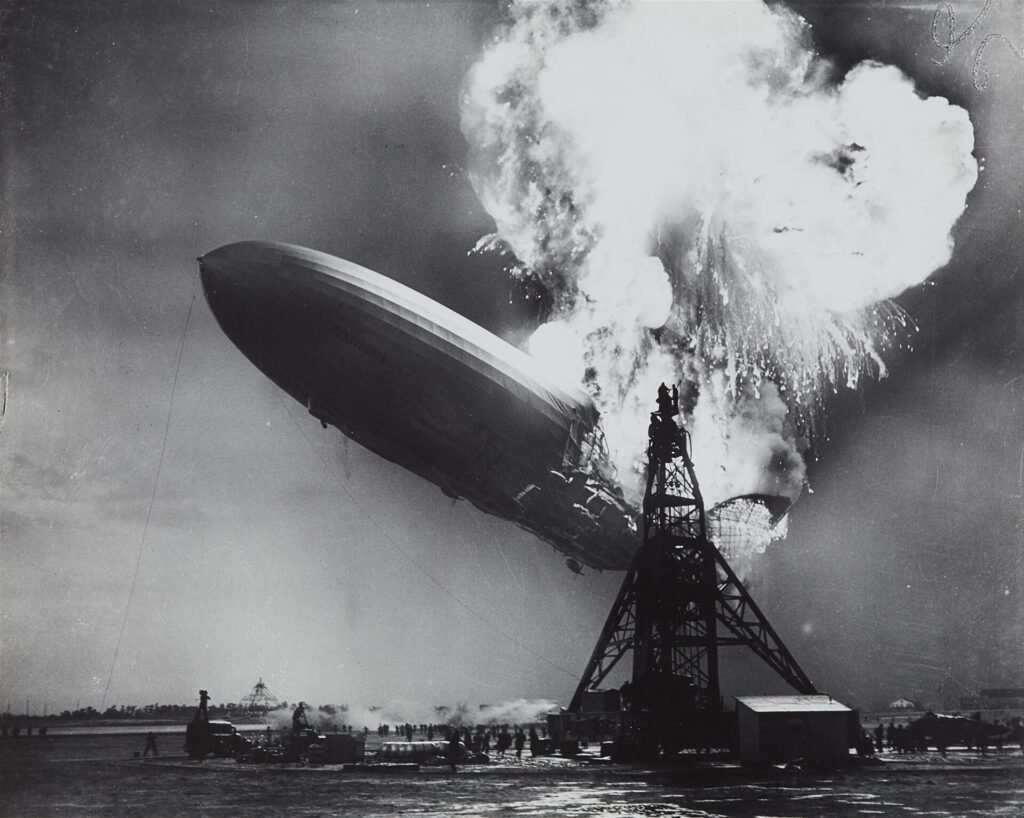
The Hindenburg disaster was the fire that destroyed the German passenger airship LZ 129 Hindenburg as it prepared to moor at Naval Air Station Lakehurst, New Jersey, on 6 May 1937. Thirty-six people died. Photographs, newsreel film and a live radio report made the fire one of the most famous disasters in aviation history, and it marked the end of the era of rigid passenger airships.
Background to the Hindenburg disaster
The Hindenburg was the pride of the Deutsche Zeppelin-Reederei line. The National Air and Space Museum calls it the longest aircraft of any type, at 245 meters (803 feet). Sixteen gas cells held up to 200,000 cubic meters of hydrogen, the lifting gas. Four 1,050-horsepower Daimler-Benz diesel engines drove it at up to 135 kilometers per hour, with a maximum range of 14,000 kilometers.
The ship carried up to 70 passengers, served by a crew of 40 to 72. Passengers had small cabins with running water, gourmet meals, a smoking lounge and a piano covered in pigskin. The Smithsonian notes that the airship was roughly the size of the RMS Titanic, but it flew. Its Atlantic service existed because ordinary aircraft could not yet cross the ocean with passengers, so the airship carried them to Lakehurst. There, representatives of American Airlines, which had a contract with the airship’s parent company, met them and took them on to connecting flights.
The line also used the airship for publicity. On 9 October 1936 Deutsche Zeppelin-Reederei and the Standard Oil Company invited prominent businessmen, politicians and military officers aboard for a 10-hour flight over New England that the press called the Millionaires’ Flight.
Course of the disaster
On 3 May 1937 the Hindenburg left Frankfurt, Germany, on the first of ten round trips to America planned for the season. The crossing was uneventful, apart from headwinds that delayed its arrival over Boston by about an hour. Thunderstorms near New York then prevented a landing at Lakehurst, so Captain Max Pruss steered the ship over Manhattan and out to sea to wait. It drew crowds in the streets as it passed over the city.
By 6:22 p.m. the storms had passed, and Pruss ordered the ship toward Lakehurst, almost half a day late. The final approach began around 7:00 p.m. Shifting winds forced sharp left turns as the ship came down from 650 feet to 295 feet. At 295 feet the crew dropped the mooring lines, and a light rain began to fall.
At 7:25 p.m., as the ship was being secured to the ground, it caught fire. Flames burst from somewhere near the stern, though eyewitnesses disagree about exactly where. The fire spread forward through the hydrogen cells, the stern fell to the ground, and flames shot out of the nose. The whole disaster lasted less than 40 seconds.
There were 97 people aboard, 36 passengers and 61 crew. Thirteen passengers and 22 crew members died, along with one member of the ground crew, for a total of 36 deaths. It was not the worst airship accident in history: the US Navy airship USS Akron had crashed off New Jersey in 1933, killing 73 of its 76 crew.
Aftermath of the disaster
The US Navy moved quickly to rescue survivors, treat the injured and secure the site. More than 1,500 men from nearby forts, ships and Marine bases, and even Coast Guard surfmen, were sent to guard the wreck. Investigators from both Germany and the United States were collecting evidence, and curious civilians kept trying to take souvenirs. After the investigations ended, the wreckage was cleared away and some of the more valuable metals were returned to Germany for recycling. A permanent memorial was built at Lakehurst.
Both the German Investigation Commission and the US Department of Commerce produced reports after interviewing witnesses and survivors and examining photographs, film and wreckage. Both concluded that a leaking gas cell allowed hydrogen to mix with oxygen in the air, and that a spark, possibly from static electricity, ignited the mixture.
Causes and theories
The exact cause has never been proven. The Smithsonian curator Tom Crouch said that we will probably never know for certain. Sabotage was suspected for a long time, but the theory has been largely discounted. The leading explanation combines static electricity built up on a large, ungrounded ship in damp air with the hydrogen leaking from the gas cells.
A related hypothesis, proposed by the former NASA scientist Addison Bain, points to the fabric covering. It was coated with a dope made from iron oxide and aluminum-impregnated cellulose, which Bain argued is highly flammable. The hypothesis remains debated.
Significance and legacy of the Hindenburg disaster
The fire made the end of the airship era visible, though the era had already been fading. Airship production ended soon after the disaster. One more airship was completed because it was already on order, and Graf Zeppelin II, the Hindenburg’s sister ship, was the only other large airship still flying. The Second World War then ended the industry. Fast fighter aircraft could easily attack slow-moving airships, and the company that had built them did not survive the war.
The disaster is also remembered because of how it was recorded. Newsreel cameras were rolling, and Herbert Morrison of Chicago radio station WLS was broadcasting the landing live. His cry of ‘Oh, the humanity’ is still widely recognized. Photographs of the burning ship spread around the world.
The airship had carried unusual cargo in happier times. The Romanian aerobatic pilot Alexandru Papana shipped his Bucker Jungmeister aircraft to the United States on the Hindenburg in August 1936 for the Cleveland Air Races, and the plane is now displayed at the museum’s Udvar-Hazy Center in Virginia.
The Smithsonian Institution preserves relics of the Hindenburg, including pieces of a girder and a propeller, a scorched cup and saucer, and a postcard that survived the fire in the mail. The investigations relied on witness accounts, photographs, film and physical evidence, the same kinds of material that investigators use today when they examine accidents in commercial aviation.
More in Aviation and Air Transport
Key facts
- The airship LZ 129 Hindenburg caught fire at 7:25 p.m. on 6 May 1937 while mooring at Lakehurst, New Jersey.1
- The disaster lasted less than 40 seconds.2
- There were 97 people aboard; 13 passengers and 22 crew died, plus one member of the ground crew.2
- At 245 meters (803 feet) the Hindenburg was the longest aircraft of any type.3
- German and US investigations concluded that leaking hydrogen mixed with air and was ignited by a spark, possibly static electricity.1
- Herbert Morrison of radio station WLS broadcast the landing live.2
Related concepts
Quick checkWhat caused the Hindenburg disaster?Show answer
Investigators concluded that hydrogen leaking from a gas cell mixed with air and was ignited by a spark, possibly static electricity. The exact trigger has never been proven.
Sources
- Smithsonian National Air and Space Museum, Dealing with the Aftermath of the Hindenburg Disaster, https://airandspace.si.edu/stories/editorial/aftermath-hindenburg
- Smithsonian Magazine, What Really Felled the Hindenburg?, https://www.smithsonianmag.com/smithsonian-institution/80th-anniversary-hindenburg-disaster-mysteries-remain-180963107/
- Smithsonian National Air and Space Museum, Following the Hindenburg, https://airandspace.si.edu/stories/editorial/following-hindenburg
Editorially reviewed by Specialty Digest Editorial TeamLast reviewed November 4, 2026Researched and drafted with AI assistanceReport an issue