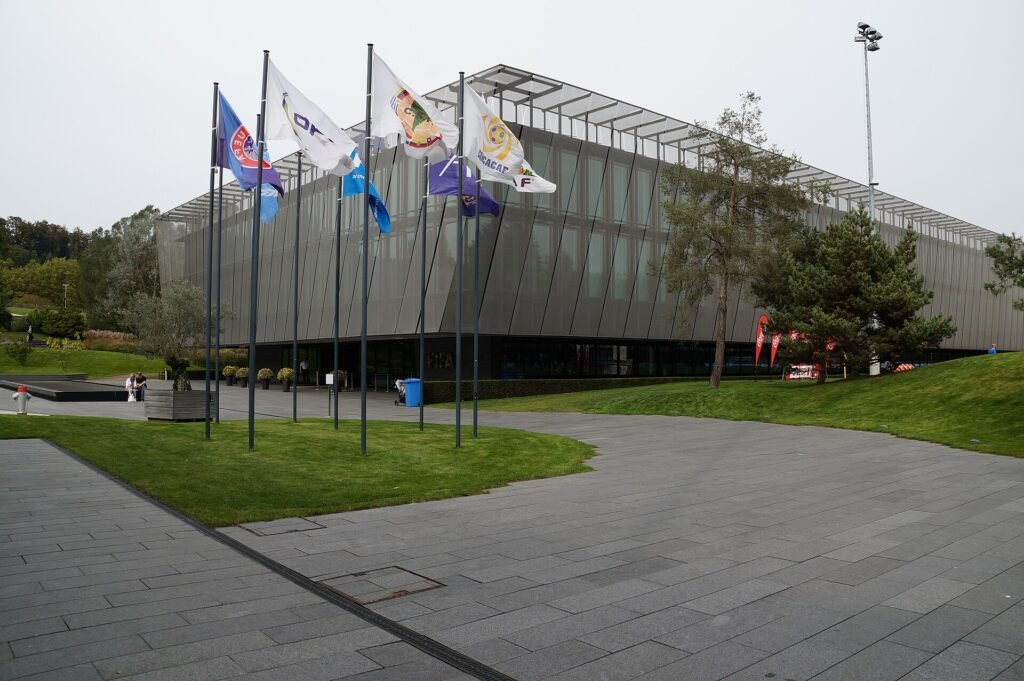
FIFA (Fédération Internationale de Football Association) is the international governing body of association football, known in the United States as soccer. It was founded in Paris on 21 May 1904, is based in Zurich, Switzerland, and has 211 national member associations.
History and founding of FIFA
FIFA was founded on 21 May 1904 at 229 rue Saint-Honoré in Paris, where it has since unveiled a commemorative plaque. Robert Guérin of France was its first president. The seven founding members were the football associations of Belgium, Denmark, France, the Netherlands, Sweden and Switzerland, together with Real Madrid CF, which represented Spain.
The organization opened its first office in Amsterdam in 1906 and moved to Zurich in 1932. Daniel Woolfall succeeded Guérin in 1906 and served until his death in 1918, and Jules Rimet led FIFA from 1921 to 1954. In 1913 FIFA joined the International Football Association Board, the body that sets the laws of play. FIFA holds half the votes on that board, and the football associations of England, Scotland, Wales and Northern Ireland hold the other half.
Membership grew steadily. FIFA counted 24 members when World War I began, 68 in 1948 and more than 100 by 1962. It stood at 203 in 1998 and has reached 211 today.
Structure and membership of FIFA
FIFA’s members are national associations, not clubs or individuals. Each association belongs to one of six continental confederations: the Asian Football Confederation (AFC), the Confederation of African Football (CAF), CONCACAF for North and Central America and the Caribbean, CONMEBOL for South America, the Oceania Football Confederation (OFC) and UEFA for Europe.
The FIFA Congress is the main legislative body, with one delegate for each member association. It elects the president, approves the budget and chooses future World Cup hosts. Between meetings of Congress, the FIFA Council governs. It has 37 members, led by the president and eight vice presidents, and members serve four-year terms with a limit of three terms. A secretary general runs daily operations, and a Football Tribunal, created in 2021, resolves disputes.
Gianni Infantino of Switzerland, then general secretary of UEFA, was elected president on 26 February 2016 at an extraordinary congress in Zurich. He won the second round with 115 votes. FIFA also keeps offices away from Zurich, and its Member Associations Division has been based in Paris since 2022.
What FIFA does
FIFA organizes world tournaments, above all the men’s World Cup. The first was held in 1930 with 13 teams. The field grew from 16 teams in the 1954 to 1978 tournaments to 24 from 1982 to 1994 and 32 from 1998 to 2022. The 2026 edition has 48 teams and is hosted jointly by Canada, Mexico and the United States. The women’s World Cup began in 1991 in China, and the United States won the first tournament.
FIFA also funds development work for association football around the world. Its FIFA Forward 3.0 program for 2023 to 2026 has USD 2,250 million available for direct football development, which is 29 percent more than the previous program. FIFA also reports that payments to players, member associations and clubs linked to the 2023 Women’s World Cup rose to USD 152 million, up from USD 50 million in 2019.
Funding and governance of FIFA
FIFA plans and reports its finances in four-year cycles built around the World Cup. For 2023 to 2026 it budgeted USD 11,000 million in revenue, and 2023 revenue exceeded the budget by 45 percent. At the end of 2023 FIFA reported total assets of USD 5,490 million and reserves of USD 3,565 million.
Television and marketing rights supply most of the income. The US Department of Justice noted in 2015 that 70 percent of FIFA’s USD 5.7 billion in revenue from 2011 to 2014 came from selling television and marketing rights for the 2014 World Cup. The same market is covered in more general terms in the entry on sports broadcasting rights.
Governance changed after the scandal described below. At an extraordinary congress in Zurich in February 2016, members approved a reform package with 89 percent support. It set term limits of three four-year terms for the president and other officials, replaced the old executive committee with a Council that includes more women, and separated policy decisions from business operations.
Criticism and controversies
On 27 May 2015 the US Department of Justice unsealed a 47-count indictment in federal court in Brooklyn, New York. It charged 14 defendants: nine FIFA officials, four sports marketing executives and one businessman accused of acting as an intermediary. The charges included racketeering, wire fraud and money laundering conspiracies, and the indictment alleged a scheme running from 1991 for 24 years.
Prosecutors alleged that officials solicited bribes and kickbacks of well over $150 million, mostly tied to tournaments in the CONCACAF and CONMEBOL regions, sponsorship of the Brazilian federation, the selection of the 2010 World Cup host and the 2011 FIFA presidential election. The Department stated that the charges were allegations, that the defendants were presumed innocent, and that the principal purpose of FIFA and its confederations was legitimate.
Britannica reports that more than two dozen executives and officials were eventually implicated in bribery linked to the awarding of the 2018 and 2022 World Cups. The choice of Russia for 2018 and Qatar for 2022 also drew criticism over LGBTQ+ rights, Russia’s invasion of Crimea and alleged mistreatment of workers in Qatar. Reforms that followed included an Audit and Compliance Committee, formed in 2016.
Legacy and impact of FIFA
FIFA’s influence runs through the laws of play, through the World Cup and through funding for national associations. Its president has cited an audience of five billion people for the World Cups, a figure that FIFA itself reports and that readers should treat as the organization’s own claim rather than an independent measure.
The reforms of 2016, including term limits and a Council that replaced the executive committee, are the most recent major change to how the organization is governed.
More in Sports Management and Administration
Key facts
- FIFA was founded on 21 May 1904 in Paris, with Robert Guérin as its first president.1
- FIFA has 211 member associations and moved its headquarters office to Zurich in 1932.1
- Each member association belongs to one of six continental confederations.5
- The first men's World Cup was held in 1930 with 13 teams, and the 2026 edition has 48 teams.1
- FIFA budgeted USD 11,000 million in revenue for 2023 to 2026 and held reserves of USD 3,565 million at the end of 2023.2
- On 27 May 2015 the US Department of Justice unsealed a 47-count indictment against 14 defendants, including nine FIFA officials.3
- In February 2016 members approved reforms with 89 percent support, including term limits of three four-year terms.4
Quick checkWhen was FIFA founded and by whom?Show answer
FIFA was founded in Paris on 21 May 1904. The founding members were the football associations of Belgium, Denmark, France, the Netherlands, Sweden and Switzerland, plus Real Madrid CF representing Spain.
Sources
- FIFA, FIFA celebrates 120th anniversary of foundation in Paris, https://inside.fifa.com/en/news/fifa-celebrates-120th-anniversary-of-foundation-in-paris
- FIFA, Annual Report 2023: Foreword by the Chairperson of the Finance Committee, https://fifadata.com/about-fifa/official-documents/annual-report-2023/financials/foreword-by-the-chairperson-of-the-finance-committee
- US Department of Justice, Nine FIFA Officials and Five Corporate Executives Indicted for Racketeering Conspiracy and Corruption (27 May 2015), https://www.justice.gov/archives/opa/pr/nine-fifa-officials-and-five-corporate-executives-indicted-racketeering-conspiracy-and
- NPR, FIFA Members Approve Anti-Corruption Reforms, Limit President's Power (26 February 2016), https://www.npr.org/sections/thetwo-way/2016/02/26/468227519/fifa-members-approve-anti-corruption-reforms-limit-presidents-power
- Encyclopaedia Britannica, FIFA, https://www.britannica.com/topic/Federation-Internationale-de-Football-Association
Editorially reviewed by Specialty Digest Editorial TeamLast reviewed November 4, 2026Researched and drafted with AI assistanceReport an issue