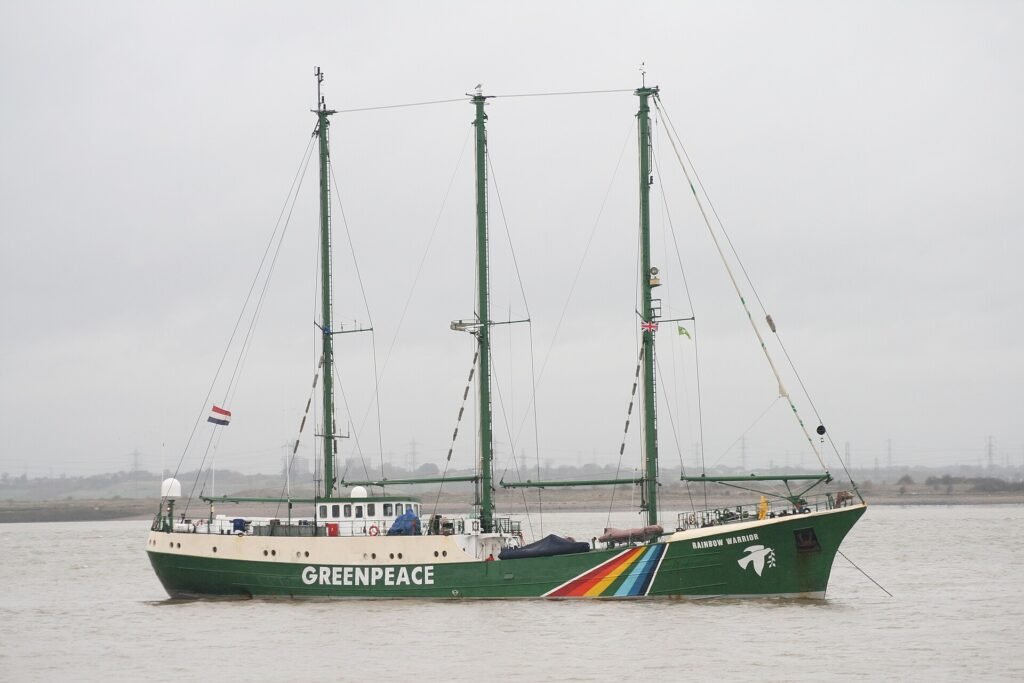
Greenpeace is an international environmental campaigning organization that began in Vancouver, Canada, in 1971 with a voyage to protest a United States nuclear test. Today it is a network of independent national and regional organizations, coordinated by Greenpeace International in Amsterdam, that campaigns on environmental and peace issues using direct action, research and litigation.
History of Greenpeace
Greenpeace says there was no single founder. Its name, idea, spirit and tactics each have separate lineages, and it jokes that in any bar in Vancouver someone will claim to have founded it. The group began as the Don’t Make a Wave Committee, set up in 1970 with one aim: stopping a second US nuclear weapons test on Amchitka Island in the Aleutians, off Alaska.
The committee was a loose alliance of Quakers, pacifists, ecologists, journalists and hippies. According to Greenpeace’s own account, Marie Bohlen floated the idea of sailing a boat to confront the bomb, and the word Greenpeace came from a remark at a meeting, “make it a green peace,” by the Canadian ecologist Bill Darnell. A benefit concert at Vancouver’s Pacific Coliseum, with performers including Joni Mitchell, Chilliwack, Phil Ochs and James Taylor, filled the venue with about 16,000 people. By the end of October 1971 the group had raised more than 23,000 dollars.
The old fishing boat, the Phyllis Cormack, also called the Greenpeace, left Vancouver on 15 September 1971. It was intercepted by the US Navy before reaching the test site, and the crew fought among themselves. The bomb went off. Yet the voyage attracted wide public interest, and the group described it as the first of its media mindbombs. Greenpeace says the tests planned after that blast were cancelled and that, five months after the mission, the United States ended its entire Amchitka test program.
Structure and membership
Greenpeace describes itself as a global network of independent national and regional organizations, 25 of them in over 50 countries across Europe, the Americas, Africa, Asia and the Pacific, plus a coordinating body, Greenpeace International. The international body is a Dutch foundation, called a stichting, based in Amsterdam, and it employs 373 people plus the crews of its ships.
Its roles include setting the long-term global campaign program, coordinating campaigns so they fit that program, operating the Greenpeace fleet, monitoring the strategic and financial performance of national organizations, developing a presence in new priority regions and managing the Greenpeace trademark. It also provides fundraising, personnel, training, scientific and legal support.
The national and regional organizations carry out the campaigns. Each has its own board in a supervisory role, and those boards are usually elected by a voting membership of volunteers and activists. Under the global operating model they develop and carry out their campaign projects independently, alone or in groups known as clusters.
What Greenpeace does
Greenpeace says that for more than fifty years, on every continent and ocean, it has spoken truth to power, borne witness and put its members’ bodies in the way of environmental destruction. It also says it has documented ecological contamination and crime, conducted scientific studies, litigated and lobbied.
Its pages describe campaigns that confront fossil fuel companies, a campaign to protect the Great Northern Forest in Canada, and protests against the sponsorship of cultural institutions by oil firms. Its ship Rainbow Warrior took a Plastic Free Now message to Hong Kong in December 2017 and January 2018 and carried out microplastic research in Hong Kong waters.
Greenpeace organizes its work through a long-term global campaign program set at the strategic level, which the national organizations then adapt to local conditions.
The Rainbow Warrior bombing
The most serious episode in Greenpeace history was the sinking of its ship Rainbow Warrior on 10 July 1985. The ship was moored in Auckland, New Zealand, before a planned protest against French nuclear testing at Moruroa Atoll. French secret service agents attached two bombs below the waterline. After the first blast, the photographer Fernando Pereira went below to fetch his equipment, and the second bomb killed him by drowning as the ship sank in four minutes.
France first denied involvement. The denials fell apart under scrutiny, and Prime Minister Laurent Fabius eventually admitted that the government had ordered the operation. Greenpeace says the bombing increased public support for the organization and for protests at Moruroa.
Funding and governance
Greenpeace International redistributes income among the national organizations according to globally agreed priorities. An incremental contribution system is meant to direct funds from established, higher-income organizations to newer ones in developing regions. Greenpeace International’s accounts are audited each year by independent public accountants under international auditing standards, and its articles of association set out its purpose as the conservation of nature.
Criticism and legal challenges
Greenpeace has faced significant legal pressure over its protest tactics. In March 2025 a North Dakota jury found Greenpeace USA, Greenpeace International and Greenpeace Fund Inc. liable in a case brought by the pipeline company Energy Transfer over protests against the Dakota Access pipeline in 2016 and 2017. The jury awarded about 666.9 million dollars in total damages, spread across the three entities. Greenpeace denied the claims and said it would appeal. Energy Transfer said the case concerned lawbreaking, not free speech.
The same period brought legal wins. A Spanish court in October 2026 acquitted 11 Greenpeace activists over a protest against fossil gas at the Port of Sagunto, finding no proof of violence or intimidation. In January 2026 the Hague District Court found that the Netherlands was doing too little to protect residents of Bonaire from climate change, in a case brought by Bonaire residents with Greenpeace Netherlands.
Legacy and impact
Greenpeace’s early voyages showed how a small group with a boat and a camera could draw global attention, a result the group itself called a media mindbomb. Its structure reflects a deliberate attempt to work as a global network rather than from one country, and its income-sharing system is designed to build newer organizations in developing regions.
More in Environmental Science
Key facts
- Greenpeace grew from the Don't Make a Wave Committee, formed in 1970 to oppose a US nuclear test at Amchitka.3
- Its first voyage left Vancouver on 15 September 1971.1
- It is a network of 25 independent national and regional organizations plus Greenpeace International, based in Amsterdam.2
- French agents sank the Rainbow Warrior in Auckland on 10 July 1985.4
- A North Dakota jury in March 2025 awarded about 666.9 million dollars in damages against three Greenpeace entities.5
Related concepts
Quick checkWho founded Greenpeace?Show answer
No single person founded it. Greenpeace says its name, idea and tactics have different origins in the group of activists that formed the Don't Make a Wave Committee in Vancouver around 1970.
Sources
- Greenpeace International, Amchitka: the founding voyage, https://www.greenpeace.org/international/story/46686/amchitka-the-founding-voyage/
- Greenpeace International, How we are structured, https://www.greenpeace.org/international/explore/about/structure/
- Greenpeace Australia Pacific, The History of Greenpeace, https://www.greenpeace.org.au/about-us/history/
- Greenpeace Aotearoa, Murder in the Pacific: the bombing of the Rainbow Warrior and what happened next, https://www.greenpeace.org/aotearoa/story/murder-in-the-pacific-the-bombing-of-the-rainbow-warrior-and-what-happened-next/
- Associated Press via WOWT, Greenpeace must pay over $660M in case over Dakota Access protest activities, jury finds, 20 March 2025, https://www.wowt.com/2025/03/20/greenpeace-must-pay-over-660m-case-over-dakota-access-protest-activities-jury-finds
Editorially reviewed by Specialty Digest Editorial TeamLast reviewed November 4, 2026Researched and drafted with AI assistanceReport an issue