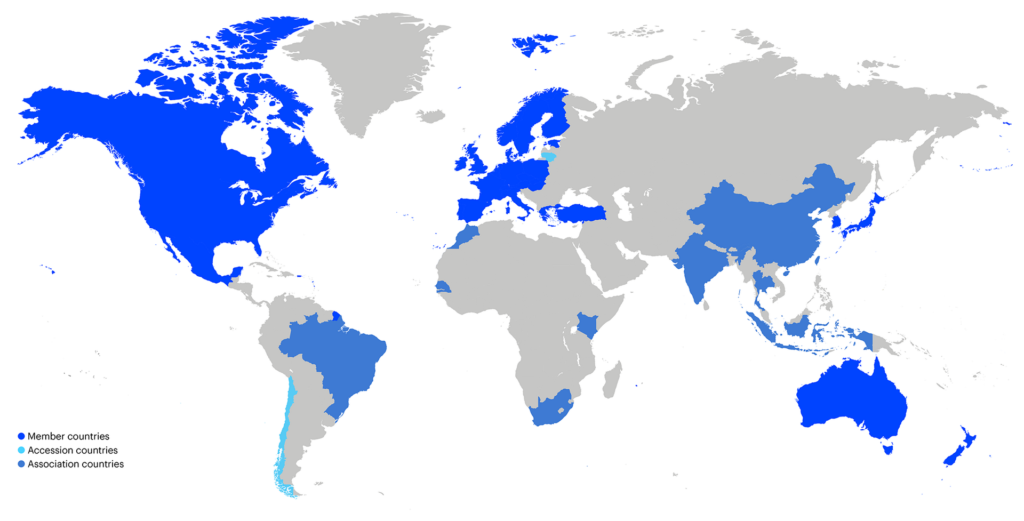
The International Energy Agency (IEA) is an autonomous intergovernmental body based in Paris, founded in November 1974 within the Organization for Economic Co-operation and Development (OECD). It was set up to help its member countries respond to major oil supply disruptions, and its work has since widened to energy data, analysis, policy advice and technology cooperation.
History of the IEA
The IEA was a response to the 1973 and 1974 Arab oil embargo, during which the average price of imported crude oil tripled, according to the Congressional Research Service. The embargo fostered both the agency and coordinated plans among its members for emergency responses to energy crises. The agency was created to implement an international energy program.
The program’s central feature was emergency preparedness. From 1974 member countries took on the obligation to hold oil reserves equal to 90 days of the previous year’s net imports. Net imports means the oil a country brings in after subtracting what it exports. The program does not require net exporters to keep such a stockpile.
In 1976 the IEA launched a long-term cooperation program for formulating and implementing energy policies. Over time its mandate expanded beyond oil security to include tracking and analyzing global energy trends, promoting sound energy policy and fostering international cooperation on energy technology, as the U.S. Department of Energy describes it.
Structure and membership of the IEA
The Governing Board is the agency’s decision-making body. It is made up of the energy ministers of each member country or their representatives, and its outcomes are binding on all members. It holds three or four meetings a year at director general level or equivalent. Every two years ministers meet at an IEA Ministerial Meeting, which sets the agency’s strategic priorities. The board also has final responsibility for administration, including the biennial work program and budget.
Four standing groups prepare the board’s work. The Standing Group on Long-Term Co-operation meets three or four times a year and covers energy policy and efficiency. Each year, technical teams carry out in-depth reviews of the policies of six member countries. An Energy Efficiency Working Party under it meets twice a year.
The Standing Group on Emergency Questions handles preparedness for oil and gas emergencies and reviews each member’s emergency response every five years. The Standing Group on the Oil Market monitors short- and medium-term market developments and works with the emergency group. The Standing Group on Global Energy Dialogue manages work with non-member countries.
Membership is linked to the OECD. A Portuguese government page lists 31 members, including Australia, Canada, France, Germany, Japan, South Korea, Mexico, Turkey, the United Kingdom and the United States, while a U.S. Department of Energy page describes an agency of 29 industrialized countries. The counts differ, and the agency’s own member list is the authoritative current source.
What does the IEA do?
Its original and best-known role is oil emergency response. Members must keep emergency stocks and be prepared for a coordinated response when supplies are disrupted. The IEA program allows members to meet the stock obligation with both public and commercial stocks. In the United States the Strategic Petroleum Reserve is the government stockpile used partly to meet these obligations. Through 2019, American presidents had ordered releases on three occasions in coordination with other IEA members, according to the Congressional Research Service.
The Portuguese government page lists the agency’s main objectives. They are to maintain and improve systems for dealing with oil supply disruptions, to promote rational energy policies in a global context, to operate a permanent information system on the international oil market, to improve the structure of world energy supply and demand through alternative energy sources and greater efficiency, to promote collaboration on energy technologies, and to support the integration of energy and environmental policies.
Those objectives cover both fossil fuel markets and renewable energy development. The Department of Energy describes the agency’s energy analyses, international data collection and collective emergency response capabilities as unique and highly regarded. It also says the agency partners with initiatives such as the G20, the G7 and the Clean Energy Ministerial, and convenes international research cooperation through its Technology Collaboration Programmes.
Funding and governance of the IEA
The Governing Board approves the agency’s biennial work program and budget, which fits its status as a body within the OECD framework. The Governing Board hosted a ministerial-level meeting on 7 and 8 November 2017, according to the Department of Energy.
The United States takes an active part in governance. The Department of Energy, working with the Department of State, oversees U.S. participation, and its Office of International Affairs leads the department’s interaction with the agency. The department’s assistant secretary for international affairs serves as a vice chair of the Governing Board.
The agency also works closely with industry on emergencies. The Standing Group on Emergency Questions has an Industry Advisory Board, and the planning and execution of its work is carried out by the Emergency Planning Division of the IEA Secretariat.
Non-member engagement and changing priorities
As the global energy picture has changed, the IEA has sought to involve countries that are not members. The Department of Energy lists Brazil, China, India, Indonesia, South Africa, Thailand, Singapore and Morocco among key non-members the agency engages with, and describes Mexico and Chile as accession countries at the time of its writing.
The Department of Energy also notes that the agency maintains a collective security coordination mechanism, first and foremost for oil, and that this mechanism evolves in response to the energy market. The agency’s mandate has therefore moved from a narrow oil-security role toward a broader remit that covers energy policy, data and technology.
More in Energy
Key facts
- The IEA was founded in November 1974 within the OECD framework and is based in Paris.1
- The 1973 and 1974 Arab oil embargo, which tripled the average price of imported crude oil, fostered the agency's creation.3
- Members under the program maintain oil reserves equal to 90 days of the previous year's net imports.1
- The Governing Board consists of member energy ministers or their representatives, and its outcomes are binding on members.1
- A Portuguese government page lists 31 members, while a U.S. Department of Energy page describes 29.12
Related concepts
In the news
- TechnologyIEA Energy Innovation Report 2026: 320 New Start-Ups and a Shift to Security
- BusinessWorld Energy Investment 2026: IEA Estimates USD 3.4 Trillion and a Tenfold Rise in Solar Additions
- BusinessCopper in 2025: USGS Reports Record Prices and a Jump in U.S. Import Reliance
- BusinessEnergy Access in 2026: 655 Million People Still Have No Electricity
- BusinessGlobal EV Outlook 2026: Electric Cars Reach 25 Percent of New Sales
Quick checkWhy was the IEA created?Show answer
It was created after the 1973 and 1974 oil embargo to help members respond to major oil supply disruptions through coordinated emergency stocks and policies. [2][3]
Sources
- 1. Portugal, Directorate-General for Energy and Geology (DGEG), The International Energy Agency (IEA), https://www.dgeg.gov.pt/en/transversal-areas/international-affairs/international/the-international-energy-agency-iea/
- 2. U.S. Department of Energy, International Energy Agency (IEA), https://www.energy.gov/ia/international-energy-agency-iea
- 3. Congressional Research Service, The Strategic Petroleum Reserve: Background, Authorities, and Considerations (R46355), https://www.everycrsreport.com/reports/R46355.html
Editorially reviewed by Specialty Digest Editorial TeamLast reviewed November 4, 2026Researched and drafted with AI assistanceReport an issue