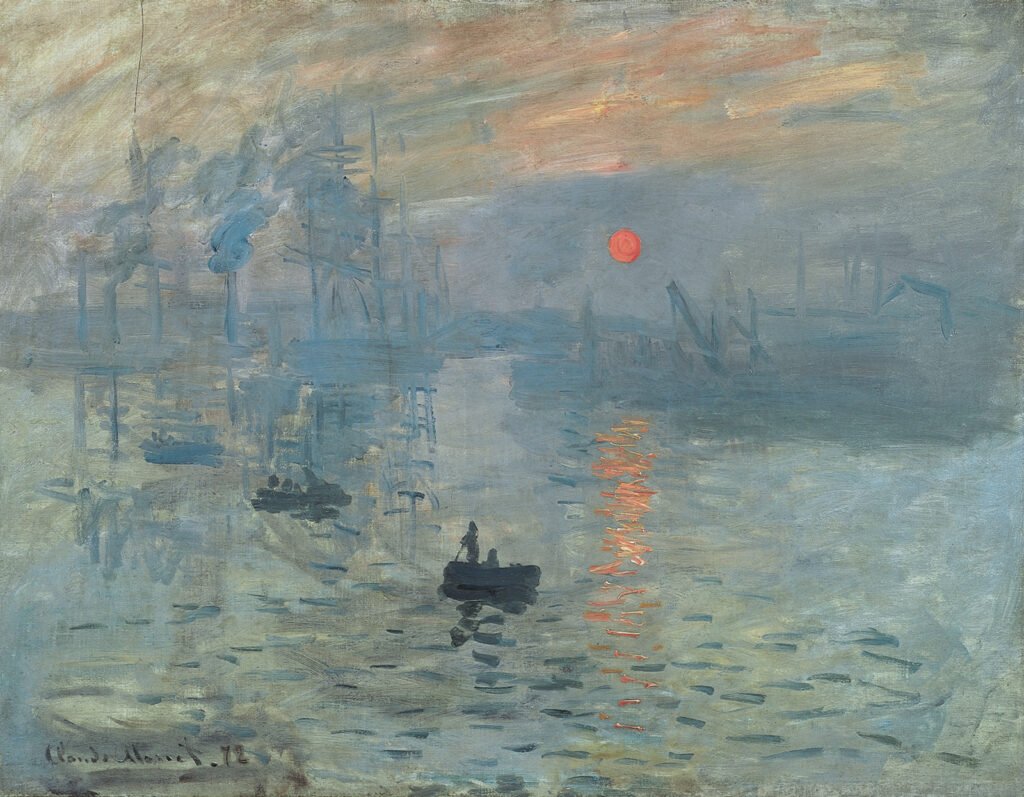
Impression, Sunrise, or Impression, soleil levant in French, is an oil painting by Claude Monet of the harbor of Le Havre in the early morning mist. The Musée Marmottan Monet in Paris, which owns it, dates it to 1872. Shown in 1874, it supplied the name of Impressionism, the art movement that Monet and his friends came to represent.
Background and creation of Impression, Sunrise
Le Havre, a port in Normandy on the northern coast of France, was Monet’s home ground. The Getty Museum notes that he spent much of his youth there and that his father and uncle earned their living from port trade. He took up marine painting in the footsteps of Eugène Boudin, Johan Barthold Jongkind and Gustave Courbet, who all painted the Normandy coast in the 1860s.
Le Havre had already supplied Monet with two major pictures for the Salon of 1868. One, now lost and known only from caricatures and written descriptions, showed a large three-masted ship being towed by a steamboat. The other showed figures walking on the port’s jetty, lashed by wind and waves. The Salon jury refused it, but it won a silver medal when it was shown in Le Havre later that year at a large international maritime exhibition.
After the Franco-Prussian War, Monet spent the months from September 1870 to May 1871 in London, then returned through Holland and settled in Argenteuil, outside Paris. Between 1872 and 1874 he made several trips to Le Havre and produced at least ten paintings of the port, in clear and foggy weather and at night, morning and midday.
The Marmottan museum says a stay at the Hôtel de l’Amirauté in Le Havre around November 1872 provided the subject of his most famous painting. From the window of his room he quickly painted a view to the southeast across the outer harbor in the early morning. The picture was painted in just a few hours. The museum adds that the rowboats of ferrymen in the foreground and the bright orange sun with its reflections were added at the end, when Monet was completing the work.
Description of Impression, Sunrise
The canvas measures 50 by 65 centimeters without its frame. It is signed at lower left, “Claude Monet,” and carries a date, “72,” that was added later.
The composition is held together by two quays. The outline of the Quai au Bois runs along the left, and on the right is the Quai Courbe, where work is under way. An opening at the center marks the tide lock that let transatlantic ships pass toward the Bassin de l’Eure. Cranes, smokestacks and masts are bathed in the vapors of an autumn dawn, so that the whole scene reads as light and atmosphere more than as a list of objects.
The mix of smoke and rigging is typical of a working harbor in the age of steam. The Getty essay describes its own Le Havre view as having a small sailing vessel setting out to sea, a ghostly steamboat whose funnel smoke veils the masts of a clipper ship behind it, and many more sailing ships fading into the fog beyond. The same crowded mixture of old and new transport appears, in far fewer brushstrokes, in the Marmottan canvas.
A related picture shows how Monet worked at this time. The Getty Museum owns a Le Havre view often titled Sunrise (Marine), painted in spring 1873 and looking east toward the rising sun. Its curator describes it as one of the most radically sketch-like paintings of Monet’s early career. The Getty essay dates the more famous canvas to 1873, while the Marmottan gives 1872, so sources differ by a year.
How Impression, Sunrise gave Impressionism its name
Monet decided to include the painting in the first exhibition of a group called the Société Anonyme des Artistes Peintres, Sculpteurs, Graveurs et Lithographes. It was held in 1874 in the former studio of the photographer Nadar. When he was asked for a title for the catalog, Monet felt the hazy view could not decently pass as a portrait of Le Havre, so he called it Impression.
The word was not new. According to the Marmottan, it came from painters’ jargon and had been a watchword since the middle of the century, reflecting a growing interest in capturing the atmosphere of a scene, its impression, instead of describing nature with painstaking care. Louis Leroy, a conservative critic sent by the satirical magazine Le Charivari, linked Monet’s title to the aims of the young painters who worked outdoors. His mocking article, “The Exhibition of the Impressionists,” appeared on 25 April 1874.
A few days later the critic Jules Castagnary, a strong supporter of the artists, used the word Impressionists in a positive sense. From then on it named the group formed by Monet and his friends.
Reception and legacy of Impression, Sunrise
The Marmottan says the painting surprised viewers with the unusual freedom of its handling, which was unlike the polished finish expected of exhibition pictures. The museum calls it the symbol of the story of how the movement received its name. The painting entered the Marmottan’s collection in 1940 as a gift from Eugène and Victorine Donop de Monchy, and it is catalogued there as inventory 4014.
For students of the period, the painting is useful because it joins several threads in one small canvas. It shows a hometown subject, a quick outdoor sketch method, a deliberately loose touch and a title that the critics turned into a label. It also shows how a word that began as ridicule could be adopted by the artists themselves.
More in Visual Arts
Key facts
- Monet painted it from a hotel window in Le Havre around November 1872, in just a few hours.1
- The canvas measures 50 by 65 centimeters and belongs to the Musée Marmottan Monet in Paris.1
- It was shown in 1874 in the first exhibition of the Société Anonyme des Artistes Peintres, Sculpteurs, Graveurs et Lithographes, held in Nadar's former studio.1
- Louis Leroy's review of 25 April 1874 mocked the exhibitors as Impressionists, and Jules Castagnary soon used the word with approval.1
- The Getty Museum dates the painting to 1873, so sources differ by a year.2
Related concepts
Quick checkWhich painting gave Impressionism its name?Show answer
Monet's Impression, Sunrise, shown in 1874, whose title critic Louis Leroy picked up in a mocking review.
Sources
- Musée Marmottan Monet, Notice 4014: Claude Monet, Impression, soleil levant, https://www.marmottan.fr/en/notice/4014/
- J. Paul Getty Museum, Scott C. Allan, Sunrise (Marine), Scholarly Essays, https://museum-essays.getty.edu/paintings/sallan-monet-sunrise/
Editorially reviewed by Specialty Digest Editorial TeamLast reviewed November 5, 2026Researched and drafted with AI assistanceReport an issue