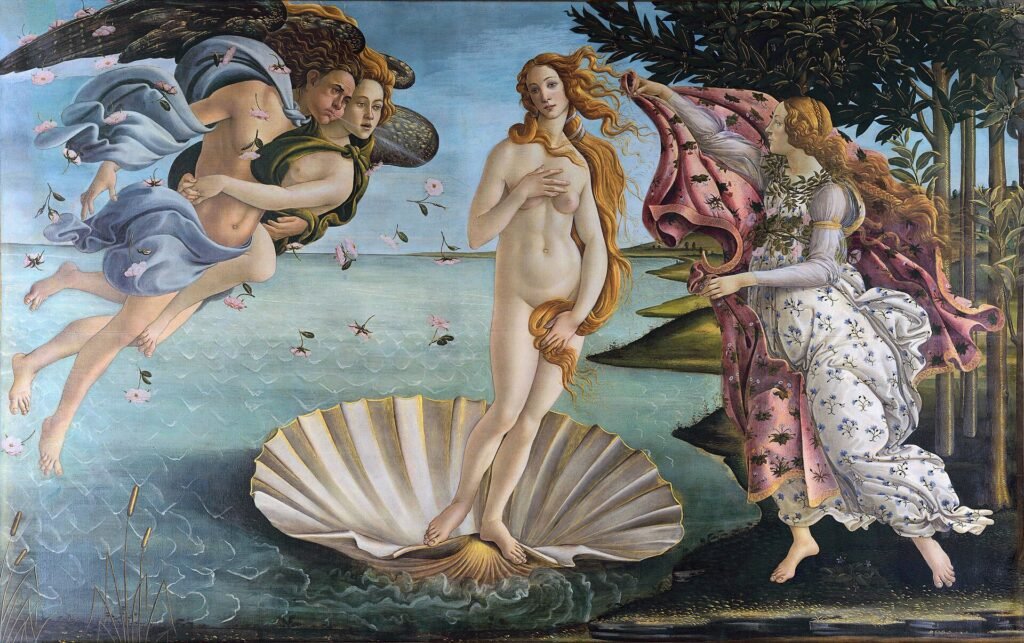
The Birth of Venus is a painting by the Florentine artist Sandro Botticelli, made around 1485 and held by the Uffizi Gallery in Florence. It is painted in tempera on canvas, measures 172.5 by 278.5 centimeters, and shows the goddess Venus arriving on the shore of Cyprus on a giant scallop shell. It is one of the best-known images of the Italian Renaissance.
Background and creation of The Birth of Venus
Botticelli was born Alessandro di Mariano Filipepi. According to the National Gallery in London, he spent almost all of his working life painting for the Medici family and their circle. In 1481 the pope summoned him to Rome to help decorate the walls of the newly completed Sistine Chapel, the only occasion on which he is known to have worked outside Florence.
The date of the painting is not exact. The Uffizi gives about 1485, and the Getty Research Institute’s catalog gives 1482 to 1485. A text from the Uffizi published on Google Arts & Culture proposes about 1484.
Nothing is written about the painting before 1550, when Giorgio Vasari described it in the Medici villa at Castello. For that reason the Uffizi calls a Medici commission highly probable but not proven. Its Google Arts text goes further and names Lorenzo di Pierfrancesco de’ Medici, a cousin of Lorenzo the Magnificent, as the patron.
The subject may have been suggested by the poet Agnolo Poliziano, whose Stanze celebrated the same theme. The Uffizi text traces the story back to Homer and to Ovid’s Metamorphoses.
An older idea held that the Birth of Venus and Botticelli’s Primavera were made for the same occasion. The Uffizi text says this is no longer accepted. The Primavera is painted on a poplar panel, while the Birth of Venus is on canvas, a support that was used for decorative works for noble houses. Sources differ on how unusual canvas was at the time, with one Uffizi text calling it widely used and another calling it fairly unusual.
Description of The Birth of Venus
Despite its title, the picture does not show the moment of birth. The Uffizi explains that the goddess is arriving on land on the island of Cyprus, born of the sea spray and blown ashore by the wind god Zephyr and, perhaps, a second wind figure. The Getty catalog identifies that figure as the nymph Aura, and the Uffizi’s Google Arts text names her as Chloris.
Venus stands on the shell, covering herself with her long hair, which has been touched with gilding so that it catches the light. A young woman waits on the shore to wrap her in a cloak covered with flowers. The Uffizi says she is sometimes identified as one of the Graces and sometimes as the Hora of spring, and roses carried by the wind add to the springtime setting.
The pose belongs to the type known as Venus pudica, or modest Venus. Scholars link it to classical statues, though they name different ones. The Getty catalog says the figure was modeled on the Aphrodite of Knidos by Praxiteles, while the Uffizi’s text compares it to the Medici Venus, a famous ancient statue also in the Uffizi.
Other details have specific sources. The entwined pair of winds is based on an ancient Hellenistic gem owned by Lorenzo the Magnificent. The orange trees on the right are read as an emblem of the Medici, because the Latin name for the fruit at the time, mala medica, sounds like the family name.
The Uffizi’s Google Arts text adds that Botticelli used thin tempera made with diluted egg yolk. This gives the paint an unusual transparency that recalls the look of a fresco. The sea is lit by a soft, delicate light and has a dreamlike quality.
Themes and interpretation of The Birth of Venus
The Uffizi states that the composition celebrates Venus as a symbol of love and beauty. The goddess arrives pure and perfect, as the museum puts it, in the image of a pearl in its shell. In this reading the picture is a celebration of beauty rather than a narrative with a single plot.
The Getty catalog lists a wedding among the painting’s subject terms, which reflects a long-standing interest in whether the work was linked to a marriage. The sources consulted here do not establish that link, and the Uffizi says only that the commission was probably Medici.
The deeper meaning remains open. The Uffizi’s Google Arts text says the real meaning of this dreamlike vision is still under scholarly debate and investigation. For a reader, the safest approach is to treat the painting as a Renaissance reworking of an ancient myth, drawing on poetry, classical sculpture and the visual culture of the Medici court.
Reception and legacy of The Birth of Venus
The Uffizi describes the painting as a universal icon of Western painting. It hangs in the museum’s Botticelli rooms, where it is catalogued under inventory number 1890 n. 878.
The picture also shows how classical mythology returned to Florentine art. Botticelli took a theme from ancient poetry, modeled the central figure on classical sculpture and painted it for a patron within the Medici circle. That combination makes it a standard example of Renaissance interest in antiquity, and it ties the work to the city of Florence, where it was made and where it is still on view.
Botticelli’s reputation rose and fell over the centuries, but the National Gallery notes that at the height of his fame he was among the most esteemed painters in Italy. His mythological paintings remain the works most often associated with his name.
More in Visual Arts
Key facts
- The Birth of Venus is a tempera painting on canvas by Sandro Botticelli, dated about 1485 by the Uffizi and 1482 to 1485 by the Getty.13
- It measures 172.5 by 278.5 centimeters and is held by the Uffizi Gallery in Florence under inventory number 1890 n. 878.13
- The scene shows Venus arriving on the island of Cyprus rather than the moment of her birth.1
- Nothing is written about the painting before 1550, when Vasari described it at the Medici villa of Castello.1
- The winds in the painting are based on an ancient Hellenistic gem owned by Lorenzo the Magnificent.1
Related concepts
Quick checkDoes The Birth of Venus show Venus being born?Show answer
Not exactly. The Uffizi explains that it shows the goddess arriving on land at Cyprus after her birth from the sea, carried by the winds on a giant scallop shell.
Sources
- Uffizi Galleries, Birth of Venus by Sandro Botticelli (artwork page), https://uffizi.it/en/artworks/birth-of-venus
- Uffizi Gallery, text on the Birth of Venus published by Google Arts & Culture, https://artsandculture.google.com/asset/the-birth-of-venus-sandro-botticelli/MQEeq50LABEBVg?hl=en
- Getty Research Institute, Cultural Objects Name Authority record for Birth of Venus, https://www.getty.edu/cona/CONAFullSubject.aspx?subid=700009225
- National Gallery, London, Sandro Botticelli (about 1445 - 1510) artist biography, https://www.nationalgallery.org.uk/artists/sandro-botticelli
Editorially reviewed by Specialty Digest Editorial TeamLast reviewed November 5, 2026Researched and drafted with AI assistanceReport an issue