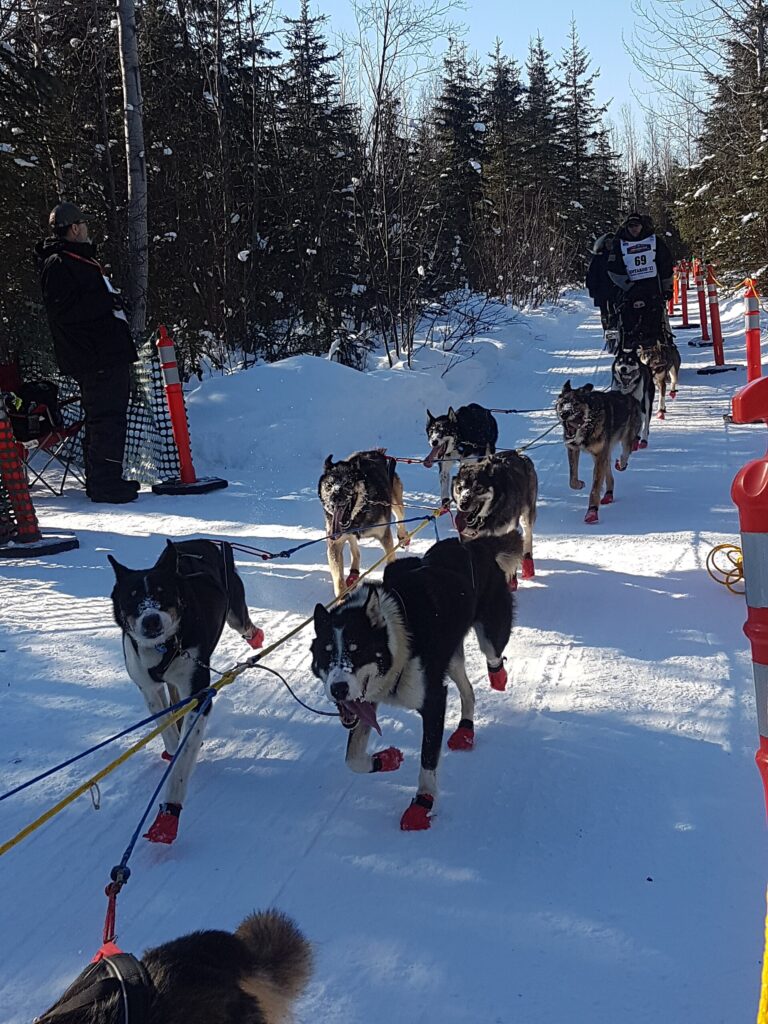
Sled dog mushing is the sport and practice of driving teams of dogs that pull a sled over snow. It was a principal means of transport across the Arctic and Alaska for centuries and in 1972 was named the official sport of the state. Alaska hosts the sport’s best-known events, including the Iditarod Trail Sled Dog Race, the Fur Rendezvous World Championship and the North American Championships, and its racing dogs are mostly Alaskan huskies [1][2][3].
| Official state sport | Since 1972 |
|---|---|
| Typical racing dog | Alaskan husky, 45–55 lb |
| Sprint races | Up to 30 miles |
| Mid-distance races | 50–200 miles |
| Long-distance races | 200 to 1,000+ miles |
| Major events | Iditarod, Fur Rendezvous, North American Championships |
Origins
Alaska Natives used dogs for hunting, protection and travel for hundreds of years before settlers arrived. When the gold rushes of the late 1800s drew newcomers to Alaska and the Yukon, dog teams scouted routes, carried mail and freight, and moved people between remote mining camps, which brought global attention to sled dogs [1][2].
Dogs and Breeds
Most racing dogs are Alaskan huskies, a mixed breed that is not officially recognized and is bred for performance rather than appearance. They typically weigh 45 to 55 pounds and are known for durable feet, weather-resistant coats, eagerness to pull and trainability [2]. This differs from the Siberian huskies and malamutes often shown in film [1]. Purebreds such as Siberian huskies, Samoyeds and Alaskan malamutes are also used [2].
Equipment
A racing sled weighs about 20 to 30 pounds and is usually made of ash lashed with leather or nylon, with a toboggan or basket body on two runners. The main line, the gangline, runs back to the sled, with a tugline of 3 to 4.5 feet connecting each harness to it and a neckline of 10 to 14 inches keeping each dog in position. Modern harnesses use 1-inch nylon webbing, and booties protect paws. The musher stops the team with a foot brake and a snow hook [2]. Early teams used a fan hitch, with each dog tethered individually, and the tandem hitch, with dogs running in pairs, later became standard [2].
Types of Racing
Races fall into three broad groups: sprint races up to 30 miles, mid-distance races of 50 to 200 miles and long-distance races of 200 to more than 1,000 miles. Teams usually have 4 to 10 dogs, and a team of six to eight can exceed 20 mph. Teams generally start at intervals and race against the clock, and dogs cannot be added mid-leg [2].
Fur Rendezvous World Championship
The Fur Rendezvous festival in Anchorage has been held every February since 1935. Its sled dog race began in 1946, when Earl Norris of Willow organized a one-day, 17.5-mile race with two other drivers, and it grew into a multi-day sprint through the city’s streets and trails. George Attla, the “Huslia Hustler,” won a record ten titles between 1956 and 1982, and the veterinarian Roland Lombard won eight, a rivalry still remembered in Alaska sport. Popularity fell in the late 1980s as the Iditarod rose, and between 2001 and 2016 five races were canceled because of poor snow [3].
North American Championships
Britannica lists the North American Championships, held in March in Fairbanks, as one of the sport’s major events, alongside the Fur Rendezvous in February and the Iditarod in March [2].
The Iditarod
The Iditarod Trail Sled Dog Race, first run in full in 1973, is the longest and most famous race and covers roughly 1,000 miles from Willow to Nome after a ceremonial start in Anchorage. Winning times have dropped from the slowest winning time of 20 days, 15 hours, 2 minutes and 7 seconds in 1974 to about eight days in recent years [1]. See the entry on the Iditarod for details.
Mushing Today
Aircraft and snowmachines have replaced dog teams for most work, so sled dogs are now kept mostly for recreation and racing [2]. Dozens of races of varying distances are held across Alaska during winter [1].
Cultural Significance
Mushing links Alaska’s Native travel traditions, the gold rush era and modern sport. Dog mushing was named “official sport of the 49th state” in 1972, a year before the first full Iditarod [1], and the 1925 serum run to Nome remains the best-known story of sled dogs in Alaska [1].
FAQs
What is the official sport of Alaska? Dog mushing, named the official sport in 1972.
What dogs are used in sled dog racing? Mostly Alaskan huskies, a mixed breed bred for speed and endurance.
What are the main types of sled dog races? Sprint (up to 30 miles), mid-distance (50–200 miles) and long-distance (200 to 1,000+ miles).
What is the Fur Rondy race? A sprint championship in Anchorage held during the February Fur Rendezvous festival, begun in 1946.
Who won the most Fur Rendezvous titles? George Attla, with ten titles between 1956 and 1982.
Sources
- Culture Trip: A Brief History of Alaska’s Official Sport: Dog Mushing
- Encyclopaedia Britannica: Dogsled racing
- Alaska Sports Hall of Fame: Fur Rendezvous Open World Championship Sled Dog Races
More in Sport & Exercise Studies
Key facts
Quick checkWhat year was dog mushing named Alaska’s official sport?Show answer
1972
Sources
- Culture Trip. A Brief History of Alaska’s Official Sport: Dog Mushing. 2026 (accessed 2026-11-12)
- Encyclopaedia Britannica. Dogsled racing. 2026 (accessed 2026-11-12)
- Alaska Sports Hall of Fame. Fur Rendezvous Open World Championship Sled Dog Races. 2026 (accessed 2026-11-12)
Editorially reviewed by Specialty Digest Editorial TeamLast reviewed November 12, 2026Researched and drafted with AI assistanceReport an issue