The willow ptarmigan (Lagopus lagopus) is a medium-to-large grouse of northern regions and the state bird of Alaska, adopted in 1955. Adults are 35 to 44 centimeters long and weigh 430 to 810 grams, and the bird turns white in winter to blend with snow. The IUCN classifies it as Least Concern, with a total population estimated at about 40 million [1][2].
| Scientific name | Lagopus lagopus |
|---|---|
| State bird since | 1955 |
| Length | 35–44 cm (14–17 in) |
| Weight | 430–810 g (15–29 oz) |
| Wingspan | 60–65 cm |
| Clutch | 6–10 eggs |
| IUCN status | Least Concern; about 40 million |
Description
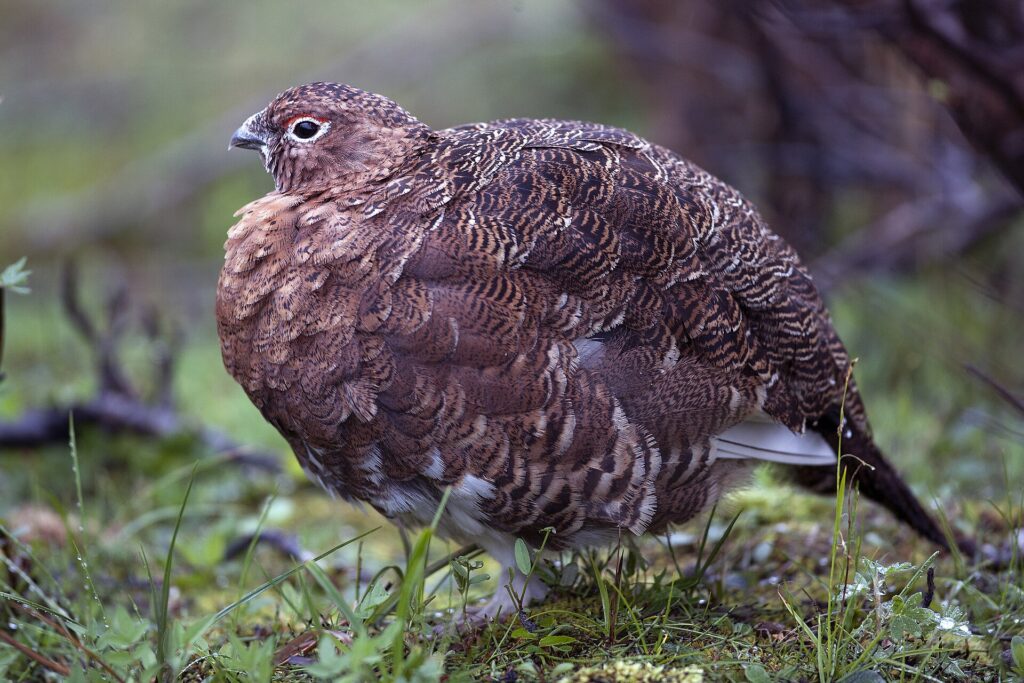
Males and females are similar in size, with adults 35 to 44 centimeters long, a wingspan of 60 to 65 centimeters and a weight of 430 to 810 grams. Summer plumage is mottled brown with a black tail and white wings and belly. In winter the body and two central tail feathers turn white, though the outer tail feathers stay black and the wings stay white all year [1].
Habitat
The willow ptarmigan lives in subarctic and subalpine areas across the Holarctic, including birch and pine forests, willow thickets, heather moors, tundra and mountain slopes. In winter females and young often move to lower, more sheltered valleys, while adult males usually stay in subalpine areas [1].
Diet
The bird is mostly herbivorous. Adults eat leaves, flowers, berries and seeds in summer and mainly willow buds, twigs and catkins in winter, while chicks eat insects at first. In Alaska, one study found that about 90 percent of reachable willow buds had been browsed [1].
Breeding
Males defend territories in spring, and females lay six to ten eggs in a ground scrape. Most pairs are monogamous and both parents care for the chicks. Fewer than 35 percent of chicks survive to 11 months [1].
Population
The species is classified as Least Concern by the IUCN. The total population is estimated at about 40 million, though numbers fluctuate widely and may be declining slightly [1].
State Bird
Alaska adopted the willow ptarmigan as its state bird in 1955 [2]. See the entry on the wildlife of Alaska and the list of Alaska state symbols.
FAQs
What is the Alaska state bird? The willow ptarmigan, adopted in 1955.
Why does the ptarmigan turn white? In winter its body feathers turn white, providing camouflage in snow.
What does the willow ptarmigan eat? Leaves, berries and seeds in summer, and mainly willow buds and twigs in winter.
How many eggs does it lay? Six to ten in a ground scrape.
Is the willow ptarmigan endangered? No. It is Least Concern, with about 40 million birds worldwide.
Sources
More in Biology
Key facts
Quick checkWhat is the state bird of Alaska?Show answer
Willow ptarmigan
Sources
- Wikipedia. Willow ptarmigan. 2026 (accessed 2026-11-12)
- Wikipedia. List of Alaska state symbols. 2026 (accessed 2026-11-12)
Editorially reviewed by Specialty Digest Editorial TeamLast reviewed November 12, 2026Researched and drafted with AI assistanceReport an issue