Alaska Native arts and crafts are the traditional and contemporary works of the Indigenous peoples of Alaska, including basketry, ivory and bone carving, masks, beadwork, Chilkat weaving and carved totem poles. Techniques and materials vary by region and culture, from rye-grass baskets in the Aleutians to cedar-bark and mountain-goat-wool robes in Southeast Alaska, and many pieces were made for daily use or ceremony before becoming art objects [1][2].
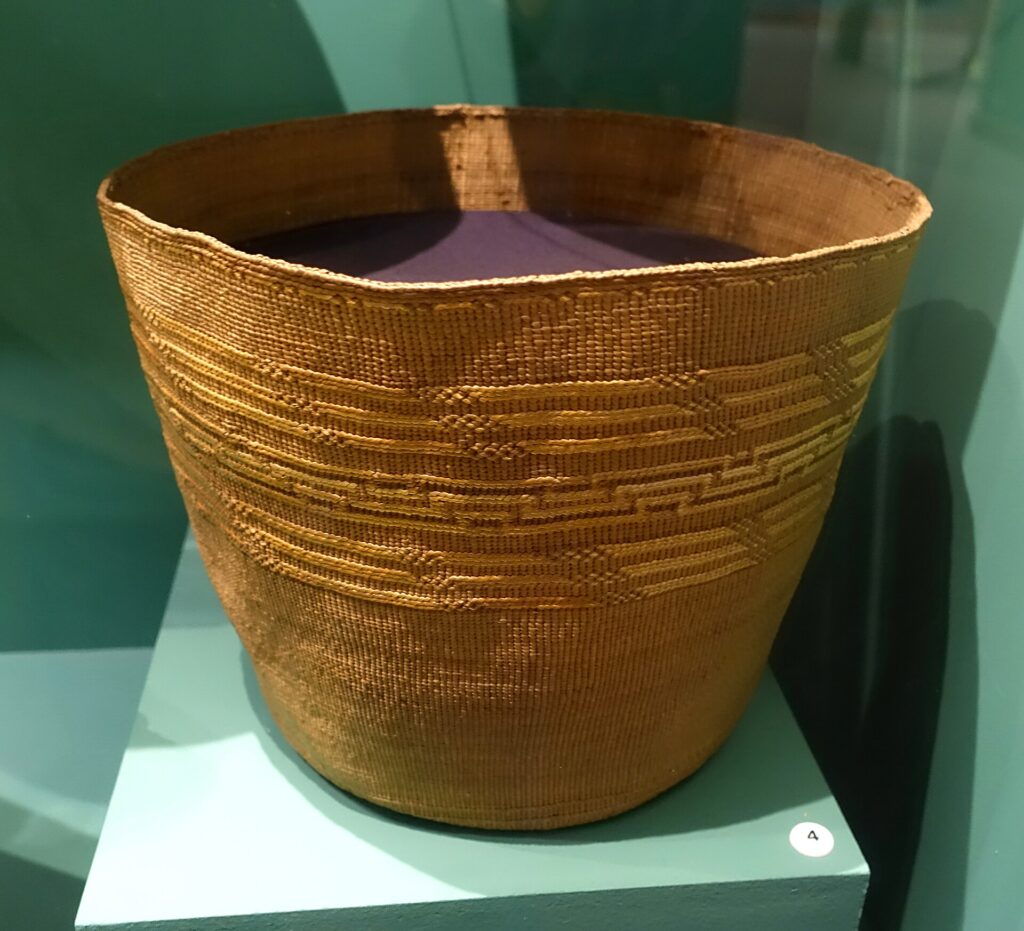
| Basketry | Rye grass, birch bark, spruce or willow root, baleen |
|---|---|
| Carving | Ivory, whale bone, baleen, soapstone, wood |
| Beadwork | Athabascan, Unangax̂ and Sugpiaq traditions |
| Weaving | Chilkat robes and blankets (Tlingit) |
| Ceremonial art | Carved wood and bone masks, totem poles |
| Authenticity mark | Silver Hand emblem |
Overview
Alaska’s Native peoples, Unangax̂, Sugpiaq, Yup’ik, Cup’ik, Iñupiaq, Athabascan, Tlingit, Haida and Tsimshian, each developed distinct visual traditions shaped by local materials and climate. Items made for hunting, clothing, storage and ceremony became the basis of the art forms that continue today [1].
Basketry
Unangax̂, Sugpiaq and Yup’ik weavers make finely woven baskets from rye grass, which grows abundantly in the Aleutian Islands and Southwest Alaska. Athabascan and Yup’ik weavers make larger baskets from birch bark or spruce or willow root, and modern Iñupiaq baleen baskets follow traditional willow-root designs [1].
Ivory and Bone Carving
Iñupiaq carvers make small figures of animals or birds from ivory, whale bone, baleen and soapstone. Yup’ik and Cup’ik carvers make dolls and carved miniatures of daily life [1].
Masks
All Alaska Native cultures use carved wood and bone masks in ceremonies. They depict animals, people, birds and fish and are often decorated with feathers and shells [1].
Beadwork
Athabascan artists in Interior and Southcentral Alaska make beaded clothing, moccasins, belts and jewelry. They traditionally used seeds, carved wooden beads, shells and porcupine quills, and adopted glass beads after European contact. Unangax̂ and Sugpiaq artists make beaded headdresses called nacaq and hunting hats [1].
Chilkat Weaving and Totem Carving
Tlingit weavers use a technique that produces precise circles to make blankets and robes from cedar bark and mountain goat wool, worn as regalia at potlatches and ceremonies [1]. In Southeast Alaska, Tlingit, Haida and Tsimshian carvers make monumental cedar totem poles that record clan histories, a tradition that revived from the late 1930s after near disappearance around 1901 [2]. See the entry on totem poles of Southeast Alaska.
Identifying Authentic Work
The Silver Hand emblem indicates that an Alaska Native craftsperson or artist made the piece, while a separate Made in Alaska symbol indicates only that it was crafted in Alaska [1]. Buyers who want Native-made work can look for the Silver Hand mark.
Where to Learn More
The Alaska Native Heritage Center in Anchorage presents rotating exhibits and artist work, and the entry on the culture of Alaska places these arts in wider context.
FAQs
What materials do Alaska Native artists use? Rye grass, birch bark, spruce and willow root, ivory, whale bone, baleen, soapstone, cedar bark, mountain goat wool and wood.
What is Chilkat weaving? A Tlingit technique that uses cedar bark and mountain goat wool to make ceremonial robes and blankets.
What does the Silver Hand label mean? It indicates that an Alaska Native artist made the piece.
Who makes ivory carvings? Iñupiaq carvers are known for small ivory, bone and baleen figures.
Where can I see this art? At the Alaska Native Heritage Center in Anchorage and at totem sites in Ketchikan and Sitka.
Sources
More in Arts & Design
Key facts
Quick checkWhich emblem indicates a piece was made by an Alaska Native artist?Show answer
The Silver Hand
Sources
- Alaska Travel. Alaska Native Arts and Traditions. 2026 (accessed 2026-11-12)
- Wikipedia. Totem pole. 2026 (accessed 2026-11-12)
Editorially reviewed by Specialty Digest Editorial TeamLast reviewed November 12, 2026Researched and drafted with AI assistanceReport an issue