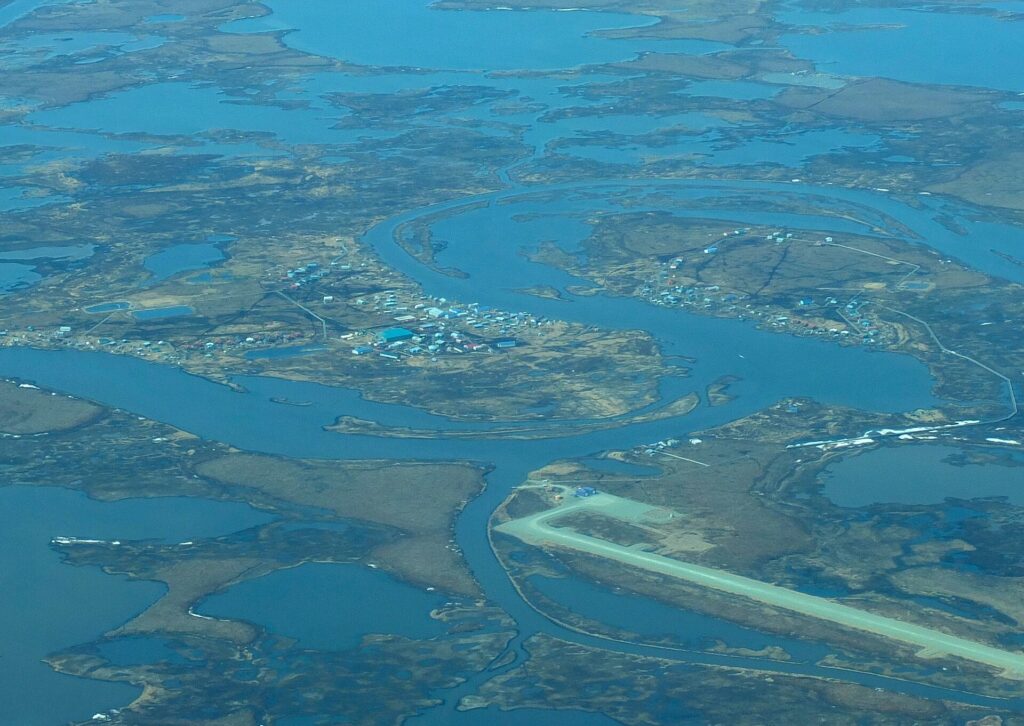
The Yup’ik (plural Yupiit) and the closely related Cup’ik are Alaska Native peoples of the Yukon-Kuskokwim Delta, the Kuskokwim River and the Bristol Bay coast of southwestern Alaska. Their name means roughly “real people.” Central Alaskan Yup’ik is the most widely spoken Native language in Alaska, and the Yupik peoples are known for their fish camps, their communal men’s houses and their dances [1][2].
| Name | Yup’ik means “real people” (yuk, person, plus -pik, real) |
|---|---|
| Homeland | Yukon-Kuskokwim Delta, Kuskokwim River and northern Bristol Bay |
| Population (2010 census) | About 30,900 Yup’ik in Alaska, alone or in combination |
| Language | Central Alaskan Yup’ik and Cup’ik, in the Eskaleut family |
| Traditional centers | Qasgiq (men’s house) and ena (women’s house) |
| Main foods | Pacific salmon and seal |
| Religion today | Mainly Orthodox and Moravian Christian |
Names and Related Peoples
The word Yup’ik comes from yuk, meaning “person,” and -pik, meaning “real” or “genuine,” and the apostrophe marks the lengthening of the p sound. The Yupik peoples as a whole include the Yup’ik of southwestern Alaska, the Cup’ik of the Hooper Bay, Chevak and Nunivak dialects, the Alutiiq or Sugpiaq of the Alaska Peninsula, Kodiak and southcentral Alaska, and the Siberian Yupik of St. Lawrence Island in Alaska and the Russian Far East, including the Naukan and Chaplino groups [1].
Britannica notes that the Yupik are also called Yupiit, Western Eskimo or Asiatic Eskimo, and that they are culturally related to the Chukchi and to the Inuit of Canada and Greenland. Russian explorers in the 1800s sometimes mistakenly called Yupik people Aleut or Alutiiq [1][2].
Homeland and Population
The Yup’ik homeland lies on the Yukon-Kuskokwim Delta, along the Kuskokwim River, along the northern Bristol Bay coast to Nushagak Bay, and on the northern Alaska Peninsula at the Naknek River and Egegik Bay [1]. The 2002 census recorded more than 24,000 Yupik in the United States, over 22,000 of them in Alaska and mostly in about 70 communities in western and southwestern Alaska [1]. In the 2010 census, 30,868 people identified as Yup’ik alone or in combination, the largest Alaska Native group, and the Bethel and Dillingham census areas were more than 90 percent Alaska Native [3].
Language
Five Yupik languages are still widely spoken, all in the Eskaleut family and related to Inuktitut. Central Alaskan Yup’ik is the most spoken Native language in Alaska by both population and number of speakers, and it is the second most spoken Indigenous language in the United States after Navajo [1].
Yupik peoples adopted a writing system developed by Moravian missionaries in Greenland in the 1760s, and late nineteenth-century Moravian missionaries in Alaska translated scripture into Yup’ik.
History and Origins
Ancestors of the Siberian Indigenous peoples and the Aleut are thought to have reached the Bering Sea area about 10,000 years ago, when the Bering land bridge was exposed during glacial periods. By about 3,000 years ago the ancestors of the Yupiit had settled along the coast of western Alaska, and around 1400 AD they moved up the Yukon and Kuskokwim rivers, reaching places such as Paimiut on the Yukon and Crow Village on the Kuskokwim. The Siberian Yupik may represent a return migration from Alaska [1].
Seasonal Life and Subsistence
Families traditionally spent spring and summer at fish camps, then gathered at village sites for the winter. Pacific salmon and seal remain key subsistence resources for many families. Britannica adds that the Yupik hunted seals and walrus, and whales until the latter half of the nineteenth century, using harpoons from shore or boats, and that hunting fur-bearing animals, fishing and gathering plants were secondary activities. Travel used one-person kayaks, open baidarkas and whaleboats on the water, and dog teams and sleds on land [1][2].
Qasgiq and Ena
The qasgiq, or men’s communal house, was the ceremonial and community center, used mainly in winter. Boys learned hunting, survival, toolmaking and kayak building there, and ceremonies involving a shaman were held in the qasgiq. Next door stood the ena, the women’s house, sometimes connected to the qasgiq by a tunnel, where women taught girls to sew, tan hides, cook and weave. Boys lived with their mothers until about age five and then joined the men, and for three to six weeks the boys and girls exchanged their training roles [1].
Customs and Arts
The Yup’ik are unique among Native peoples of the Americas in the practice of naming a child after the most recently deceased member of the community. Yup’ik dance is performed with dancers mostly staying in place, moving the upper body and arms, often with hand fans. The kuspuk, called qaspeq in Yup’ik, is a traditional garment worn by all genders in both casual and formal settings, and the naniq, a seal-oil lamp, was an important household item [1].
Religion
Traditional religion included shamanism and belief in benign and harmful spirits, with harmful spirits blamed for misfortune and illness. Certain animals and birds were considered sacred, and rituals aimed at future hunting success and gratitude for past hunts often included dramatic performances and dances, with women playing an important part [2]. Today most Yup’ik people practice Eastern Orthodox or Moravian Christianity [1]. Olga Michael (1916 to 1979), the wife of an Orthodox priest, was canonized as a saint by the Orthodox Church in America in 2023 [1].
Notable Yup’ik People
Notable Yup’ik include Rita Pitka Blumenstein (1936 to 2021), the first certified traditional doctor in Alaska, Olympic snowboarder Callan Chythlook-Sifsof (born 1989), businessman and politician Moses Paukan (1933 to 2017), Alaska Native leader Crow Village Sam (1893 to 1974), and researcher Elizaveta Dobrieva, an expert on the Naukan [1].
FAQs
What does Yup’ik mean? It means roughly “real people,” from yuk (person) and -pik (real or genuine).
Where do the Yup’ik live? Mainly on the Yukon-Kuskokwim Delta, along the Kuskokwim River and on the northern Bristol Bay coast of southwestern Alaska.
What is the most spoken Native language in Alaska? Central Alaskan Yup’ik, which is also the second most spoken Indigenous language in the United States after Navajo.
What is a qasgiq? The traditional communal men’s house, the ceremonial and community center of a Yup’ik village.
What is a kuspuk? A traditional Yup’ik garment, called qaspeq in the language, worn by all genders.
Sources
More in Anthropology
Key facts
Quick checkWhat does the name Yup’ik mean?Show answer
Real people
Sources
- Wikipedia. Yupik peoples. 2026 (accessed 2026-11-11)
- Encyclopaedia Britannica. Yupik. 2026 (accessed 2026-11-11)
- Wikipedia. Alaska Natives. 2026 (accessed 2026-11-11)
Editorially reviewed by Specialty Digest Editorial TeamLast reviewed November 11, 2026Researched and drafted with AI assistanceReport an issue