Cold War Alaska describes the period from 1946 to 1991 when the territory and then state became the front line of United States air defence against the Soviet Union. Military and civilian populations grew sharply, and radar, communications and missile networks were built across the state.[1]
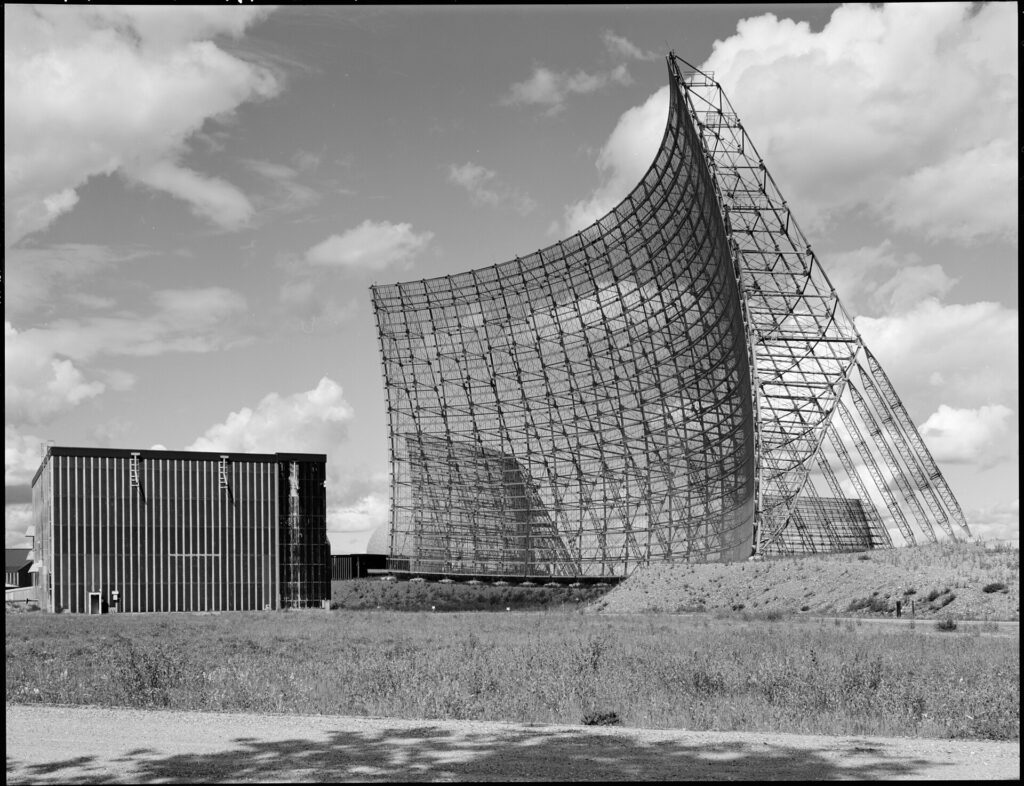
| Period | 1946–1991 |
|---|---|
| Military population | 25,000 (1947) to 48,000 (1957) |
| Civilian population | 83,000 to 180,000 (1947–1957) |
| White Alice sites | 33, accepted March 1958 |
| DEW Line | Seven Alaska sites, operational 1957 |
| Nike sites | Three near Anchorage, four near Fairbanks (1959) |
A shift in the threat
In the late 1940s the perceived threat moved from Japan to Soviet bombers, and Alaska became an air theatre led by Air Force generals. Between 1947 and 1957 the military spent about $1.2 billion on construction in Alaska. The military population grew from 25,000 to 48,000 and the civilian population from 83,000 to 180,000.[1]
Bases
The main bases were Elmendorf Air Force Base, Fort Richardson, Ladd Air Force Base (later Fort Wainwright), Eielson Air Force Base and the Navy base on Kodiak, with forward bases at King Salmon, Galena and Shemya. Eielson was lengthened for heavy bombers, which rotated to Elmendorf from 1960 to 1965. Adak passed to the Navy in 1950, grew to about 6,000 personnel by the late 1980s and closed in 1997.[1]
Early warning and air defence
The Aircraft Control and Warning system began in March 1950, with its first ten stations online in September 1951 and 18 by mid-1958. The DEW Line contract was awarded in July 1955, and its Alaska segment of seven sites became operational in 1957. The White Alice communications system, accepted in March 1958, had 33 sites, cost about $150 million and employed roughly 3,500 people. Fighter interceptors stood 15-minute alert at Elmendorf, Eielson, Galena and King Salmon.[1]
Nike missiles
Nike Hercules sites were approved in October 1954, and three sites near Anchorage and four near Fairbanks were operational in early 1959. The Fairbanks batteries closed in 1971 and the Anchorage-area sites in 1979.[1]
Changes and the end of the era
After Sputnik in October 1957, missiles replaced bombers as the main threat and interceptor squadrons fell from six to one. Soviet bomber intercepts began in 1961, peaked at 33 in 1987 and fell to 15 in 1991. The Soviet Union imposed the Ice Curtain in January 1947, ending free movement between Alaska and Siberia, and it was lifted in June 1988. The source treats 19 August 1991, when two Soviet fighters and a transport turned back at Elmendorf, as the end of the Cold War in Alaska.[1]
FAQs
Why was Alaska important in the Cold War? It lay closest to the Soviet Union for air defence and early warning.
What was White Alice? A 33-site communications system accepted in 1958.
When was the Ice Curtain lifted? June 1988.
Sources
Key facts
- Ice Curtain 1947–1988
- DEW Line 1957
Quick checkHow many White Alice sites were there?Show answer
33
Sources
- Alaska Historical Society. The Cold War Years, 1946–1991. 2026 (accessed 2026-11-13)
Editorially reviewed by Specialty Digest Editorial TeamLast reviewed November 13, 2026Researched and drafted with AI assistanceReport an issue