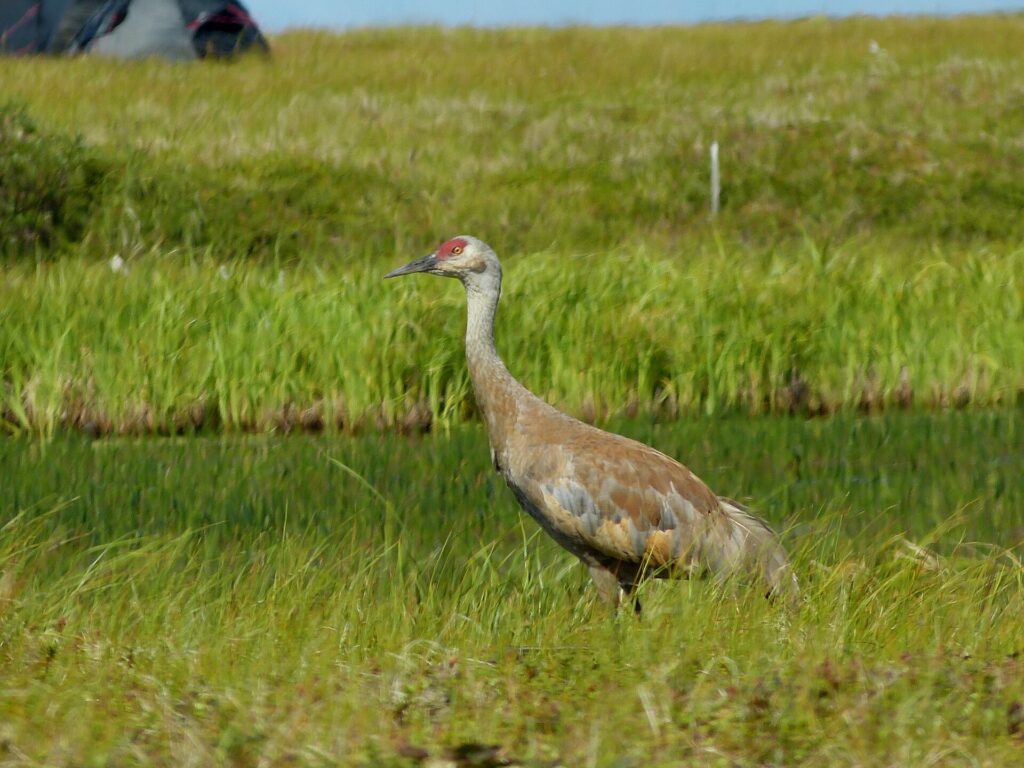
The sandhill crane (Antigone canadensis) is Alaska’s largest game bird, standing nearly three feet tall with a wingspan of six feet or more. Two groups breed in Alaska, and huge migrations pass through the Tanana Valley, the Copper River Delta and the Yukon Flats.[1]
| Height | Nearly 3 ft |
|---|---|
| Wingspan | 6 ft or more |
| Clutch | Usually two eggs |
| Incubation | About 30 days |
| Fledging | 2–2½ months |
| Tanana Valley passage | About 200,000 cranes |
Description
The crane has long black legs, a long neck and a black chisel-shaped bill. Mature adults are ash-gray with a bright red forehead, while immatures are mottled copper or rust and lack the red forehead, and adult plumage arrives at about 2½ years. Alaska’s lesser sandhill cranes are considered a separate subspecies from the greater sandhill cranes of southern Canada and the lower 48 states.[1]
Range
The more numerous northern group breeds on the Yukon-Kuskokwim Delta, in the Interior and along western and northern coasts, and winters in Texas, the Southwest and Mexico. The smaller Pacific Flyway group breeds in the Bristol Bay lowlands, Alaska Peninsula and Cook Inlet-Susitna Valley, with a few nests in Southeast Alaska, and winters in California’s Central Valley.[1]
Habitat and diet
Cranes nest on wet tundra, marshes and muskegs, in shallow soil depressions lined with dry grass and feathers, and use farm fields, wetlands and river sandbars in winter and migration. They are omnivorous ground feeders that eat frogs, rodents, insects, bulbs, seeds and berries, and rely largely on waste grain and small animals from farm fields in winter and migration.[1]
Nesting and migration
Cranes arrive in early to mid-May and usually lay two spotted gray-to-brown eggs, which both sexes incubate for about 30 days, and young fledge in two to 2½ months. About 20,000 cranes use the Copper River Delta, about 8,000 pass the Yukon Flats near Eagle, and about 200,000 mid-continent cranes pass through the Tanana Valley between Delta Junction and George Lake in early May and mid-September, up to 50,000 a day at peak. Cranes can fly up to 350 miles a day.[1]
FAQs
How big is a sandhill crane? Nearly 3 feet tall with a wingspan of 6 feet or more.
When do they arrive in Alaska? Early to mid-May.
Where do large numbers migrate? Through the Tanana Valley, Copper River Delta and Yukon Flats.
Sources
Key facts
- About 200,000 in Tanana Valley passage
- Two eggs usual
Quick checkWhat is Alaska largest game bird?Show answer
The sandhill crane
Sources
- Alaska Department of Fish and Game. Sandhill Crane, Wildlife Notebook Series. 2026 (accessed 2026-11-14)
Editorially reviewed by Specialty Digest Editorial TeamLast reviewed November 14, 2026Researched and drafted with AI assistanceReport an issue