The king eider (Somateria spectabilis) is a circumpolar sea duck that breeds on Arctic tundra and winters at sea. About 10,000 breed in Alaska, concentrated along the eastern half of the Beaufort Sea coast, while nearly half a million migrate through the Beaufort Sea.[1]
| Scientific name | Somateria spectabilis |
|---|---|
| Average length | 23 in |
| Alaska breeders | About 10,000 |
| Eggs | 2–6 |
| Incubation | 23–24 days |
| Recorded feeding depth | 180 ft |
Description
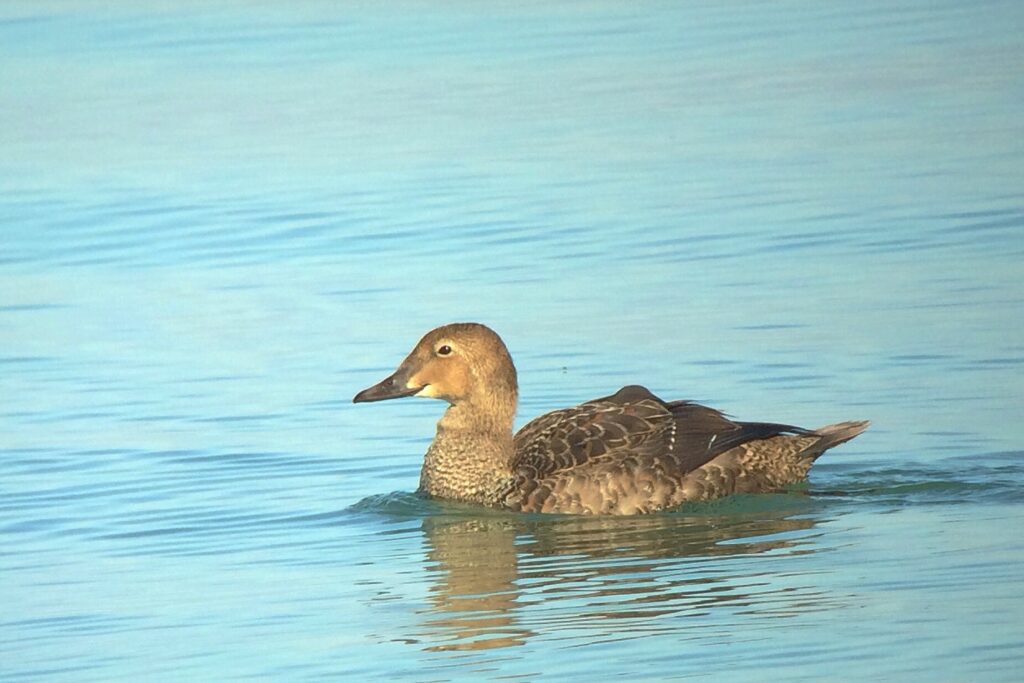
The king eider averages 23 inches in length. Males have a red bill with a large orange frontal lobe outlined in black, a pale blue-gray head top, sea-green cheeks, a white chest and a black back, and females show less feathering along the sides of the bill. By late July males lose breeding plumage and the frontal shield shrinks and dulls.[1]
Range and migration
The species is circumpolar. Many more breed in the Canadian Arctic islands than in Alaska. Birds may reach Point Barrow as early as April 3, though most arrive in May. From late June through July males migrate west to molting grounds in the Bering and Chukchi seas, which are unknown, and females and young follow them to the wintering grounds.[1]
Nesting
Nests are dispersed along the coast, mostly on small islets in freshwater tundra ponds. Clutches contain two to six dark olive-buff eggs, incubated for 23 to 24 days.[1]
Diet and diving
The diet is mainly marine animals, though in the short breeding season freshwater insects and crustaceans are the main prey. With long-tailed ducks, king eiders are unmatched for diving ability, and one record shows a king eider feeding in 180 feet of water in the Bering Sea.[1]
Wintering
King eiders winter as far north as open sea allows, and most winter around Kodiak, along the Alaska Peninsula and in the Aleutian Chain. The source gives no population trend or conservation status. The species appeared on the 1997 Alaska Waterfowl Conservation Stamp.[1]
FAQs
How many king eiders breed in Alaska? About 10,000, per the source.
Where do they winter? Around Kodiak, the Alaska Peninsula and the Aleutians.
How deep can they dive? One was recorded feeding in 180 feet of water.
Sources
Key facts
- About 10,000 breed in Alaska
- Dives to at least 180 ft
Quick checkWhere do most king eiders winter in Alaska?Show answer
Around Kodiak, the Alaska Peninsula and the Aleutians
Sources
- Alaska Department of Fish and Game. Eiders, Wildlife Notebook Series. 2026 (accessed 2026-11-14)
Editorially reviewed by Specialty Digest Editorial TeamLast reviewed November 14, 2026Researched and drafted with AI assistanceReport an issue