The Porcupine caribou herd is a migratory herd of barren-ground caribou (Rangifer tarandus) whose range covers the Arctic slope, the Brooks Range and northeastern Alaska and extends into Canada’s Yukon and Northwest Territories. It is managed under an international agreement between Alaska and Canada.[1]
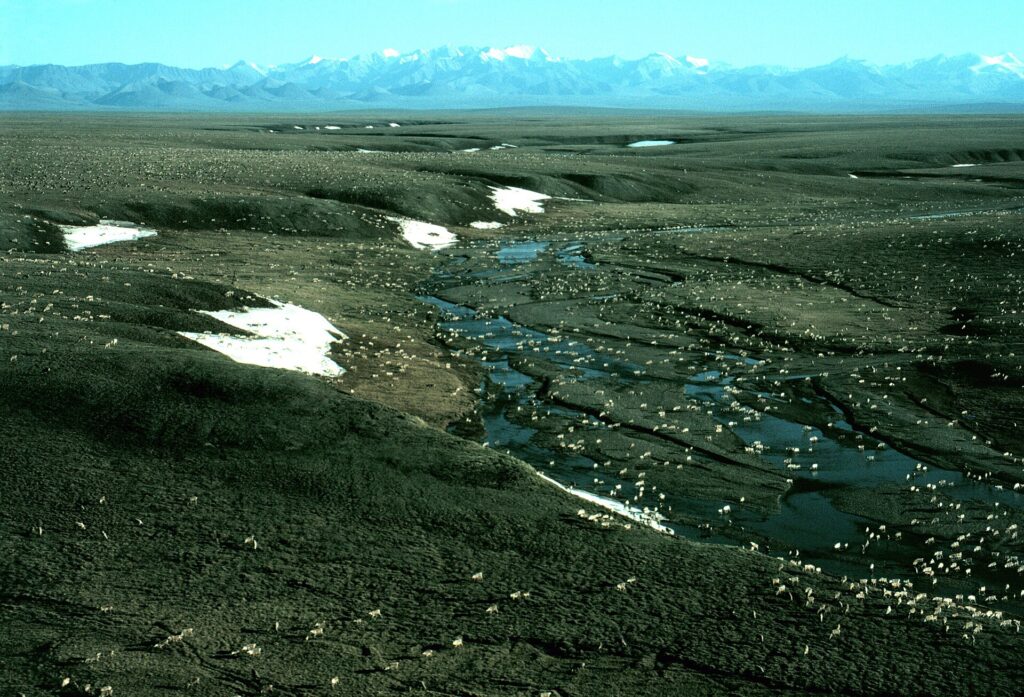
| Species | Caribou (Rangifer tarandus) |
|---|---|
| Range | Northeastern Alaska, Yukon, Northwest Territories |
| Estimate, 2025 | 143,000 (photocensus) |
| Record high, 2017 | 218,000 |
| Calving | Coastal plain, early June |
| Management | Alaska–Canada agreement |
Range and management
The herd calves on the coastal plain of the Arctic slope and spends summers in the Brooks Range, in a range that extends across the international border. It is managed under an international agreement between Alaska and Canada, and caribou herds mix on winter ranges but each uses its own calving area.[1][2]
Population trend
The summer 2025 photocensus estimated 143,000 animals. The herd has declined by an estimated 34 percent since 2017, when it reached a record high of 218,000. The Alaska Department of Fish and Game attributes the decline to lower reproduction in three-year-old females, possibly linked to poor early-life nutrition, and to adult female survival below 85 percent, and biologists expect the decline to continue until survival and reproduction improve.[1]
Caribou biology in Alaska
The following describes caribou in Alaska generally and is not specific to this herd. Alaska has 32 caribou herds and about 900,000 wild caribou, including herds shared with Yukon. Adult bulls average 350 to 400 pounds, mature females 175 to 225 pounds and newborn calves about 13 pounds. Caribou in northern and southwestern Alaska are generally smaller than those in the Interior and south.[2]
Migration and calving
Large herds may travel up to 400 miles between summer and winter ranges, and once migration begins caribou can cover up to 50 miles a day. Cold and snowstorms probably trigger movement, and long-used routes may suddenly be abandoned. In northern and southwestern Alaska calving takes place in early June, and caribou tend to calve in the same general areas year after year.[2]
Diet and predators
From May to September caribou eat willow leaves, sedges, flowering tundra plants and mushrooms, and from September they turn to lichens, dried sedges and small shrubs such as blueberry. Wolves, grizzly bears and golden eagles kill many newborn calves in some areas, and wolves and bears take many injured or exhausted bulls after the rut.[2]
FAQs
How many caribou are in the Porcupine herd? 143,000 in the summer 2025 photocensus.
Where does the herd calve? On the coastal plain in early June.
How far can caribou migrate? Large herds may travel up to 400 miles between ranges.
Sources
- Alaska Department of Fish and Game: Porcupine and Central Arctic Caribou Herd News, Spring 2026
- Alaska Department of Fish and Game: Caribou, Wildlife Notebook Series (revised 2008 and 2025)
Key facts
- Record 218,000 in 2017
- Shared Alaska–Canada range
Quick checkWhat was the 2025 Porcupine herd estimate?Show answer
143,000 animals
Sources
- Alaska Department of Fish and Game. Porcupine and Central Arctic Caribou Herd News, Spring 2026. 2026 (accessed 2026-11-14)
- Alaska Department of Fish and Game. Caribou, Wildlife Notebook Series (revised 2008 and 2025). 2025 (accessed 2026-11-14)
Editorially reviewed by Specialty Digest Editorial TeamLast reviewed November 14, 2026Researched and drafted with AI assistanceReport an issue