For one day each year, the United Nations asks the world to do something unusual for an international body: be quiet. World Meditation Day, observed every December 21, invites people to pause, breathe and turn attention inward. That may sound gentle, but it rests on a hard fact. Mental strain touches a very large share of humanity, and care systems are stretched thin. The day follows International Human Solidarity Day by one day.
A day proclaimed in 2024
The General Assembly proclaimed December 21 as World Meditation Day in resolution A/RES/79/137, during its 79th session in 2024. UN pages describe the resolution as recalling the right of everyone to enjoy the highest attainable standard of physical and mental health. The Permanent Mission of India, together with a core group of member states that led the adoption, invites governments to commemorate the day. UN News described the 2025 observance as the second, which places the first in 2024.
The day is new, but the idea is not. In 1952 the United Nations opened a Meditation Room at its New York headquarters under Secretary-General Dag Hammarskjöld, who wanted a space “dedicated to silence in the outward sense and stillness in the inner sense.” The 2024 resolution gave that spirit a date on the global calendar.
What meditation means
The UN describes meditation as an ancient practice that involves focusing one’s attention on the present moment, rooted in religious, yogic and secular traditions across cultures. In practical terms, the U.S. National Center for Complementary and Integrative Health (NCCIH) explains that meditation is a variety of practices focused on mind and body integration, used to calm the mind and enhance overall well-being. Some practices direct attention to a sensation, sound, image or mantra. Others emphasize mindfulness, which means keeping awareness on the present moment without judgment. Structured programs such as mindfulness-based stress reduction (MBSR) and mindfulness-based cognitive therapy (MBCT) combine these practices with other elements.
Example 1: ten quiet minutes. Imagine someone who sits for 10 minutes each morning and simply counts breaths from one to ten, starting over whenever the mind wanders. Across a 30-day month that adds up to 300 minutes, or five hours of practice. The numbers are round and illustrative, but they show why teachers stress small, steady habits over long, rare sessions.
Ancient roots, wide reach
According to the UN observance page, archaeologists trace meditation back to about 5,000 BCE, and estimates suggest that between 200 and 500 million people practice it worldwide. That range is wide because no census counts meditators, so treat it as an estimate rather than a measurement.
The strain behind the day
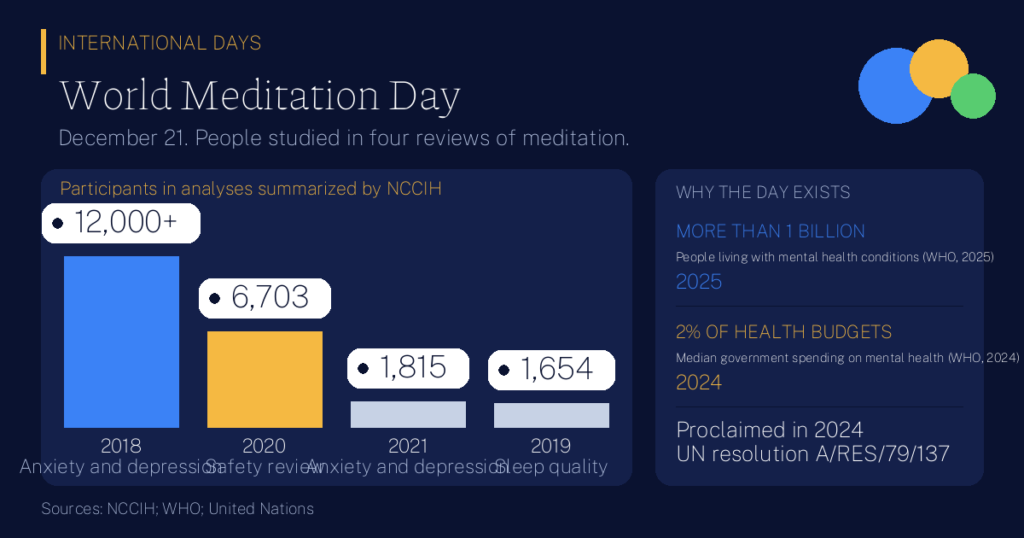
The case for paying attention to mental well-being is well documented. The World Health Organization reported in 2025 that more than 1 billion people are living with mental health conditions, and that depression and anxiety alone cost the global economy an estimated US$1 trillion each year. Suicide claimed an estimated 727,000 lives in 2021, according to the same release. Care has not kept pace: WHO’s Mental Health Atlas 2024 found that median government spending on mental health is just 2 percent of health budgets, unchanged since 2017, and that the global median is 13 mental health workers per 100,000 people.
- 1 billion+people living with a mental health condition (WHO, 2025)
- US$1 trillionyearly cost of depression and anxiety alone (WHO, 2025)
- 2%median share of health budgets spent on mental health (WHO Atlas, 2024)
- 13mental health workers per 100,000 people, global median (WHO Atlas, 2024)
WHO also notes that non-specialist psychological interventions and digital self-help tools can be scaled efficiently and affordably. Meditation is not named in that passage, but it belongs to the same family of low-cost, self-directed approaches, and that is a large part of its appeal to governments.
Example 2: the thin line of care. Suppose a district of 100,000 people had the global median of 13 mental health workers. If each saw 8 patients a day, only 104 people could be seen daily. The numbers are round and illustrative, but they show why tools people can use alongside professional care attract attention.
If you or someone near you is in crisis, contact local emergency services or a crisis line. In the United States, you can call or text 988 to reach the Suicide and Crisis Lifeline.
What the research says
Research on meditation is large but uneven, and NCCIH cautions that much of it is preliminary or not rigorous, and that results may have been interpreted too optimistically. With that warning, the findings are still worth knowing. A 2018 NCCIH-supported analysis of 142 groups, with more than 12,000 participants, found that mindfulness approaches beat no treatment for anxiety and depression and worked about as well as evidence-based therapies. A 2021 analysis of 23 studies with 1,815 participants found mixed short-term results, and no long-term effects in studies followed beyond two months. For sleep, a 2019 analysis of 18 studies with 1,654 participants found improved sleep quality compared with education-based treatments, but no difference from treatments such as cognitive behavioral therapy.
Other results are narrower. A 2018 Department of Defense trial of 203 veterans found meditation as effective as prolonged exposure therapy for post-traumatic stress disorder, according to NCCIH. Evidence on blood pressure is described as limited, and on pain as mixed. UN News, citing WHO, describes meditation as a powerful self-care tool that can reinforce treatments and improve overall well-being, especially for anxiety. The key word is reinforce: the evidence supports meditation as a companion to care, not a replacement for it.
Example 3: noticing the drift. Picture a five-minute session in which attention wanders six times. Each time the person notices and gently returns to the breath, that counts as one repetition of the skill. Six returns in five minutes means the session was not a failure, it was six small exercises. The count is made up for illustration, but it matches how teachers describe the practice.
Honest limits and safety
NCCIH says meditation and mindfulness are usually considered to have few risks, but few studies have looked for harm, so definite statements about safety are not possible. A 2020 review of 83 studies with 6,703 participants found that 55 of the studies reported negative experiences. NCCIH concluded that about 8 percent of participants had a negative effect, similar to the rate seen with psychological therapies. The most commonly reported effects were anxiety and depression.
The practical advice is plain. Do not use meditation to replace conventional care or to delay seeing a health professional about a medical problem. Ask about the training and experience of any instructor, and tell your health care providers about any complementary approaches you use.
How the day is marked
The 2025 observance at UN Headquarters took place on December 19 in the Trusteeship Council chamber under the title Meditation for Global Peace and Harmony. It featured reflections from experts on well-being and a guided meditation led by Indian spiritual leader Gurudev Sri Sri Ravi Shankar, who said that nearly 500 universities and many hospitals have begun to adopt meditation. He also said that 700 research papers show over 100 benefits, a claim that readers should weigh against the careful findings above.
You do not need a conference to take part. On December 21, try five minutes of quiet attention to your breath, share the day with a friend or class, or ask your school or workplace whether it offers a calm space. The point of the day is not a technique. It is the reminder that mental well-being deserves the same attention we give to the body.
Key Takeaways
- The day is recent. The General Assembly proclaimed December 21 as World Meditation Day in resolution A/RES/79/137, in 2024.
- Meditation is a family of practices. They range from focused attention to mindfulness to structured programs such as MBSR and MBCT.
- The need is large. WHO reports more than 1 billion people living with mental health conditions, while care budgets and workforces remain small.
- The evidence is encouraging but uneven. Mindfulness approaches performed about as well as evidence-based therapies for anxiety and depression in a large 2018 analysis, yet quality varies and long-term effects are unclear.
- It works best beside care, not instead of it. NCCIH advises against using meditation to replace conventional care or delay seeing a provider.
- Safety deserves attention. About 8 percent of participants had a negative effect, according to NCCIH, so choose experienced guidance and stop if a practice distresses you.
- Start small. A few quiet minutes a day is a realistic first step, and December 21 is a good day to begin.
How solid is this? UN pages give the resolution symbol and describe its aims, but this article does not quote the resolution’s operative text or give its adoption date. The 200 to 500 million estimate of practitioners is a UN estimate, not a count. Research figures come from NCCIH summaries of analyses from 2018 to 2021, much of it of mixed quality, and WHO figures are from 2021 to 2025. The three worked examples use round, made-up numbers. See also the International Days hub and the International Days Calendar.
More in Health
- United Nations, World Meditation Day observance page
- UN News, “Calming the mind and promoting global peace on World Meditation Day” (December 2025)
- UN General Assembly, resolution A/RES/79/137, World Meditation Day
- WHO, “Over a billion people living with mental health conditions” (September 2, 2025)
- WHO, Mental health fact sheet
- NCCIH, Meditation and Mindfulness: Effectiveness and Safety (updated June 2022)