Most holidays celebrate a person, a cause or a harvest. World Basketball Day celebrates a game with a known birthday. On December 21, 1891, in a gymnasium in Springfield, Massachusetts, a small group of players tossed a ball at a basket for the first time. More than a century later, the United Nations General Assembly chose that date to honor what the sport has become: a shared language spoken on driveways, school yards and arenas in almost every country. FIBA, the sport’s world governing body, notes that basketball was the first team sport to receive this kind of UN recognition.
The day is also a quiet public health message. Roughly one adult in three does not get enough physical activity, and a game that needs only a ball, a hoop and a few friends is one of the cheapest ways to change that.
From a Springfield gym to the United Nations
The inventor was James Naismith, then 30 years old, who taught at the International YMCA Training School, now Springfield College. According to FIBA, he wrote 13 original rules, and the first game pitted two teams of nine players against each other. It ended 1 to 0. The targets were peach baskets mounted above the floor, which is how the sport got its name.
From there the game spread through YMCA networks and schools. FIBA was founded on June 18, 1932 by eight national federations: Argentina, Czechoslovakia, Greece, Italy, Latvia, Portugal, Romania and Switzerland. Men’s basketball made its Olympic debut at the Berlin Games in 1936, and in 1992 professional players first took part in the Olympics, in Barcelona. FIBA today describes itself as made up of 213 national federations.
What the UN resolution says
On August 25, 2023, the General Assembly adopted resolution A/RES/77/324, proclaiming December 21 as World Basketball Day. The date was set on the eve of the FIBA Basketball World Cup 2023, and the resolution commends Indonesia, Japan and the Philippines for hosting the tournament. It also encourages the relevant authorities to ensure the Cup leaves a lasting legacy for peace and development around the world.
Notice how modest and open the request is. The text encourages everyone, everywhere, to play, watch, read, discuss or otherwise connect with the game. It invites Member States, UN system organizations, the private sector and civil society to observe the day in an appropriate manner and in accordance with national priorities. Its stated purpose is to spread the advantages of basketball for all, including through education and public awareness. The UN’s Department of Economic and Social Affairs, through its Division for Inclusive Social Development, supports the observance. The day has no fixed annual theme in the resolution.
A game with a global footprint
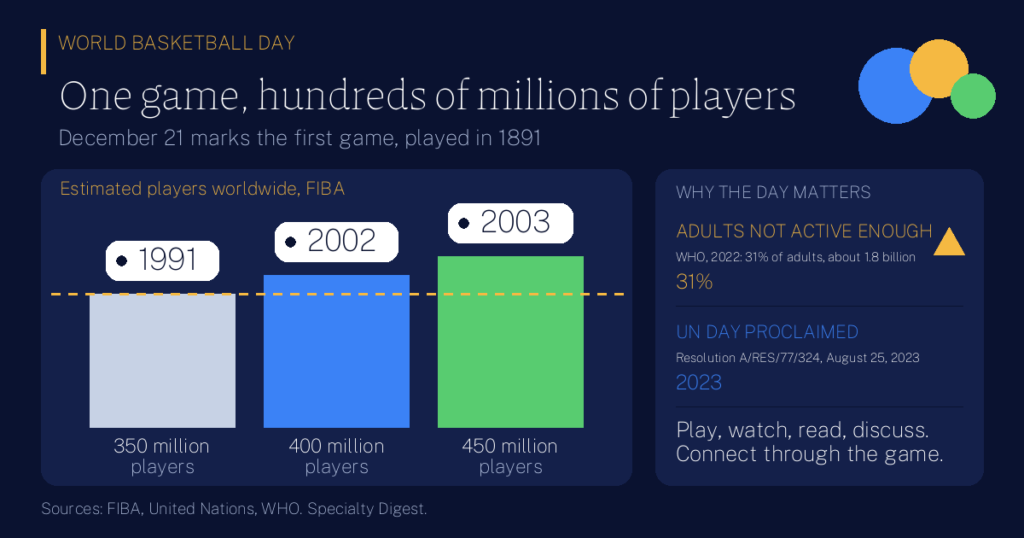
How many people play? There is no census of pickup games, so every figure is an estimate. FIBA’s own quick facts report an estimated 350 million players in 1991, 400 million in 2002 and 450 million in 2003. Later FIBA material repeats the 450 million figure for 2007. These are governing-body estimates that include grassroots play, not registered athletes, and they are best read as an order of magnitude.
- 213national federations in FIBA
- 13original rules, per FIBA
- 9 v 9players per team in the first game
- 1 to 0score of that first game
Example 1: counting games in a local league. Suppose a town forms a league of 8 teams with 10 players each. That is 80 people on the roster. If every team plays every other team once, the league plays 28 games. The numbers are round and illustrative, but they show how one inexpensive sport can keep dozens of people active for a whole season.
Why a game matters to health
The health case is the strongest reason to take the day seriously. The World Health Organization reports that 31 percent of adults, about 1.8 billion people, did not meet recommended physical activity levels in 2022. That is an increase of five percentage points since 2010, and WHO projects it could reach 35 percent by 2030. WHO recommends at least 150 minutes of moderate-intensity activity per week for adults. People who are insufficiently active have a 20 to 30 percent higher risk of death than those who are sufficiently active, and inactivity raises the risk of heart disease, stroke, type 2 diabetes, dementia and some cancers.
Basketball is a good fit for that recommendation because it is intense, social and easy to scale down. A half court and a single hoop will do, and so will a three-on-three game.
Example 2: reaching 150 minutes. Imagine an adult who plays a 30-minute pickup game three evenings a week and walks briskly for 30 minutes on two other days. That adds up to 150 minutes. The routine is illustrative, and any activity that raises the heart rate counts. The lesson is that the weekly target is five half-hour sessions, not a gym membership.
Who gets left on the sideline
The activity gap is not shared equally. WHO reports that inactivity among women was 34 percent, compared with 29 percent among men, and that the highest rates were in high-income Asia Pacific (48 percent) and South Asia (45 percent). Among young people, WHO’s fact sheet says one in four adolescents aged 11 to 17, about 240 million, reported no active days in the past week, and that girls were more likely than boys to report none (28 percent against 22 percent). Cost, safety, a lack of courts and social expectations all keep people away, and the UN resolution’s call to play “everywhere” is partly an invitation to fix those barriers.
Inactivity also has a price tag. WHO projects it will cost public health care systems nearly $300 billion between 2020 and 2030, about $27 billion a year. WHO’s global target is a 15 percent relative reduction in inactivity by 2030 compared with 2010, and in 2024 it said the world was off track.
How the day is marked
The resolution leaves the details to each country, so observances vary. For the first World Basketball Day in 2023, FIBA hosted a special event at its Patrick Baumann House of Basketball in Switzerland for UN, Olympic and YMCA guests, launched its FIBA Foundation photo contest on the theme “Basketball For Good,” invited every national federation to take part, and opened a social wall for #WorldBasketballDay posts. UN pages also highlight the Harlem Globetrotters’ peace message and a record attempt by UNRWA summer campers in Gaza City.
Example 3: a school plan. A school with 300 students and one court could run a lunchtime 3-on-3 tournament. With 24 teams of three, 72 students play, about one in four. If each plays 4 games of 10 minutes, that is 40 minutes of active play per student. The figures are made up for illustration, but they show how a single day can open the door to a habit.
Key Takeaways
- The day has a real birthday. Basketball was first played on December 21, 1891, in Springfield, Massachusetts.
- It is a UN day. Resolution A/RES/77/324, adopted August 25, 2023, proclaimed December 21 as World Basketball Day.
- The ask is simple. The resolution encourages everyone to play, watch, read, discuss or connect with the game.
- It is a huge game. FIBA estimates hundreds of millions of players, and counts 213 national federations.
- Inactivity is the real problem. About 31 percent of adults, 1.8 billion people, were not active enough in 2022.
- Small sessions add up. WHO’s 150 minutes a week is five half-hour games or walks.
- Access decides who plays. Women, girls and people without safe courts are most often left out, so the best way to mark the day is to widen the circle.
How solid is this? Dates and resolution details come from United Nations pages. Player counts are FIBA estimates, not a census, and FIBA’s own pages differ slightly on details such as the number of peach baskets and federations, so this article uses the figures that agree. Activity figures are WHO estimates, and the worked examples use round, made-up numbers. See also the International Days hub and the International Days Calendar.
More in Society