Epidemics rarely announce themselves. They start as a handful of unusual illnesses in one clinic, one village or one market, and what happens in the first few weeks decides whether the trouble stays local or crosses the world. International Day of Epidemic Preparedness, observed every year on December 27, asks everyone to get ready for those weeks before they arrive. It is one of the youngest days on the United Nations calendar, born directly from the experience of COVID-19, and it speaks to anyone who depends on a health system, which means all of us. It is a natural companion to World AIDS Day, which marks a long epidemic that is still being fought.
A day born from a pandemic
The General Assembly proclaimed the day in December 2020, in resolution 75/27, while COVID-19 was still sweeping through every region. The first observance followed on December 27, 2020. In his message that day, UN Secretary-General António Guterres described the year as one in which a scenario many had feared came tragically true, and the President of the General Assembly called the pandemic a final warning. According to UN News, the date is the birthday of Louis Pasteur, the scientist whose work on germs and vaccines helped transform medicine.
The resolution invites Member States, UN organizations, regional bodies, the private sector, civil society, universities and individuals to observe the day each year through education and awareness-raising activities, in line with national contexts and priorities. The UN notes that its system, in particular the World Health Organization, plays a pivotal role in coordinating responses to epidemics. It also warns that future epidemics could surpass past outbreaks in intensity and gravity, and it promotes a One Health approach, which treats the health of people, animals and the environment as linked.
What preparedness really means
Preparedness is not a stockpile sitting in a warehouse. It is the everyday ability to notice a problem early, confirm it quickly, tell the right people, and act before it grows. That ability rests on ordinary things: trained health workers in every district, laboratories that can test, reliable data systems, supplies that can move, and trust between officials and communities. The Secretary-General’s 2025 message makes the point directly, saying the best defense lies not only in science but in strong local health systems and well-supported frontline health workers.
Many outbreaks begin when a germ moves from animals to people. About 75 percent of emerging infectious diseases in humans are zoonotic, according to the UN. That is why the One Health idea matters: watching animal health, farming practices and ecosystems can reveal a threat before the first human patient arrives.
Example 1: why the first weeks count. Suppose a clinic sees 5 unusual cases and the number of cases doubles every 4 days. After 8 days there are 20 cases, and after 16 days there are 80. A response that starts on day 8 faces a quarter of the outbreak that a response starting on day 16 must face. The numbers are round and illustrative, not a forecast, but the logic of early action is the one preparedness plans are built on.
The numbers behind the day
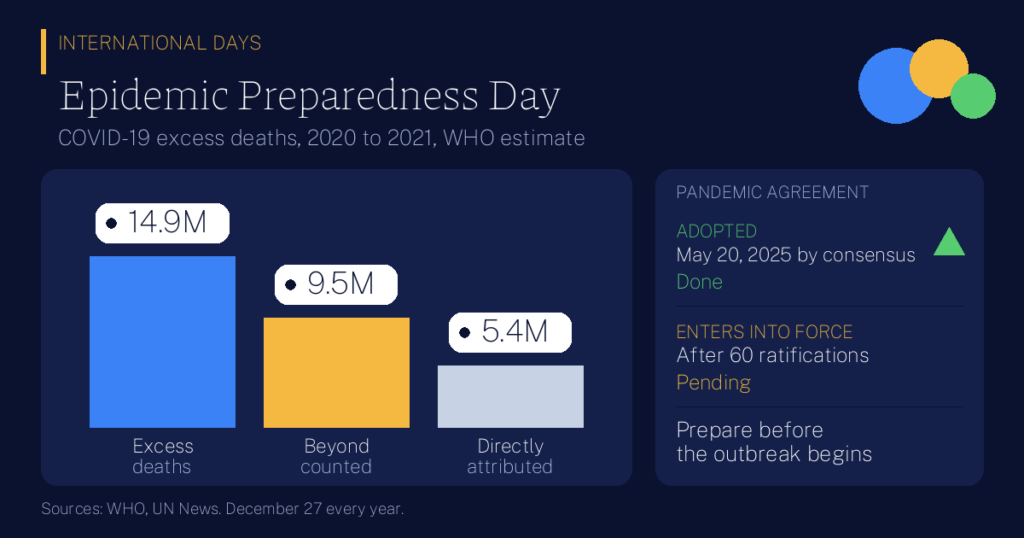
COVID-19 shows the scale of what is at stake. Reported deaths understate the loss, so WHO estimated excess mortality, which is the difference between the deaths that occurred and the number expected without the crisis. By the end of 2021, about 14.9 million excess deaths were associated with the pandemic, with a plausible range of 13.3 million to 16.6 million. That is 9.5 million more than the deaths directly attributed to COVID-19 at the time. WHO published revised estimates for 2020 and 2021 in May 2023 and has said further revisions may follow, so treat the figure as a model, not a count.
The toll was uneven. Of the excess deaths estimated for 2020 and 2021, 84 percent were concentrated in Southeast Asia, Europe and the Americas, and nearly 70 percent occurred in just 10 countries. Middle-income countries accounted for 81 percent, and men for 57 percent against 43 percent for women.
- 7 million+lives lost to COVID-19, per WHO as cited by the UN
- 4.5 billionpeople not fully covered by essential health services, 2021
- 75%of emerging human infectious diseases are zoonotic
- 90%of countries reported disruptions to essential health services
Health systems themselves buckled. During COVID-19, 90 percent of countries reported disruptions to essential health services. WHO estimated that between 80,000 and 180,000 health and care workers may have died from COVID-19 between January 2020 and May 2021. And the base was thin to begin with: in 2021, about 4.5 billion people were not fully covered by essential health services.
Who is left behind
Epidemics follow the gaps in a society. Where a clinic is a day’s walk away, where laboratories are scarce, or where people cannot afford care, an outbreak is noticed later and costs more lives. The 4.5 billion people without full coverage are the first exposed, and health workers, who carry the highest daily risk, are often the first to fall ill. Protecting them with supplies, training and fair pay is not charity. It is part of a country’s early-warning system.
Example 2: a stretched hospital. Imagine a hospital with 100 nurses, 20 of whom fall sick during a surge while patient numbers double. The 80 who remain must care for twice the patients, so each carries two and a half times the usual load. The figures are round and illustrative, but they show why protecting staff is itself a preparedness measure.
From lessons to law
The world has begun to turn lessons into rules. The International Health Regulations, revised in 2005, were amended in 2024 to strengthen the framework after COVID-19, and a 2023 political declaration is described by the UN as the main political outcome of its high-level work on the topic. On May 20, 2025, the World Health Assembly adopted the WHO Pandemic Agreement by consensus, a day after a committee vote of 124 in favor, none against and 11 abstentions. It is only the second agreement under Article 19 of the WHO Constitution, after the Framework Convention on Tobacco Control, adopted in 2003.
The agreement is not finished business. Its central piece, the Pathogen Access and Benefit Sharing system, known as PABS, is still to be negotiated by an intergovernmental working group and considered by the Assembly. Under it, manufacturers would make available rapid access targeting 20 percent of their real-time production of vaccines, therapeutics and diagnostics for the pandemic pathogen. Only after the Assembly adopts the PABS annex does the agreement open for signature, and it enters into force after 60 ratifications. Because this process is moving, check WHO for its current stage.
Example 3: what 20 percent could mean. Suppose a manufacturer makes 1,000,000 doses of a new vaccine in a given period. A 20 percent target would mean about 200,000 of those doses are available for rapid access through the system. The numbers are round and illustrative. The real shares, products and rules depend on the final annex.
How the day is marked
The UN page for the day does not list a fixed theme each year, but the Secretary-General’s messages show its direction. In 2024 he urged countries to deliver on the historic pandemic agreement and cited recent outbreaks of mpox, cholera, polio and Marburg. In 2025 he stressed strong local health systems and well-supported frontline workers, and asked the world to stop epidemics in their tracks. Communities can mark the day with training, drills, vaccination drives and public talks. Individuals can mark it by checking that their own vaccinations are current, learning how their local health authority reports outbreaks, and thanking the health workers who keep watch.
Key Takeaways
- Preparedness is daily work. Early detection, trained workers and trusted communication matter more than any single stockpile.
- COVID-19 set the scale. WHO estimated 14.9 million excess deaths in 2020 and 2021, 9.5 million more than directly attributed.
- The burden was uneven. 84 percent of excess deaths fell in Southeast Asia, Europe and the Americas, and middle-income countries bore 81 percent.
- Health workers are the front line. WHO estimated that 80,000 to 180,000 died between January 2020 and May 2021.
- The rules are changing. The Health Regulations were amended in 2024 and the Pandemic Agreement was adopted on May 20, 2025.
- The work is unfinished. The agreement opens for signature only after the PABS annex is adopted, and it needs 60 ratifications.
- Everyone has a role. Vaccinations, honest information and support for local health care help communities respond sooner.
How solid is this? Excess death figures are modeled WHO estimates for 2020 and 2021 and have been revised since 2022. The figure of more than 7 million COVID-19 deaths is WHO’s, as cited by the UN, and the attributed-deaths bar in the first chart is implied by subtracting 9.5 million from 14.9 million. The three worked examples use round, made-up numbers to show an idea. See also World AIDS Day, the International Days hub and the International Days Calendar.
More in Health
- United Nations, International Day of Epidemic Preparedness, 27 December (observance and messages pages)
- United Nations, Focus: Pandemic preparedness
- UN News, World must be ready for the next pandemic, December 27, 2020
- UN News, Nearly 15 million deaths directly or indirectly linked to COVID-19, May 5, 2022
- WHO, World Health Assembly adopts historic Pandemic Agreement, May 20, 2025
- WHO, Global excess deaths associated with the COVID-19 pandemic
- United Nations, International Day of Epidemic Preparedness 2025, Secretary-General’s Message