Most international days last twenty-four hours. This one lasts seven. Every year from March 21 to 27, the United Nations marks the Week of Solidarity with the Peoples Struggling against Racism and Racial Discrimination, a stretch of time long enough to move from remembering to doing. It opens on the International Day for the Elimination of Racial Discrimination, when the world recalls a massacre under apartheid, and it runs on as an invitation to teach, to listen and to act. This article explains where the week came from, what the legal machinery behind it looks like, and why a full week can matter more than a single date.
A day grows into a week
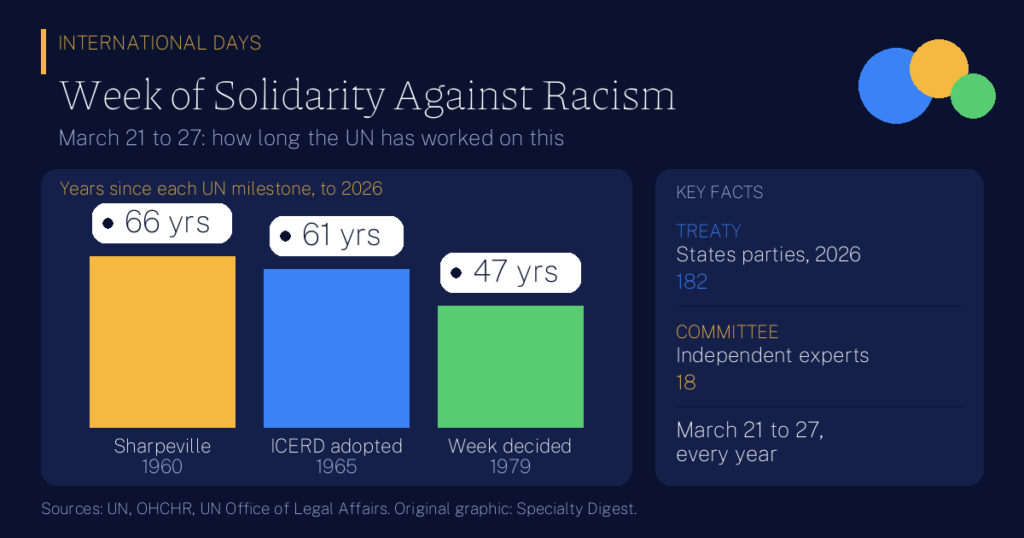
The story starts in Sharpeville, South Africa. On March 21, 1960, police opened fire on a peaceful demonstration against apartheid pass laws and killed 69 people. In 1966 the General Assembly designated March 21 as a day to remember them and to renew the struggle against racial discrimination.
The week came later. In 1979 the General Assembly decided that a week of solidarity, beginning on March 21, would be organized annually in all States. The UN lists the decision as resolution 34/24. The reasoning is easy to follow. A single day invites a statement and a ceremony. A week leaves room for a school unit, a community meeting, a review of how local services treat different groups, and a conversation that does not end at midnight.
Notice the wording. The week is named for solidarity with peoples who are struggling, which puts the weight on what others can do alongside them, not only on what the problem is.
What discrimination means in law
The central legal idea is that racial discrimination is not only a matter of attitude. It can sit inside laws, budgets and institutions. A joint statement issued on March 20, 2026 by the UN Committee on the Elimination of Racial Discrimination (CERD) and the European Commission against Racism and Intolerance (ECRI) puts it plainly: states have “a clear and immediate obligation to ensure that education systems are inclusive, equitable and free from both direct and indirect discrimination.”
The two words are worth separating. Direct discrimination is a rule or practice that openly treats groups differently. Indirect discrimination is a neutral-looking rule that in practice leaves one group worse off. The second kind is harder to see, which is one reason a week of looking closely is useful.
Example 1: a school week. Suppose a school has 20 classes of 20 pupils, 400 in all. Each class spends one 45-minute lesson during the week on the history of the struggle against racism. That is 20 lessons and 15 hours of teaching, and every pupil takes part. The numbers are round and illustrative, but they show how small, planned steps can reach a whole school.
Example 2: reading the pattern. Suppose a company reviews its hiring and finds that, among 100 equally qualified applicants from each of two groups, 60 from one group are invited to interview and 40 from the other. No single decision looks unfair, yet the gap is 20 interviews. Counting is what reveals it. The figures are made up for illustration.
The treaty at the center
On December 21, 1965, the General Assembly adopted the International Convention on the Elimination of All Forms of Racial Discrimination, known as ICERD, through resolution 2106 (XX). The UN describes it as the first of its core international human rights treaties. It entered into force in 1969, and the UN says it is now nearing universal ratification.
As of the March 2026 CERD and ECRI statement, 182 States are parties. Compliance is monitored by CERD, a body of 18 independent experts. States that have ratified the Convention must report regularly to the committee, which answers with concrete recommendations on how forms of racism in each country can be addressed. Because the count changes as states ratify, treat 182 as a 2026 figure.
Decades of effort
The week sits inside a longer campaign. The UN has run three Decades to Combat Racism and Racial Discrimination: 1973 to 1982, 1983 to 1993 and 1993 to 2003. In 2001 the World Conference against Racism met in Durban, from August 31 to September 8, and a Review Conference followed in Geneva in April 2009.
The General Assembly then proclaimed the International Decade for People of African Descent for 2015 to 2024 (resolution 68/237), with a second Decade for 2025 to 2034 (resolution 79/193). Resolution 75/314 of August 2021 operationalized a Permanent Forum on People of African Descent, which held its first session in December 2022.
Who is affected, and who is not counted
Around 200 million people who identify as being of African descent live in the Americas, and many millions more live elsewhere outside the African continent, according to the UN. It describes them as among the poorest and most marginalized groups, often “invisible” in official statistics. Counting matters because budgets and services follow the numbers.
Example 3: the uncounted residents. Imagine a town of 10,000 people where 1,000 residents, or 10 percent, belong to a group that official forms never record. If a clinic is funded at $100 per recorded resident, the town’s funding misses $100,000 every year. The figures are round and illustrative, but they show why “invisible” is a practical problem, not only a symbolic one.
The Human Rights Council took up this question in resolution 43/1, adopted by consensus in June 2020. It led to a report by the High Commissioner for Human Rights (A/HRC/47/53, 2021) with a four-point agenda: stop denying and start dismantling, pursue justice, listen up, and redress.
The problem is not confined to one region. The 2026 CERD and ECRI statement voices concern about de facto school segregation affecting Roma children and children with migration backgrounds. ECRI covers the 46 member states of the Council of Europe.
How the week is marked
The UN observance pages list no separate theme for the week, so the theme of March 21 is the clearest guide. The 2025 theme marked the 60th anniversary of ICERD. In 2026, CERD and ECRI called for renewed commitment to address racism “in and through school education,” pointing to Article 7 of the Convention, and warned that education is one of the most powerful tools available to States for dismantling racial discrimination at its roots.
For individuals, the week works best at a local scale: a lesson, a staff meeting, a library display, a review of how an organization gathers and uses data. People who face discrimination can turn to their national equality body, ombudsperson, human rights commission or a legal aid service, and many schools and workplaces have their own complaint routes.
Key Takeaways
- The week is about action. From March 21 to 27, the UN asks for solidarity with peoples struggling against racism, not only remembrance.
- It began with a massacre. Police killed 69 people at a peaceful protest in Sharpeville in 1960, and March 21 was set aside in 1966.
- The week dates from 1979. The General Assembly decided that it would be organized annually in all States (resolution 34/24).
- A treaty gives it teeth. ICERD has been in force since 1969, with 182 States parties in 2026 and 18 independent experts monitoring.
- Discrimination can be indirect. Neutral-looking rules can still leave a group behind, so looking closely at the data matters.
- Being counted is power. People of African descent are often invisible in official statistics, and services follow numbers.
- Schools are the 2026 focus. CERD and ECRI urged states to address racism in and through education.
How solid is this? Dates, resolution symbols and the 2026 statement come from UN and OHCHR pages. The count of 182 States parties is a 2026 figure and rises as states ratify; an older OHCHR page lists 177. The UN pages give no separate theme for the week itself. The three worked examples use round, made-up numbers to show an idea. See also the International Days hub and the International Days Calendar.
More in Society
- United Nations: Week of Solidarity with the Peoples Struggling against Racism and Racial Discrimination
- United Nations: International Day for the Elimination of Racial Discrimination
- UN Ask DAG: What is the UN doing to combat racism and racial discrimination?
- UN Office of Legal Affairs: International Convention on the Elimination of All Forms of Racial Discrimination
- OHCHR: CERD and ECRI joint statement, March 20, 2026
- United Nations: People of African Descent