Every year on March 24, the United Nations pauses to say something that sounds simple and is often hard to achieve: people have a right to know what happened to those they love. When a person vanishes, when a family is told nothing, when a wrong is buried under silence, the harm does not end with the original act. It continues every day that the truth stays hidden. The International Day for the Right to the Truth concerning Gross Human Rights Violations and for the Dignity of Victims exists to honor victims and to keep that question alive. It sits close to the purpose of Human Rights Day, because truth is where the repair of rights begins.
A date chosen for one man
On March 24, 1980, Archbishop Oscar Arnulfo Romero of El Salvador was assassinated, shot as he celebrated mass, after he had denounced violations of human rights. The United Nations chose the date of his death for the day. On December 21, 2010, the General Assembly proclaimed March 24 as the International Day, in resolution A/RES/65/196, and the Human Rights Council also proclaimed it, in resolution A/HRC/RES/14/7. The UN says the day aims to honor the memory of victims of gross and systematic human rights violations and to promote the importance of the right to truth and justice.
The idea did not appear from nowhere. Societies emerging from violence kept returning to the same demand. According to a 2026 UN Chronicle article, tens of thousands of people were murdered or disappeared in Argentina between 1976 and 1983, and the country’s CONADEP truth commission followed in 1984. El Salvador’s Commission on the Truth produced a report published in 1993 (document S/25500). Colombia established its Commission for the Clarification of Truth in 2017. The timeline below sets these steps beside the UN’s own milestones.
What the right to truth means
The phrase can sound abstract, so it helps to put it plainly. The right to truth is the claim of victims, their families and society to learn what happened: who was responsible, what the circumstances were, and, for people who have disappeared, what became of them. A 2006 study by the UN human rights office (OHCHR), document E/CN.4/2006/91, described it as an inalienable and autonomous right, linked to the duties of States to investigate and to provide remedy and reparations. Put simply, it is treated as a right in its own name.
Truth is not the same as punishment, and it is not the same as compensation. In practice it is the step that makes the others possible, because a State cannot investigate, repair or promise that a wrong will not be repeated if the facts are unknown. In April 2025 the UN High Commissioner for Human Rights, Volker Türk, put the family’s view directly: for families, accountability begins with knowing the truth about the fate of their loved ones, regardless of how they went missing.
The numbers behind the day
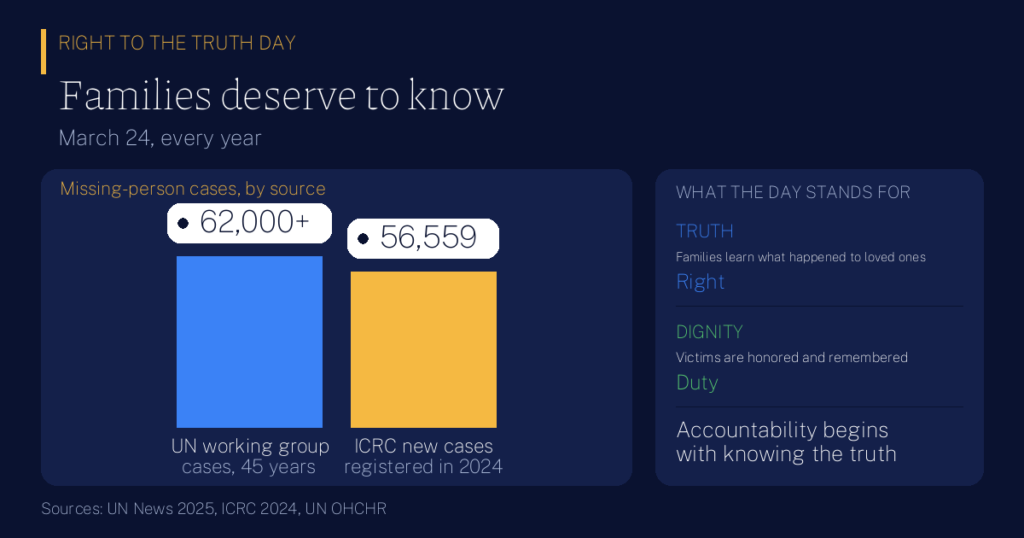
Counting the missing is hard, and every figure here is a floor, not a ceiling. The International Committee of the Red Cross (ICRC) registered 56,559 new cases of missing persons in 2024, which UN News described as the highest annual increase in at least two decades. The UN Working Group on Enforced or Involuntary Disappearances has handled more than 62,000 cases across 115 countries in 45 years, as of April 2025. Mr. Türk called these numbers just the tip of a very large iceberg.
- 56,559new missing-person cases registered by the ICRC in 2024
- 62,000+cases handled by the UN working group over 45 years
- 115countries involved in those cases
- 77countries had ratified the disappearance convention by April 2025
The Working Group’s recent work shows how slowly answers arrive. In September 2025 it transmitted 1,280 new cases to 38 States, 927 of them urgent. Its November 2025 newsletter notes that despite repeated requests, no responses have been received regarding over 3,000 individuals, and that 20 Member States provided information that led to the clarification of 231 cases. The International Convention for the Protection of All Persons from Enforced Disappearance was adopted in 2006, and as of April 2025 just 77 countries had ratified it.
Example 1: a count that grows. Suppose a registry lists 400 missing people, and each of them has three close relatives still waiting. The registry reports 400 cases, but about 1,200 relatives are living without an answer. The numbers are round and illustrative, but they show why a single case count understates how many lives a disappearance touches.
Why silence does lasting harm
Few violations stay open as long as a disappearance can. Families cannot hold a funeral or close a chapter, and the uncertainty can last for decades. In 2025 UN officials told the Security Council that numbers of missing persons in armed conflict continue to rise, six years after it adopted resolution 2474 (2019), and urged that the resolution be implemented fully and with urgency.
The day is therefore about more than remembrance. It speaks to those left behind: parents, children, siblings and whole communities. The UN Chronicle article marking the day in 2026 carries the title Dignity Requires Truth, and it recalls the fiftieth anniversary of the coup d’etat in Argentina. The point is that dignity for victims is not only about the past. It is about whether the living are allowed to know.
Example 2: waiting through a lifetime. Imagine a sister who was 25 when her brother disappeared and who is still asking at 65. Forty years of birthdays and anniversaries pass without an answer. The ages are round and made up for illustration, yet the UN’s own figure for the Working Group covers 45 years of cases.
How societies look for the truth
There is no single path. Truth commissions, such as those in Argentina, El Salvador and Colombia, gather testimony and publish findings. Courts can establish facts. Searching for the missing, registering cases and sharing information across borders can bring answers to individual families. The Working Group acts as a channel, sending cases to governments and asking for information. Each tool answers a different need: a commission serves a society that needs a shared account, and a search serves a family that needs one name.
Example 3: a commission’s reach. Suppose a commission investigates 1,000 cases and is able to resolve 300. For those 300 families the answer changes everything, while for the other 700 the work must continue. The figures are round and illustrative, but they capture a real pattern: truth-seeking is often partial, and it needs patience and follow-through.
How the day is marked, and what progress needs
The UN’s observance page names no yearly theme, so the day takes its shape from memorials, school lessons, statements and public events. Progress, as the numbers suggest, rests on a few practical things: joining and applying the Convention, answering the Working Group’s requests, searching for the missing in a systematic way, and listening to families. Anyone looking for a missing relative can contact their national Red Cross or Red Crescent society, which can help with tracing, or a local human rights organization for support. For everyone else, the day is an invitation to learn how their own country has dealt with its past, to read a commission’s report, or to attend a local memorial.
Key Takeaways
- The date honors a person. March 24 marks the 1980 assassination of Archbishop Oscar Romero of El Salvador.
- The UN made it official in 2010. The General Assembly proclaimed the day on December 21, 2010, in resolution A/RES/65/196.
- Truth is a right in its own name. A 2006 OHCHR study called it inalienable and autonomous.
- The scale is large. The ICRC registered 56,559 new missing-person cases in 2024, and the UN working group has handled more than 62,000 cases across 115 countries.
- Answers come slowly. The working group reports no responses regarding over 3,000 individuals, despite repeated requests.
- Many paths lead to truth. Commissions, courts, searches and international channels each answer a different need.
- Families are at the center. Accountability begins with knowing what happened to a loved one.
How solid is this? Case counts come from the ICRC (2024) and the UN Working Group (as of April 2025) and are minimums, because many disappearances are never reported. The UN page names no annual theme, so none is stated here. The three worked examples use round, made-up numbers to show an idea. See also Human Rights Day, the International Days hub and the International Days Calendar.
More in Society
- United Nations, International Day for the Right to the Truth concerning Gross Human Rights Violations and for the Dignity of Victims
- UN Chronicle, Dignity Requires Truth (March 2026)
- UN News, Accountability for missing persons is crucial (April 2, 2025)
- OHCHR, Working Group on Enforced or Involuntary Disappearances, Newsletter No. 13 (November 2025)
- UN Security Council press release SC/16063 on resolution 2474 (2019), 2025