Theatre is one of the oldest ways people have of looking at themselves together. A group gathers in a room, the lights change, and for a couple of hours strangers share the same story at the same moment. World Theatre Day, observed every year on March 27, celebrates that shared act. It is run by the International Theatre Institute (ITI) and built around a simple idea: theatre belongs to everyone, in every language. It sits comfortably beside World Poetry Day, which honors another art that lives in the human voice.
A season opens in Paris
The ITI gives a precise origin for the day. World Theatre Day was created by the ITI and celebrated for the first time on March 27, 1962, the date of the opening of the “Theatre of Nations” season in Paris. The date, then, comes from a real event in the theatrical calendar, not from a distant anniversary.
That origin shapes the character of the day. It grew out of a professional community of theatre makers who wanted one day each year when their art would speak to the whole world. It is led by the ITI, with UNESCO as a partner, and its tone is closer to a festival than to a campaign. Its main tool is not a treaty or a target but a text, the International Message.
The International Message
Every year, at the invitation of the ITI, a figure of world stature shares reflections on the theme of theatre and a culture of peace. The first International Message was written by Jean Cocteau in 1962. The message is translated into different languages and distributed widely, and the official World Theatre Day site says it has been translated into more than 50 languages. The authors change every year, and the list mixes actors, directors and writers from different countries and traditions.
Willem Dafoe, whom the ITI describes as an actor and theatre maker from the United States, wrote the message for 2026. The ITI states the guiding theme of the whole series as theatre and a culture of peace, so each author is invited to add a personal view to that shared question.
What the day asks of us
The word “theatre” covers a wide family of live art: plays and musicals, puppetry, street performance, dance theatre and community stories told by amateurs. What they share is presence. Performers and audience occupy the same space and time, and the audience helps make the event happen. That is why theatre is often described as a rehearsal for listening to other people, and why the ITI ties it to peace.
It is also an economic activity, built from actors, writers, stage managers, designers, ticket sellers and cleaners. Example 1: a community theatre. Imagine a hall with 100 seats that stages 40 performances a year, fills 80 percent of the seats and charges $20 a ticket. Ticket income would be about $64,000. After rent, lighting and fees, little is left, so volunteers, grants and local sponsors often decide whether the doors stay open. The numbers are round and illustrative, but the pattern is familiar to small venues everywhere.
The numbers behind the stage
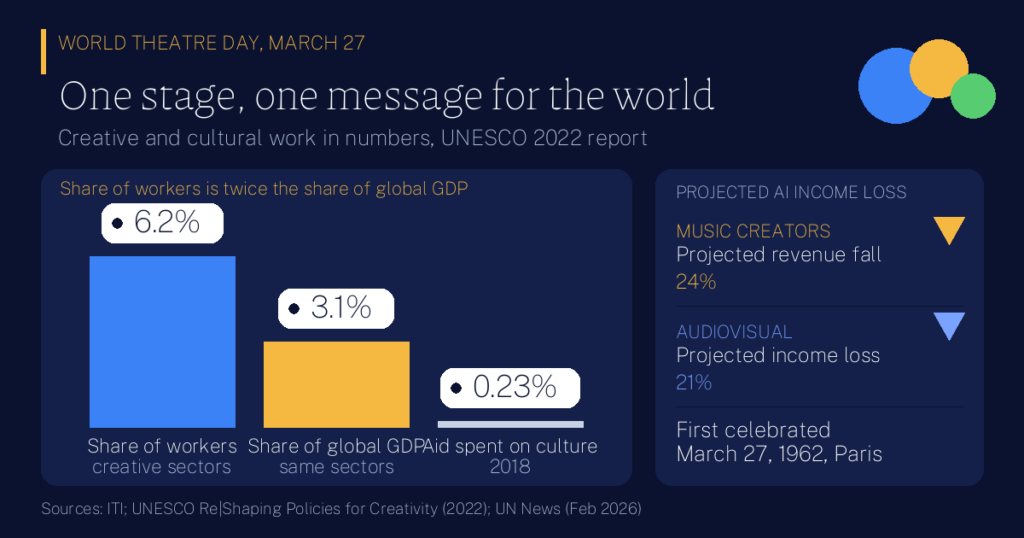
Few statistics count theatre alone, so the best global picture comes from the wider creative and cultural sectors. UNESCO’s 2022 report Re|Shaping Policies for Creativity, the third edition of a series that monitors the 2005 Convention on cultural expressions, reports that 6.2 percent of all workers operate in the creative and cultural sectors, contributing 3.1 percent to global GDP. The share of workers is twice the share of output, which hints at how modest earnings in these fields can be, although the report’s headline figures do not explain why.
- 6.2%of all workers are in creative and cultural sectors
- 3.1%of global GDP comes from those sectors
- 10 millionjobs lost in culture and creativity in 2020
- 0.23%of development aid went to culture in 2018
The same report records the shock of 2020, when 10 million jobs were lost in culture and creativity globally as venues closed. Live theatre felt that shock sharply, because a performance cannot be stored and sold later. The report also notes that only 0.23 percent of development aid was spent on culture in 2018.
Example 2: reading the share. In a country with 10 million workers, 6.2 percent would mean about 620,000 people working in creative and cultural fields, from stage crews to musicians to designers. The country and the figures are invented for illustration, but they show how a global percentage translates into real livelihoods.
Who is left behind
Opportunity inside the arts is not evenly shared. The UNESCO report finds that only 33 percent of film awards go to women, a number about film that points to a wider question of who gets recognized in the creative professions. Many theatre workers also lack steady contracts, sick pay or pensions, and freelance careers can end abruptly when a season is cancelled.
A newer pressure comes from technology. UN News reported on February 18, 2026 that the latest edition of the UNESCO report, covering more than 120 countries, warns that generative AI could cut incomes: music creators could see revenues fall by 24 percent, and those working in the audiovisual sector may lose 21 percent of their income. The same report finds a digital divide, with 67 percent of people in developed countries holding essential digital skills against just 28 percent in developing countries. It outlines more than 8,100 policy measures that countries have taken. Those AI figures concern music and audiovisual work rather than theatre, and they are projections, not measured losses.
Example 3: what a 24 percent drop means. Suppose a composer earns $40,000 a year from licensing and commissions. A 24 percent fall would remove $9,600 and leave $30,400. The composer and the sums are made up for illustration, but a drop of that size would force many freelancers to take second jobs or leave the field.
How the day is marked
The ITI publishes guidelines on how to celebrate World Theatre Day and invites its centers and members to take part, and its 2026 program brochure lists activities across the days leading up to March 27. In practice the day is marked by theatres, schools, companies and community groups. Many choose to share the International Message with their audiences in many languages.
Ordinary people can take part too. You can attend a local performance, bring a young person to their first play, volunteer at a community theatre, read the year’s message aloud with friends, or simply ask what keeps your nearest stage in business. Each of these actions supports the idea behind the day: live stories need both makers and witnesses.
Key Takeaways
- The day has a real address. It was first celebrated on March 27, 1962, the opening of the Theatre of Nations season in Paris.
- Artists lead it. The International Theatre Institute created the day, with UNESCO as a partner.
- One message, many voices. Each year a figure of world stature writes an International Message, translated into more than 50 languages.
- The sector is large. Creative and cultural sectors hold 6.2 percent of all workers and contribute 3.1 percent of global GDP, per UNESCO’s 2022 report.
- It is also fragile. 10 million jobs were lost in culture and creativity in 2020.
- New risks are emerging. UNESCO projects income losses of 24 percent for music creators and 21 percent for audiovisual workers from generative AI.
- Anyone can take part. Buy a ticket, bring a friend, or read the message aloud.
How solid is this? The origin, authors and translation facts come from the ITI’s own World Theatre Day pages. Employment and GDP shares come from UNESCO’s 2022 report and cover all creative and cultural sectors, not theatre alone. The AI figures are projections reported by UN News in February 2026, and the report text there does not tie them to a specific year. The three worked examples use round, made-up numbers. See also the International Days hub and the International Days Calendar.
More in Society
- International Theatre Institute (ITI). World Theatre Day.
- World Theatre Day. Official World Theatre Day site, International Messages.
- ITI. World Theatre Day 2026 message by Willem Dafoe.
- UNESCO. Re|Shaping Policies for Creativity: Addressing culture as a global public good (2022).
- UN News. Artists face steep income decline due to AI, UNESCO finds (February 18, 2026).