Every day, small pieces of space rock burn up in our sky without anyone noticing. The rare large ones are the reason International Asteroid Day exists. Observed every year on June 30, it asks a simple question: if a dangerous asteroid were ever found heading our way, would the world know in time, and would it be ready? For the first time in history, the honest answer is that we are learning how to say yes. Like World Tsunami Awareness Day, it is about preparing for a rare event whose consequences could be severe.
From a Siberian blast to a United Nations day
The date points back to June 30, 1908, when an object struck the atmosphere over Siberia in what is known as the Tunguska impact. The General Assembly chose its anniversary. In December 2016 it adopted resolution 71/90, which proclaimed June 30 as International Asteroid Day. The UN says the decision followed a proposal by the Association of Space Explorers, endorsed by the Committee on the Peaceful Uses of Outer Space (COPUOS).
The resolution invites all Member States, UN system organizations, other international and regional organizations, civil society, nongovernmental groups and individuals to observe the day. Its purpose is public awareness: how asteroids and comets behave, what the risk really is, and what governments can do together about it.
What counts as a near-Earth object
A near-Earth object, or NEO, is an asteroid or comet whose orbit brings it into the neighborhood of Earth’s orbit. Most are asteroids, leftover building blocks from the early solar system. Being near is not the same as being on a collision course. The great majority will never hit us, and the point of surveying them is to know that for certain rather than to assume it.
Size matters enormously. A small rock that enters the atmosphere usually breaks up harmlessly high above the ground. Objects larger than about 140 meters are the ones planners worry about most, and objects larger than a kilometer would be a global threat. That is why astronomers count the sky by size class.
The numbers behind the day
By NASA’s tally as of December 2025, astronomers had discovered 39,123 near-Earth asteroids of all sizes. ESA reported in November 2025 that the total of identified near-Earth asteroids had passed 40,000, a difference that reflects dates and counting methods. The census is far from complete in the middle size range.
- 39,123near-Earth asteroids discovered, NASA, December 2025
- 873discovered larger than 1 km, with about 50 estimated left to find
- 11,343discovered larger than 140 m, with about 14,000 estimated left
- June 30the date, from the 1908 Tunguska impact
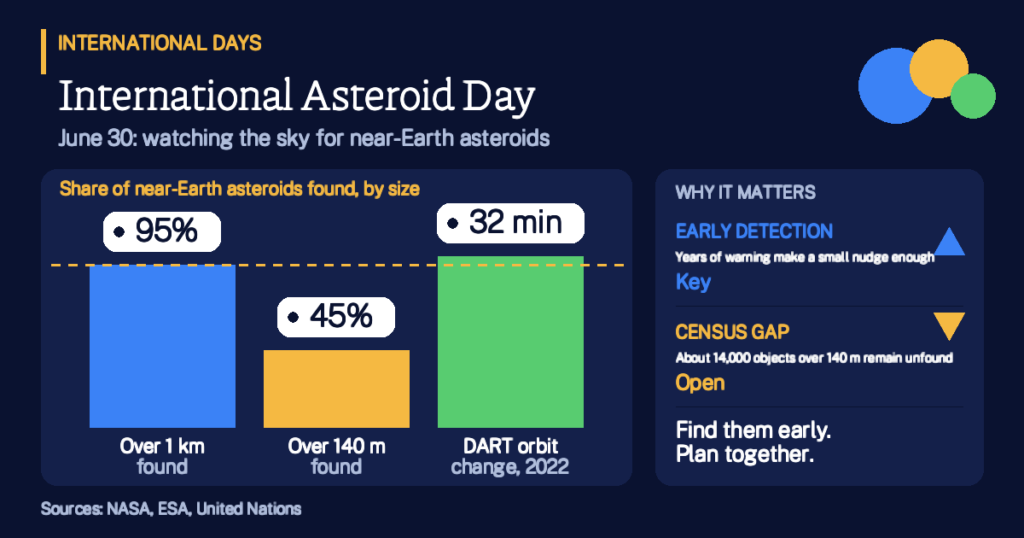
The picture is reassuring and sobering at once. Nearly all of the largest objects are already known, which is the most important job done first. The 140-meter class, large enough to devastate a region, is only about 45 percent found by this arithmetic. ESA likewise says the vast majority of kilometer-size objects are found, and puts mid-sized objects of roughly 100 to 300 meters at about 30 percent. Sources differ because the size ranges differ. The conclusion is the same: the search must continue.
Example 1: how big a nudge? Suppose, with round numbers for illustration, a rock could be slowed by just 1 centimeter per second ten years before a predicted impact. Ten years is about 315 million seconds, so the rock would arrive about 3,150 kilometers away from where it was headed. That is roughly half of Earth’s radius of about 6,371 kilometers. A tiny push applied early beats a huge push applied late.
A real test: DART
Planetary defense stopped being only theory on September 26, 2022, when NASA’s DART spacecraft deliberately struck Dimorphos, a small moon orbiting the asteroid Didymos. Neither object posed any danger to Earth. The aim was to see whether a collision could change an asteroid’s motion.
It could. NASA reported in October 2022 that Dimorphos’s orbit around Didymos shortened from 11 hours and 55 minutes to 11 hours and 23 minutes, a change of 32 minutes, give or take about 2 minutes. NASA’s minimum success benchmark had been 73 seconds, and the result beat it by more than 25 times. The test showed that a kinetic impact is a real tool, though the lesson is to use it with years of warning.
Example 2: how long to finish the census? Imagine, as an illustration only, that surveys find 1,000 new 140-meter objects a year. With about 14,000 still to find, the job would take about 14 years. Faster survey telescopes shorten that, and slower funding lengthens it.
Apophis and the 2029 year
The most famous upcoming visitor is the asteroid Apophis. On April 13, 2029, it will pass less than 32,000 kilometers from Earth’s surface, closer than many satellites, and ESA describes it as roughly 375 meters across. Both NASA and ESA analyses show no impact risk from this pass. For scientists it is a gift: a large asteroid passing so near that Earth’s gravity may tug on it, letting us study its structure. ESA’s Ramses mission, the Rapid Apophis Mission for Space Safety, is planned to accompany it through the flyby.
In 2024 the General Assembly, in resolution 79/86, declared 2029 the International Year of Asteroid Awareness and Planetary Defence. The UN calls the Apophis pass a once-in-a-millennium event.
Who watches the sky together
No country can watch the whole sky alone. After COPUOS endorsed recommendations in 2013, two bodies were established in 2014. The International Asteroid Warning Network, IAWN, uses shared communication plans and protocols to help governments analyze the consequences of a possible impact and plan a response. The Space Missions Planning Advisory Group, SMPAG, is an inter-agency forum that identifies the technologies needed for deflection and builds consensus on recommendations. ESA chairs SMPAG.
Example 3: reading the DART result. A 32-minute change out of 715 minutes is about 4.5 percent. If a hypothetical 20-hour orbit changed by the same share, it would shift by about 54 minutes. The numbers are round and illustrative, but they show how a measurable shift in timing turns into a position change that grows with time.
On June 30, schools, observatories, museums and space agencies hold talks, livestreams and star parties. Anyone can take part by learning how the sky is watched and why early detection is so valuable.
Key Takeaways
- The date marks Tunguska. June 30 recalls the 1908 impact over Siberia, and resolution 71/90 made it a UN day in December 2016.
- The biggest threats are mostly known. About 95 percent of kilometer-size near-Earth asteroids are estimated to be found.
- The middle sizes remain the gap. Only about 45 percent of 140-meter objects are found by NASA’s counts.
- Deflection has been demonstrated. DART shortened an orbit by 32 minutes in 2022, far above its 73-second goal.
- Early warning is everything. A small push years ahead moves an object far more than a big push late.
- Apophis arrives April 13, 2029. It will pass under 32,000 kilometers, and 2029 is a UN international year.
- It is a shared effort. IAWN and SMPAG, set up in 2014, let nations coordinate warning and response.
How solid is this? Discovery counts and the numbers still to be found are NASA figures as of December 2025, and the share found is our own calculation from them. ESA counts differ because of size ranges and dates, and sources give slightly different sizes for Apophis; we use ESA’s. The three worked examples use round, made-up numbers. See also the International Days hub and the International Days Calendar.
More in Science