Every time you buy fuel, take a pill, fill a bag of rice or check the temperature of a fever, you rely on a promise most people never think about: that a measurement means the same thing everywhere. That promise is not an accident. It is built and maintained by a quiet science called metrology. World Metrology Day, observed every year on May 20, is the day the world pauses to thank it. It is not a United Nations day. It is an awareness day carried out jointly by two international organizations, and it is worth knowing why they chose this date.
A treaty that gave the world one yardstick
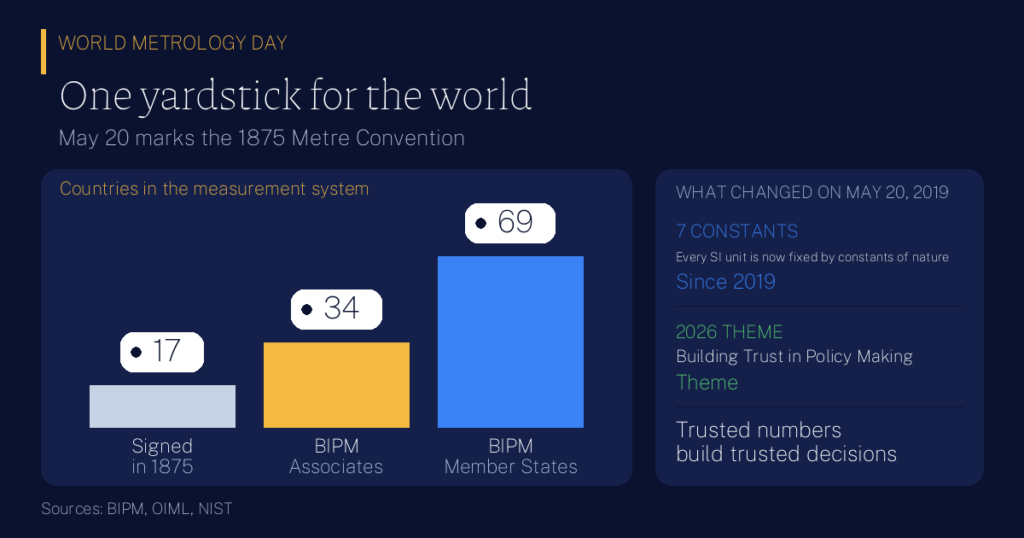
May 20 is the anniversary of the signing of the Metre Convention in 1875. According to the official World Metrology Day site, representatives of seventeen nations put their names to it that day. The idea was simple and radical: instead of every country, and often every town, using its own pounds, ells and gallons, nations would agree on common units and keep common standards. The treaty created the International Bureau of Weights and Measures, known by its French initials BIPM, which still looks after the system today.
The day itself is a joint project of the BIPM and the International Organization of Legal Metrology, or OIML. The OIML dates from 1955 and focuses on the rules that make measurement trustworthy in daily life, such as the accuracy required of shop scales and fuel pumps. Together, one body looks after the science of units and the other looks after the laws that apply them.
What metrology actually means
Metrology is the science of measurement and its application. It answers three questions: what does a unit mean, how do we realize it in a laboratory, and how do we make sure a scale in a market or a sensor in a hospital agrees with that laboratory? The chain that links an ordinary instrument back to the definition of a unit is what experts call traceability.
The units themselves sit in the International System of Units, the SI. Since May 20, 2019, according to the BIPM, all SI units have been defined by fixing the numerical values of seven defining constants of nature. The change took effect on the anniversary of the Metre Convention on purpose. As the U.S. National Institute of Standards and Technology explains, the revised SI defines the kilogram using a fixed value for the Planck constant, ending the long reliance on a physical object. A vote of 60 countries in Versailles, France, on November 16, 2018, set the change in motion.
Example 1: the baker’s scale. Suppose a bakery uses 500 kilograms of flour a day and its scale reads 2 percent low. Each day the bakery would receive about 10 kilograms less than it pays for, and over a 300-day year that is roughly 3,000 kilograms. The numbers are round and illustrative, but they show why shops, not only laboratories, depend on regular calibration against traceable standards.
The numbers behind the system
The system has grown from seventeen signatories into a broad network. The BIPM reports that there are currently 69 Member States, meaning states that have ratified or acceded to the Metre Convention, and 34 Associate States and Economies. The OIML reports 129 Members. These bodies count their members differently, so the figures should not be added together, but both show how far the idea has traveled since 1875.
- 17nations signed the Metre Convention on May 20, 1875
- 69BIPM Member States today
- 7defining constants fix every SI unit since 2019
- 129Members of the OIML
Why trust is the real product
Measurement looks technical, but its output is trust. A buyer in one country accepts a shipment weighed in another because both rely on the same units. A doctor acts on a lab result because the instrument was calibrated. A regulator can set a limit on a pollutant only if everyone measures it the same way. When agreement breaks down, the cost can be spectacular. In 1999, NASA’s Jet Propulsion Laboratory reported preliminary findings that the Mars Climate Orbiter was lost after one team used English units such as pounds while the other used metric units for a key spacecraft operation.
Example 2: the cross-border shipment. Imagine an exporter ships 1,000 containers whose contents must weigh within 1 percent of the contract. If the two ports use scales that disagree by 3 percent, every container could be disputed. With traceable calibration at both ends, the disagreement disappears and the paperwork shrinks. The numbers are made up, but the logic is the daily work of legal metrology.
Measurement and good policy
The 2026 theme, announced by the BIPM and the OIML on February 13, 2026, is “Metrology: Building Trust in Policy Making.” The announcement says measurement underpins informed decision-making and supplies the evidence base on which sound policy and public trust depend, linking it to trade, innovation, public health and emerging technologies. In plain terms, a law is only as good as the numbers behind it.
Example 3: the air limit. Suppose a city sets an air pollution limit of 50 units and its sensors read 5 percent high. On a day when the true level is 48, the sensor shows 50.4, and the city declares a violation that did not happen. Residents lose trust, businesses face needless costs, and real problems later get less attention. The figures are round and illustrative, yet they show why policy makers need measurements they can defend.
Who is left behind, and how the day is marked
A measurement system is only as strong as its weakest link. Countries and communities without calibration laboratories, trained staff or legal metrology rules struggle to trade, to protect consumers and to prove that their data are reliable. That is one reason the Metre Convention welcomes Associate States and Economies as well as full Member States, and one reason the network keeps growing. The BIPM’s own pages note recent accessions, including new Member States in August 2026.
You can mark the day in simple ways. Laboratories, standards bodies and schools hold open days and webinars, and each year the organizers publish a poster and materials for the theme. At home, you might check the sticker on a pump, look at the units on a recipe or ask how your local market scale is tested. For a related subject, see International Day of Mathematics, since numbers and measurement go hand in hand.
Key Takeaways
- The date has a reason. May 20 marks the Metre Convention, signed in 1875 by seventeen nations.
- Two bodies share the work. The BIPM looks after the units, and the OIML looks after the legal rules that apply them.
- Units now rest on nature. Since May 20, 2019, seven fixed constants define every SI unit.
- Traceability is the quiet hero. It links the scale in a shop to the definition of the unit.
- Trust is the real output. Trade, medicine and law all depend on numbers that mean the same thing everywhere.
- Mistakes can be costly. The Mars Climate Orbiter was lost after a unit mismatch, according to JPL’s preliminary findings.
- The 2026 theme is policy. Good measurement gives decision makers evidence they can defend.
How solid is this? Membership counts come from the BIPM and OIML websites as read in 2026 and change as states join. The Mars Climate Orbiter account reflects JPL’s preliminary 1999 findings, not a later board report. The three worked examples use round, made-up numbers to show an idea. See the International Days hub and the International Days Calendar.
More in Science
- BIPM and OIML, World Metrology Day
- BIPM, World Metrology Day 2026 theme announcement (February 13, 2026)
- BIPM, Member States and Associates
- BIPM, SI units and the seven defining constants
- NIST, A Turning Point for Humanity: Redefining the World’s Measurement System
- OIML, International Organization of Legal Metrology
- NASA JPL, Mars Climate Orbiter Team Finds Likely Cause of Loss (1999)