Most public conversation about terrorism concerns security, policy and politics. This day asks a quieter question: what happened to the people who were harmed, and what do they need afterward? Every August 21, the United Nations pauses to remember those killed, to honor survivors and bereaved families, and to ask whether societies are doing enough to support them for the long run, not only in the first week of headlines. It is a sibling of World Humanitarian Day, which honors the people who answer crises, because both days put human beings at the center of events too often described in abstractions.
A day that puts victims first
The General Assembly, in its resolution 72/165 of 2017, proclaimed August 21 as the International Day of Remembrance of and Tribute to the Victims of Terrorism. The first commemoration followed in 2018, which is why the 2026 observance is counted as the ninth. The same year, the UN Office of Counter-Terrorism launched its Global Victims of Terrorism Support Programme, a unit dedicated to the rights and needs of victims.
The idea behind the date is simple. Attacks end in minutes, but their consequences last for decades: injuries that need treatment, families that need income and counseling, and communities that need to be heard. A later resolution, 73/305, on international cooperation to assist victims, asks the UN to help member states develop comprehensive assistance plans covering immediate, short-term and long-term relief and rehabilitation. The UN Global Counter-Terrorism Strategy likewise stresses protecting the rights and addressing the needs of victims.
Who counts as a victim
When people hear the word, they usually picture those who died. The day is wider than that. It includes people who were injured, relatives of those who were killed, survivors who carry psychological wounds, and communities that lost a place they trusted. Member states have long debated how to define terrorism in law, and the day does not depend on settling that debate. Its purpose is remembrance, dignity and practical support for people who were harmed.
Example 1: the long tail of one event. Suppose an attack injures 100 people and 20 of them need rehabilitation lasting years. Add one close relative for each of the 20 and the number of households needing sustained help is already around 40, long after the news cycle has moved on. These numbers are round and illustrative, but they show why UN texts speak of long-term needs, not only emergency care.
The numbers behind the day
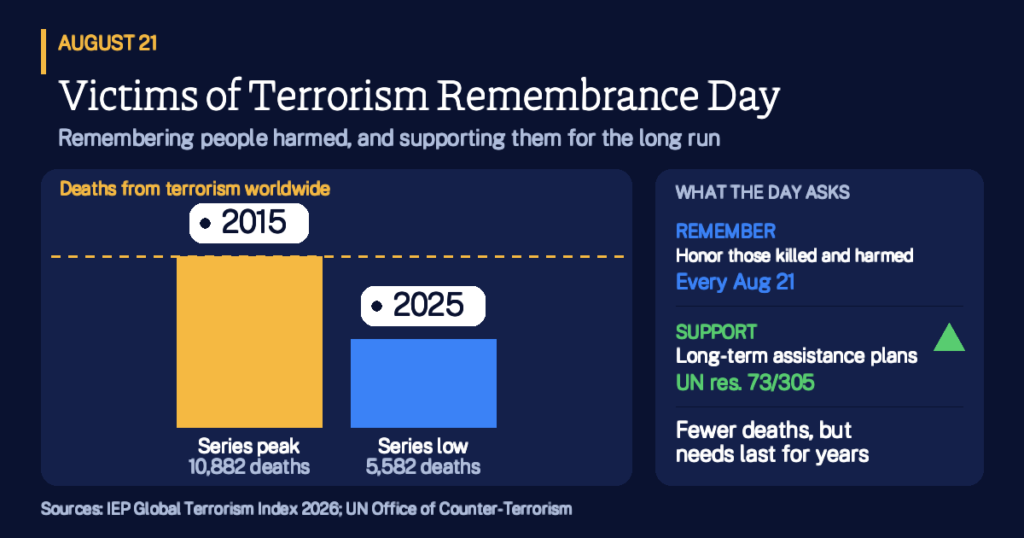
Counting is hard, definitions differ, and no single figure captures everyone harmed. One widely cited dataset is the Global Terrorism Index, produced by the Institute for Economics and Peace, a research organization. It reports that in 2025, 5,582 people were killed in terrorist attacks across 2,944 incidents. Deaths peaked at 10,882 in 2015, so the 2025 total is the lowest in the series and about half the peak. The index also found that the impact of terrorism fell in 81 countries and rose in 19.
- 2,944terrorist incidents recorded worldwide in 2025
- 51%share of 2024 deaths in the Sahel, per the 2025 index
- 1,805deaths linked to Islamic State across 22 countries in 2024
- 58 to 66countries recording an attack, 2023 to 2024
Example 2: reading a falling number. If deaths fall from 10,000 to 5,000, that is a 50 percent drop, and it is welcome. But the 5,000 who died each left families, and many more people were injured, a figure such datasets do not capture. Round and illustrative, the lesson is that a lower total is good news about prevention, not a reason to shrink support for survivors.
Where the burden falls
Terrorism is not evenly spread. The 2026 index ranks Pakistan first for the first time, followed by Burkina Faso, Niger, Nigeria and Mali, with Syria, Somalia, the Democratic Republic of the Congo, Colombia and Israel completing the top ten. The Sahel accounted for more than half of all deaths in 2025, compared with under one percent in 2007. That means many victims live in places with strained health systems and few specialized services, which is exactly where assistance plans are hardest to build.
What support looks like
Support is practical before it is symbolic. UN Office of Counter-Terrorism publications include a 2018 handbook of good practices for victims’ associations in Africa and the Middle East, a 2020 set of guidelines and principles for civil society in Asia-Pacific, and a 2022 set of Model Legislative Provisions to support the needs and protect the rights of victims. A Group of Friends of Victims of Terrorism, established in 2019 and now co-chaired by Spain and Iraq, keeps the issue on diplomatic agendas. A Global Congress at UN Headquarters in 2022 drew over 400 attendees, and an International Conference took place on October 8 and 9, 2024, in Vitoria-Gasteiz, Spain.
Example 3: an assistance plan in numbers. Imagine a country identifies 300 victims. If each needs, on average, three services over time, such as medical care, counseling and legal or financial help, the system must deliver about 900 services. Planning for that load before an attack, rather than after, is what comprehensive assistance plans aim to do. The numbers are round and illustrative.
How the day is marked
The 2025 observance, the eighth, carried the theme “United by Hope: Collective Action for Victims of Terrorism”. The 2026 commemoration, selected in consultation with the Victims of Terrorism Associations Network, is titled “Healing through Memory”. It was organized as a high-level virtual event with a keynote by Secretary-General António Guterres, voices of victims, a Global Minute of Silence and a panel launching “Building a Safer Internet for Victims of Terrorism”.
- 2025United by Hope: Collective Action for Victims of Terrorism
- 2026Healing through Memory
Anyone can take part quietly: by learning the names and stories shared by victims’ associations, by supporting local survivor services, or by observing a moment of silence. If you or someone you know has been affected by violence, local victim support services, a health professional or a trusted counselor can help, and in an emergency you should contact your local emergency number.
Key Takeaways
- The day centers people. Resolution 72/165 (2017) asks the world to remember and honor those harmed, not to debate politics.
- Victims are a wide group. They include the injured, the bereaved and survivors, not only those who died.
- The data show a decline with limits. Deaths fell from 10,882 in 2015 to 5,582 in 2025, yet each number is a life.
- The burden is uneven. The Sahel accounted for more than half of 2025 deaths, in places with fewer services.
- Support must be long-term. Resolution 73/305 calls for plans that cover immediate, short-term and long-term needs.
- Voices of victims lead. The 2026 theme, Healing through Memory, was chosen with a victims’ network.
How solid is this? Death counts come from the Institute for Economics and Peace, a research group whose definitions and sources differ from UN bodies, and they exclude injuries and bereaved families. The UN program dates come from the UN Office of Counter-Terrorism pages. The three worked examples use round, made-up numbers. See also the International Days hub and the International Days Calendar.
More in Society
- UN Office of Counter-Terrorism, International Day of Remembrance of and Tribute to Victims of Terrorism, 21 August 2026
- UN Office of Counter-Terrorism, Victims of Terrorism
- UN Office of Counter-Terrorism, International Day of Remembrance and Tribute to Victims of Terrorism, 21 August 2025
- Institute for Economics and Peace, Global Terrorism Index 2026 Briefing
- Institute for Economics and Peace, Global Terrorism Index 2025 media release