When a flood, a war or an earthquake upends a community, someone usually arrives to open a clinic, truck in clean water or register families who have lost everything. World Humanitarian Day, observed every year on August 19, exists to honor those people and to remind the rest of us why their work matters. It also carries a sober message. The same people who answer the world’s worst days are increasingly targets themselves, and the money needed to keep them working is falling short.
A bombing, a resolution and a first observance
The day began with a loss. On August 19, 2003, a bomb attack on the Canal Hotel in Baghdad, Iraq, then the United Nations headquarters in the country, killed 22 humanitarian workers. Among them was Sergio Vieira de Mello, the Special Representative of the Secretary-General for Iraq. Five years later, in 2008, the General Assembly adopted resolution 63/139 and designated August 19 as World Humanitarian Day. The first observance took place in 2009, when the UN marked the day at its headquarters to raise public awareness and honor staff who gave their lives in the line of duty.
What “humanitarian” means here
Humanitarian action aims to save lives, ease suffering and protect human dignity during and after emergencies, whether caused by conflict, disaster or hunger. It is guided by principles that keep aid credible: humanity, neutrality, impartiality and independence. In practice that means help goes to people because they need it, not because of who they are. Humanitarian workers include doctors and nurses, logisticians, water engineers, food distributors and protection officers. Most are national staff who live in the countries where they serve, often in the same communities they are helping. The UN’s own description of the day calls it a celebration of people helping people.
The numbers behind the day
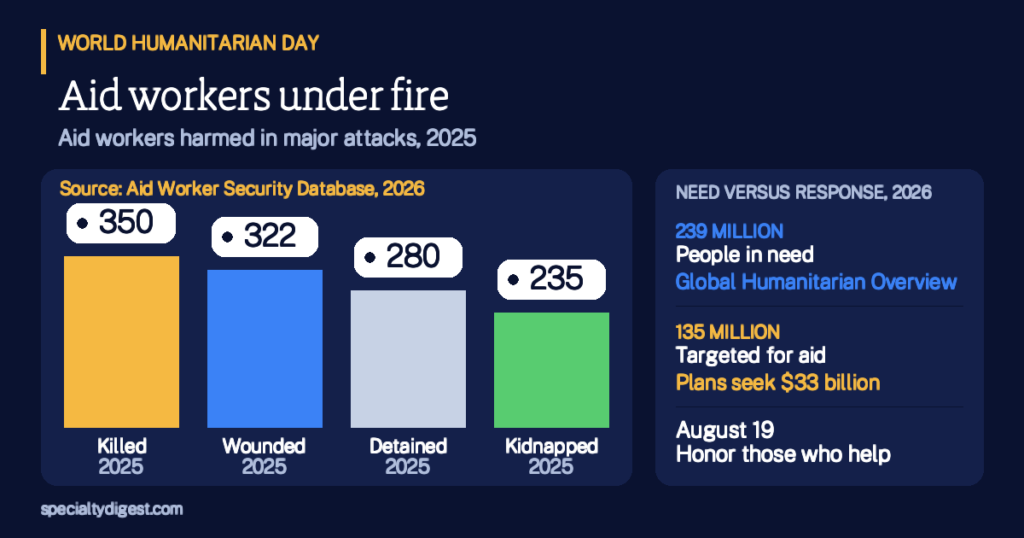
Each year the Aid Worker Security Database, run by Humanitarian Outcomes, counts major attacks on aid workers. In 2024 it confirmed a record 383 aid workers killed, a 31 percent rise over 2023, according to UN News. For 2025 the database recorded 1,187 aid workers as victims of major security incidents: 350 killed, 322 wounded, 235 kidnapped and 280 arrested or detained. The 2025 toll of those killed was the second highest ever recorded, and the number kidnapped nearly doubled from the previous year. The database attributes 186 of the 2025 deaths to Gaza and a record 71 to Sudan.
These are counts of reported, confirmed incidents, so the real picture may be larger. They also tell us something about who is at risk. Most of those killed in 2024 were national staff, the local colleagues who stay when international teams rotate out. Behind each figure is a nurse, driver or engineer, and behind each of them are the communities who lose a lifeline.
Who is waiting for help
The Global Humanitarian Overview for 2026, launched by the UN and partners in December 2025, estimates that 239 million people need humanitarian assistance. The plans aim to reach 135 million of them in 50 countries and ask for $33 billion. Within that, humanitarians are seeking $23 billion to deliver lifesaving support to 87 million people who need it most. The overview contains 29 detailed plans, the largest being for the occupied Palestinian territory, Sudan and Syria.
Example 1: why targeting matters. Picture a region where 1,000 people need help but the plan can fund aid for only 560. Planners must decide who goes first: the youngest children, the sick, people cut off by fighting. The numbers are round and illustrative, but this is the kind of choice the gap between need and funds forces.
Why the money matters as much as the courage
Funding is the other half of the story. The 2025 appeal received only about $12 billion, the lowest in a decade, and humanitarians reached 25 million fewer people than the year before, according to UN News. The UN reports that by May 31, 2026, plans required $33.66 billion and had received $8.21 billion, or 24.4 percent.
- $33.66 billionneeded by 2026 plans, as of May 31, 2026
- $8.21 billionreceived by that date, 24.4 percent
- $12 billionreceived by the 2025 appeal, lowest in a decade
- 252 millionpeople in urgent need by the end of May 2026
Example 2: a gap in the budget. Suppose a clinic network needs $4 million to run for a year but receives $1 million, or one quarter. Managers may close mobile units, cut medicine stocks or reduce hours. The sums are made up, yet they show how a funding shortfall becomes fewer treated patients and, sometimes, a worker sent home.
The problems also overlap. Displaced families in crowded camps face disease outbreaks when safe water and toilets are scarce, which is why humanitarian response often works hand in hand with the goals of World Water Day.
Protection, accountability and the people who stay
International humanitarian law requires parties to conflicts to respect and protect civilians and aid workers, and to allow relief to reach people in need. The UN uses the day to call for that protection to be honored in practice and for attacks on aid workers to be investigated. The 2026 campaign, #ActForHumanity, carries the message: “The time for concern is over. The time for consequence is now.” Its theme invites everyone to make protecting each other our greatest achievement.
Example 3: the value of a local team. Imagine a response team of 20 people where 17 are from the affected area. When roads close, those 17 know the back routes, speak the language and have the trust of families. If a few are lost or detained, the team’s reach shrinks fast. These numbers are illustrative, but they reflect why UN reporting stresses the toll on national staff.
How the day is marked and what you can do
The day is observed with commemorations in Geneva, New York and in field operations, with public campaigns by OCHA and partners. Ordinary people can take part by learning how appeals work, supporting reputable relief organizations, sharing verified information and asking leaders to protect civilians and aid workers. Small, steady support matters, because crises last longer than headlines.
Key Takeaways
- The day honors loss. It marks the August 19, 2003 Canal Hotel attack in Baghdad that killed 22 humanitarian workers.
- It is a UN day with a clear date. The General Assembly created it in 2008 through resolution 63/139, and the first observance came in 2009.
- Attacks on aid workers are at historic highs. A record 383 were killed in 2024, and 350 in 2025, the second highest on record.
- Local staff carry the greatest risk. Most aid workers killed in 2024 were national staff.
- Need outruns response. The 2026 overview counts 239 million people in need and aims to reach 135 million.
- Funding is falling short. Only 24.4 percent of 2026 requirements had been received by May 31, 2026.
- Everyone can help. Support trusted relief groups, share facts and urge protection of civilians and aid workers.
How solid is this? Aid worker counts come from the Aid Worker Security Database and cover confirmed incidents, so they are minimum figures and may be revised. Other bodies, including OCHA, report slightly different totals for 2025 because of differing methods. Funding and need figures are UN planning numbers that change through the year. The three worked examples use round, made-up numbers to show an idea. See also the International Days hub and the International Days Calendar.
More in Society
- United Nations. World Humanitarian Day, 19 August.
- UN News. Remembering victims of Baghdad bombing, UN marks first World Humanitarian Day (2009).
- UN News. World Humanitarian Day 2025: Aid workers mull record toll of their own.
- Humanitarian Outcomes. Aid Worker Security Report Figures at a glance (2026).
- UN News. Humanitarians launch $33 billion appeal for 2026 (December 2025).
- OCHA. Global Humanitarian Overview 2026 launch press release.