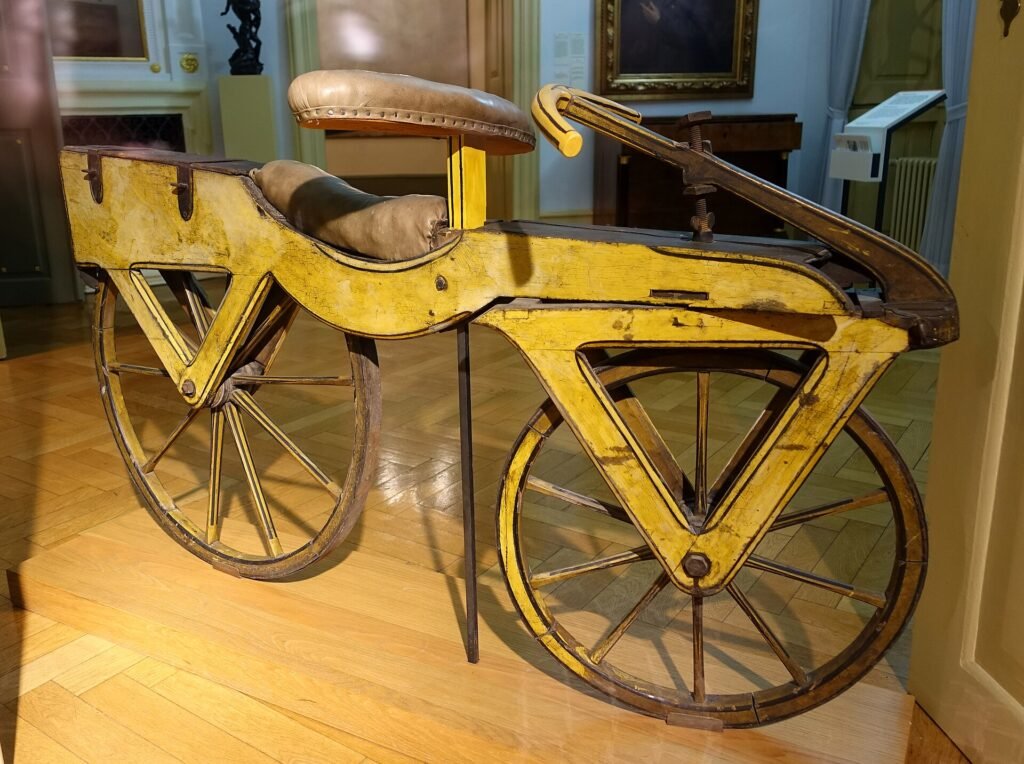
The bicycle is a human-powered vehicle with two wheels in line, a frame, a saddle, handlebars for steering and, in its modern form, pedals that drive the rear wheel through a chain. Its direct ancestor is the wooden running machine that Karl von Drais rode in Mannheim, Germany, on June 12, 1817, and the design people ride today was largely complete by about 1890.
History of the bicycle
On June 12, 1817, Karl von Drais, then 32 years old, rode his new “Laufmaschine,” or running machine, from Mannheim almost to Schwetzingen and back, a trip of about 8.5 miles. The rider sat on a padded saddle, steered with a handlebar and pushed along the ground with both feet. TÜV NORD, a German testing and certification organization, gives speeds of 13 to 15 kilometers per hour, faster than a pedestrian or a mail coach.
The running machine did not last long. Roads were poorly maintained, the machine was expensive, and Drais had no effective patent protection, so copies were built without any benefit to him. Mannheim banned its use, first on sidewalks and later throughout the city, and the Technoseum museum in Mannheim notes that nearly 70 years passed before Drais was recognized as a brilliant inventor.
About 40 years after the first rides, inventors began to fit cranks and pedals to the front axle. The Paris World Exhibition of 1867 showed two pedal-driven velocipedes from the Michaux firm. They had cast-iron frames and weighed more than 30 kilograms, and the public soon called them “boneshakers.”
Riders and makers then looked for comfort and speed. Eugène Meyer patented a pedal machine in Paris with solid rubber tires, spokes and an iron hub, which made riding much less punishing than metal-banded wooden wheels. James Starley’s “Ariel” of 1871 put the idea into series production, and its wire spokes allowed a front wheel 127 centimeters across without making it too heavy. This became the penny-farthing, which was fast and fashionable but dangerous, because a rider sat high above the ground and could be thrown forward over the wheel.
Designers next moved the drive to the rear wheel. Thomas Shergold built a chain-driven rear-wheel bicycle in 1878, and the “Rover III” of 1888, made by John Kemp Starley, combined equal-sized wheels, a curved handlebar, a height-adjustable saddle and rear-wheel drive. TÜV NORD calls it the prototype of the modern bicycle. In the same year, the Irish veterinarian John Boyd Dunlop invented a pneumatic tire with a valve, and in 1890 Thomas Humber introduced the diamond frame.
Inventor and origins of the bicycle
No single person invented the bicycle, and the credit is divided among several makers. Drais is credited with the steerable two-wheeled running machine of 1817. Who first added pedals has never been settled, although TÜV NORD says considerable evidence points to the coach builder Pierre Michaux and his son Ernest.
The pneumatic tire shows how priority can be tangled. Dunlop’s tire of 1888 worked well, but the Englishman Robert William Thomson had been awarded a patent for an air-filled tire in 1845. His invention was never taken further and was forgotten, so Dunlop in effect reinvented it.
How the bicycle works
On a modern bicycle the rider’s legs turn pedals fixed to cranks, and the cranks turn a chainring. A chain carries the motion to a sprocket on the rear wheel. Chain drive made the oversized front wheel unnecessary, because the ratio between the chainring and the sprocket decides how far the bicycle travels with each turn of the pedals. The “Kangaroo” of 1884 used this principle to match the distance covered by a penny-farthing with a 142-centimeter wheel while having a front wheel of only 92 centimeters.
The diamond frame is made of two triangles, one formed by the front tubes and one by the rear tubes. It combines strength with a sparing use of material, which made bicycles lighter and cheaper. Drais’s original design, according to the Technoseum, also had a self-stabilizing caster mechanism in the steering and a brake, features that the English copies patented by Johnson did not include.
Gears and brakes were refined after the frame was settled. Fichtel and Sachs introduced the first freewheel hub with a coaster brake in 1903, which let a rider stop by pedaling backward, and the first hub gear system followed two years later. Paul de Vivie built a derailleur in 1906 that moved the chain between rings of different sizes, although the first version practical for daily use, the Campagnolo Corsa, appeared only in 1946. These devices apply the same idea as the toothed wheels described in the entry on gears.
Types and variants of the bicycle
Several designs mark stages in the history above. The running machine, or draisine, had no pedals. The velocipede, or boneshaker, had cranks on the front wheel. The high-wheel, or penny-farthing, had a very large front wheel and a small trailing wheel. The rear-wheel-driven safety bicycle is the ancestor of nearly all bicycles in use now.
Tricycles offered a more stable option. The Technoseum notes that they were welcome to women who enjoyed cycling but whose clothing did not allow them to ride a high-wheel machine. Electric bicycles add a motor to the pedal drive, and TÜV NORD reports that more and more of the roughly 84 million bicycles in Germany, as of 2024, have electric drive. They belong to the wider group described in the entry on electric vehicles.
Impact of the bicycle
The first safety bicycles were handcrafted and expensive, so they were used mainly for sport by young middle-class men and a few bold women. After 1900 prices fell, and the bicycle became a means of transport for the masses, with cycling clubs, organized excursions and popular races, the Technoseum reports. A product once made by hand began to be manufactured on an industrial scale.
Bicycle makers also shaped other technologies. The Technoseum calls the air-filled tire one of the most important inventions for road traffic, since it was used first on bicycles and later on motorcycles and cars. James Starley worked at a sewing machine factory in Coventry before he built the Ariel, and the sewing machine maker Singer produced a high-wheel design called the Xtraordinary in 1878, a link explored further in the entry on the sewing machine.
Uses today
Bicycles remain a form of personal transport, exercise and sport. TÜV NORD estimated that about 84 million were in use in Germany in 2024, a number that works out to roughly one for every resident. Shared fleets that cities lend to the public are covered in the entry on bike-share systems.
More in Transport
Key facts
- Karl von Drais rode his running machine in Mannheim on June 12, 1817.1
- Who first added pedals has never been settled, but evidence points to Pierre Michaux and his son Ernest.2
- John Kemp Starley's Rover III of 1888 is regarded as the prototype of the modern bicycle.2
- Robert William Thomson patented an air-filled tire in 1845, before John Boyd Dunlop reinvented it in 1888.2
- Thomas Humber introduced the diamond frame in 1890.2
Related concepts
In the news
- NaturePennsylvania’s Grand Canyon: NASA Landsat Shows Autumn Color in Pine Creek Gorge
- TechnologyNASA’s CASALS Lidar Fills Gaps in 3D Maps of Earth’s Surface
- HealthTuberculosis in 2024: WHO Estimates 10.7 Million Cases and 1.23 Million Deaths
- NatureSeptember 2026 Was the Second-Warmest September on Record, Copernicus Reports
- NatureArctic Sea Ice Minimum 2026: NASA and NSIDC Report the 10th-Lowest on Record
Quick checkWho invented the bicycle?Show answer
No one person did. Karl von Drais built the steerable running machine in 1817, and the Michaux family, James Starley, Thomas Shergold and John Kemp Starley added pedals, wire wheels and rear chain drive.
Sources
- Technoseum, State Museum of Technology and Work in Mannheim, 2 WHEELS: 200 Years, Freiherr von Drais and the History of the Bicycle, https://artsandculture.google.com/story/xgVhIoWklpvSLQ
- TÜV NORD, A brief history of the bicycle, Part 1: From the Draisine to the Safety Bicycle (September 5, 2024), https://www.tuev-nord.de/en/knowledge/explore/a-brief-history-of-the-bicycle/
Editorially reviewed by Specialty Digest Editorial TeamLast reviewed November 4, 2026Researched and drafted with AI assistanceReport an issue