Charity is one of the oldest human habits and one of the hardest to measure. A coin in a cup, a meal for a neighbor, an hour at a shelter, a gift to a global relief agency: all of it counts, and most of it goes unrecorded. The International Day of Charity, observed every year on September 5, asks the world to notice. The United Nations created it to recognize what giving does in times of crisis and to encourage more of it through education and awareness. Many of the needs it highlights, such as safe sanitation on World Toilet Day, depend on both public money and private generosity.
A day named for a life of service
The date marks the anniversary of the death of Mother Teresa of Calcutta, who died on September 5, 1997, at age 87. She was born in 1910 in Uskup, then part of the Ottoman Empire and now Skopje in North Macedonia. She went to India in 1928, became an Indian citizen in 1948 and founded the Missionaries of Charity in 1950. She served for more than 45 years, and in 1979 she received the Nobel Peace Prize for her work for bringing help to suffering humanity. Pope Francis declared her a saint in 2016.
The General Assembly established the day in resolution A/RES/67/105, adopted at its 67th session. As the UN describes it, the resolution recognizes the role of charity in alleviating humanitarian crises and human suffering within and among nations, and the efforts of charitable organizations and individuals, including the work of Mother Teresa. The first observance came on September 5, 2013. Secretary-General Ban Ki-moon said then that charity plays an important role in upholding the values and advancing the work of the United Nations, and he asked people to see it as a noble enterprise aimed at bettering the human condition. In 2016 he called charity one of the best investments we can make in our common future and linked it to the 17 goals of the 2030 Agenda for Sustainable Development.
What charity means here
The word covers more than money. The UN describes the day as a way to sensitize and mobilize people, nongovernmental groups and other stakeholders to help others through volunteer and philanthropic activities. In practice that means three kinds of gift: money, time and simple help to a stranger. Gallup’s annual World Poll measures all three, which makes it a useful window on how people actually behave. Charity also differs from official aid. A government sends aid by policy and budget, while a charity depends on people choosing to give.
Example 1: a town of 1,000 adults. Using Gallup’s 2024 world averages as a rough guide, about 560 would have helped a stranger in the past month, about 330 would have donated money and about 260 would have volunteered time. The numbers are round and illustrative, and real towns vary widely, but they show that most generosity is small, local and rarely recorded.
The numbers behind the day
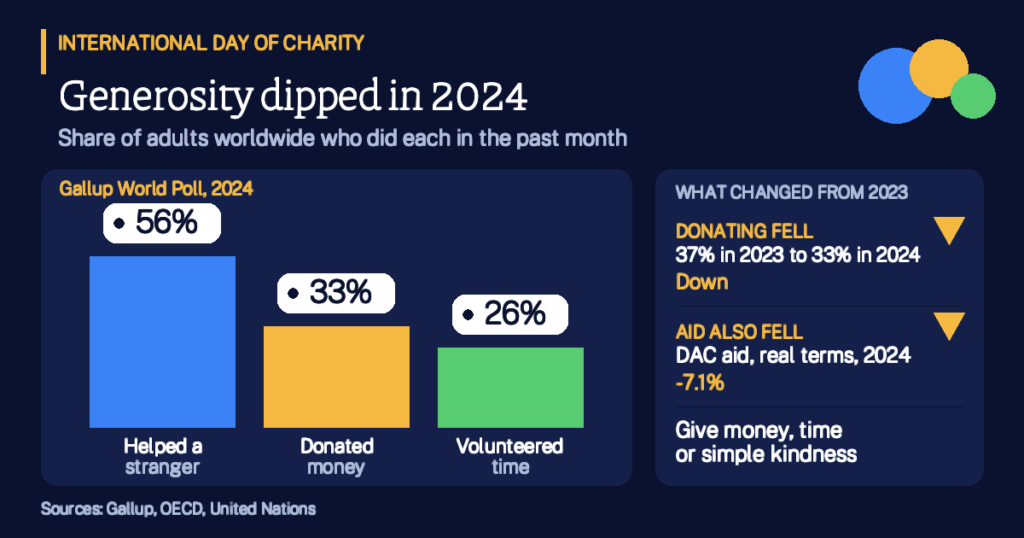
Gallup interviewed adults in 144 countries and territories throughout 2024. It found that 56 percent had helped a stranger in the past month, 33 percent had donated money to charity and 26 percent had volunteered time to an organization. Each figure was lower than in 2023, when the shares were 62, 37 and 30 percent, and Gallup reported that charitable activity declined significantly from its 2021 to 2023 peak. The dip is a reminder that generosity is not fixed. It responds to hardship, trust and opportunity.
Giving is also concentrated in who gives. In the United States, people gave an estimated $592.50 billion to charities in 2024, up 6.3 percent in current dollars and 3.3 percent after inflation, according to Giving USA. Individuals accounted for $392.45 billion, about two thirds of the total. Foundations gave $109.81 billion, bequests $45.84 billion and corporations $44.40 billion.
- 56%of adults worldwide helped a stranger in the past month, 2024
- 33%donated money to charity in 2024
- $212.1 billionofficial development assistance from DAC members, 2024
- 0.33%of DAC members’ combined national income, 2024
Why it matters now
Private giving does not replace public aid, and the two are linked. Official development assistance from members of the OECD’s Development Assistance Committee came to $212.1 billion in 2024, representing 0.33 percent of their combined national income. That was a fall of 7.1 percent in real terms from 2023, the end of a run of continuous growth, according to the OECD’s April 2025 announcement.
When public funds shrink, charities and volunteers can be asked to fill gaps in food, health care, shelter and emergency relief. That is exactly the humanitarian role the General Assembly had in view when it created the day. It is also why the way people give matters, not only how much they give.
Giving well
Good intentions do not guarantee good results. A few habits help gifts count: check that an organization is registered and publishes its accounts, ask what share of money reaches programs, prefer steady gifts over a one-time rush after a headline, and consider giving skills or time as well as cash. These are general rules of thumb, not UN findings.
Example 2: two charities. Suppose a donor gives $1,000 and compares two groups. Charity A spends 85 cents of every dollar on programs and Charity B spends 60 cents. The gift would put about $850 to work at A and $600 at B. The percentages are made up for illustration, and a low overhead rate alone does not prove impact, but asking the question is a sound start.
Example 3: the gift of time. Twenty neighbors each give three hours a week for four weeks to run a food pantry. That is 240 hours of work. If a community valued an hour at an illustrative $15, the time donated would be worth about $3,600, a gift few of the volunteers would ever have written a check for.
How the day is marked
The UN encourages governments, groups and individuals to mark the day through education and awareness-raising activities. Typical observances include volunteer days, community fundraisers, school lessons on service and public recognition of charitable organizations. The UN pages for the day do not set an annual theme, though in 2016 the UN tied it to the 2030 Agenda for Sustainable Development. Taking part can be simple: set up a small regular gift, offer an hour of your skills, or help someone near you.
Key Takeaways
- The date honors a life. September 5 is the anniversary of Mother Teresa’s death in 1997, and the first observance was in 2013.
- The mandate is humanitarian. Resolution A/RES/67/105 recognizes charity’s role in easing crises and human suffering.
- Charity is more than cash. Gallup tracks helping strangers, donating money and volunteering time.
- Generosity dipped in 2024. Donating fell from 37 to 33 percent and volunteering from 30 to 26 percent worldwide.
- Individuals carry giving. In the United States they gave $392.45 billion of $592.50 billion in 2024.
- Public aid fell too. DAC aid dropped 7.1 percent in real terms in 2024 to $212.1 billion.
- Give with care. Check an organization’s record, give steadily and remember that time is a gift too.
How solid is this? Gallup figures come from a 2024 survey of about 1,000 adults per country and are estimates with sampling error. Giving USA figures cover the United States only. The aid figures describe DAC members, not all donors. The three worked examples use round, made-up numbers to show an idea. See also World Toilet Day, the International Days hub and the International Days Calendar.
More in Society
- United Nations, International Day of Charity
- UN News, UN marks first annual International Day of Charity (2013)
- UN News, Charity is one of best investments for common future (2016)
- Gallup, Global generosity: world felt less charitable in 2024
- OECD, International aid falls in 2024 for first time in six years
- Giving USA 2025, U.S. charitable giving grew to $592.50 billion in 2024
- NobelPrize.org, Mother Teresa facts